Cultural Events
CastleTriefenstein-Homburg am Main
Homburg Castle
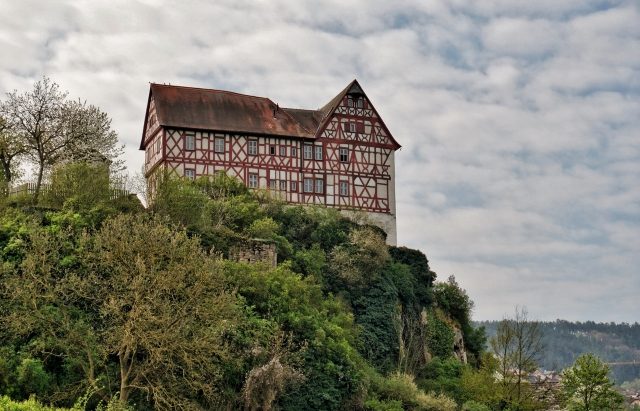
Homburg Castle presented itself for centuries as a mighty territorial cornerstone and intellectual pawn of its owners. The darkness of history is first illuminated in the first half of the 8th century, when the Frankish kings, as part of the early medieval land development, had a secondary castle built as a traffic and economic base on the long-distance roads of the time. The then "Hohenburg" - which later gave its name to the town of Homburg - developed in the following centuries into a coveted "valuable asset" in the sphere of influence of the Würzburg bishops and Wertheim counts.
At the end of the 10th century, Homburg first came into the possession of the Prince-Bishopric of Würzburg, which then granted it as a fief to the Counts of Wertheim. Their vassals - at least according to historians - called themselves the "Lords of Hohenburg". As bailiffs and vogts, they also exercised jurisdiction. The indebted Prince-Bishopric of Würzburg under Bishop Gerhard von Schwarzenberg finally sold Homburg to Count Johann I of Wertheim.
At the end of the 15th century, Bishop Rudolf von Scherenberg exercised the documented right of repurchase and acquired the Wertheim property for 15,500 guilders.
This repurchase marked the beginning of the actual tenure of the Prince-Episcopal Authority for the castle. The Homburg office received its first chief bailiff, an office cellarer, and a centgraf.
One of these "officials" was the knight Philipp von Gebsattel. He finally laid the foundation for the current architectural form of the castle. In 1568, a building with a castle-like character was erected in place of a fortress.
After the Gebsattels and their descendants gave up their property in Homburg after disputes with the Prince-Bishopric of Würzburg and retreated to the Rhön, the Julius Echter era began at the beginning of the 17th century, and with it the further expansion of the Homburg office.
The reorganization of the political landscape at the beginning of the 19th century meant that Homburg and its castle passed into the possession of the Kingdom of Bavaria and henceforth belonged to the Grand Duchy of Würzburg. The castle lost its administrative significance when the district court was first moved to Lengfurt and Roßbrunn and later to Marktheidenfeld. With the relocation of the tax office, the loss of official functions continued. The former pride of the wine-growing village stood empty. Later, the building was even described as "irreparable" for state purposes, although the structure itself had not been directly affected by an earlier rockfall.
With the acquisition of Homburg Castle by the political municipality in 1869, the newer communal history began. After 32 years of uncertainty, the historic walls were filled with new life when the rectory, school, and municipal administration took up residence in Homburg Castle. In 1972, a renewed loss of function began when first the teacher and a year later the pastor moved out, and in 1978 the municipal administration was relocated to Lengfurt as part of the municipal territorial reform. The wish of the Homburg residents that the town hall of the new unified municipality of Triefenstein would move into their castle, which certainly had an extremely representative character, was not fulfilled. The market town of Triefenstein, as the new lord of the castle, subsequently searched for a long time for a sensible use for its half-timbered building. Its preservation and rescue from further decay was finally a central concern of the newly founded "Association for the Rescue of Homburg Castle" under its extremely active chairman Heinz Otremba, a Würzburg publishing director who had found a new home in Homburg after his expulsion.
At the end of the nineties, the castle changed its face with a complete exterior renovation by the municipality. The Association for the Rescue of Homburg Castle also ensured, with the restoration of the stucco hall and the castle chapel, that the building became a much-admired architectural-historical jewel box in the Main Valley.
In parallel, the political municipality - the exterior renovation had cost around half a million Deutschmarks - spent another 5,000,000 Deutschmarks on the interior renovation. "Art at Homburg Castle" is the name of the successful project today, which musician Michael Günther and painter Gertrude E. Lantenhammer launched with chamber concerts and exhibitions. In another wing of the building, the artist Linda Schwarz has her printmaking workshop. The former knight's castle has become an artistic gem.
Take Mobile History with you
You are reading this text for free. Premium adds what matters on the road: descriptions read aloud, sites found through your camera, whole regions taken offline.
- Every description, including the ~17,700 Premium sites
- Audio guide: have descriptions read to you on location
- AR finder: see sites through your camera, with distance and bearing
- Unlimited saved sites
14 days free, then from €2.99 a month. Cancel anytime.
Source: Wikipedia · Licence: CC BY-SA 4.0 · Image: Reinhold Schulz
This description draws on the facts documented in the linked Wikipedia article; Wikipedia content is licensed under CC BY-SA 4.0. Wording and editing: Mobile History.
Location: 49.7938, 9.6208