Hotel
CastleAhorn
Hohenstein Castle
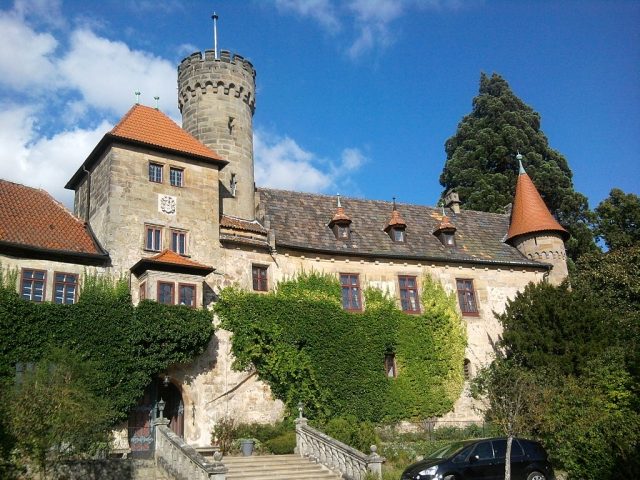
Hohenstein Castle, first mentioned as a castle in 1306, is located on a wooded sandstone ridge in the Hohenstein district of the municipality of Ahorn, six kilometers southwest of Coburg in Bavarian Upper Franconia (Germany).
Hohenstein Castle
The present Hohenstein Castle was first documented in 1306 as Castrum Hohenstein in dem Grabfelde, meaning it was mentioned as a castle. Countess Jutta von Henneberg was registered as the owner. In the following 150 years, the hilltop castle changed hands several times until Duke Wilhelm of Saxony, who enfeoffed the castle guard of Hohen Steyn to the brothers Hans and Thomas von Lichtenstein. In 1466, the Bamberg vassals Kunz von Aufseß and Kunz von Streitberg, whose ancestral castles were located in Franconian Switzerland, devastated the castle. Both knights and their also involved brother Kunz Ochs were soon after sentenced by the Coburg city court to compensate for the damage caused and to pay 4000 guilders for breach of the public peace to the Coburg lordship. In 1525, rebellious peasants from the hordes of Thomas Müntzer invaded, burning the medieval castle to its foundations. A part of the square tower of the southern outer bailey remained as a ruin next to the castle chapel.
Hohenstein Palace
The uninhabitable castle remains, still held in fief by the Lichtensteins, were only rebuilt in 1573 by Michael von Lichtenstein as a palace in the Renaissance style, as an inscription on the so-called Lichtenstein building testifies. The tall gatehouse also originated during this period. The round tower, against which the gatehouse nestles, is six years older and offers views from its crenellated crown of the surrounding castles of Banz and Callenberg, the Basilica of Vierzehnheiligen, Veste Heldburg, and the Altenburg near Bamberg.
Shortly before the end of the Thirty Years' War, the palace was plundered in 1648 by "Swedish peoples" and five years later sold to Christof von Thüna, bailiff of Schauenstein (Brandenburg). Thüna bequeathed the estate to his five daughters in equal parts. The youngest heiress married Johann Helmhard Auer von Herrenkirchen, who bought out his sisters-in-law and thus managed to keep the palace in the family for three generations. In 1741, the chamberlain Adam von Schauroth from Ansbach acquired the estate for 65,000 Franconian guilders and 200 ducats of "Gönnegeld" for ongoing use and sold it 18 years later to the Brunswick Lieutenant General Philipp Ernst Freiherr von Imhof (spelled Imhoff on some memorial stones). The new owner had the palace rebuilt according to his own ideas and the palace garden initially laid out in the Rococo style, which his descendants expanded into a romantic park. After the First World War, the von Imhoff family lost their property due to the Imperial Constitution of 1921; it became allodial, i.e., imperial property. During the Third Reich, from 1941, the palace was initially used by the Reichspost as a postal recreation home and after the Second World War leased by the Deutsche Bundespost to Caritas, which established a retirement home. In 1976, the Post sold the estate to the Munich entrepreneur Oskar Hacker, who had the palace restored between 1987 and 1993 to open it as a guesthouse with a wine bar and restaurant. In 1996, Hacker leased his palace to the hotel operating company Kötterl & Wandt, which continues to run it as a castle hotel with upscale gastronomy.
Palace Chapel+
Within the original medieval castle complex, probably Christof Freiherr von Thüna, whose marital coat of arms is affixed above the portal, had the palace chapel built in the second half of the 17th century. The rectangular building, whose roof is adorned with a roof turret with a double bell frame, closes off to the south with the three-sided altar area. Above the continuous interior of the chapel with its simple wooden ceiling, a simple gallery rises in the north and a double gallery in the east. The pulpit with its magnificent, carved wooden sounding board is dated to the year 1688. A tomb of Johann Helmhard Auer von Herrenkirchen († 1718) is located behind the altar. The epitaph of Philipp Ernst von Imhof († 1768) on the west wall of the church space is richly designed.
From 1749 to 1751, the Franconian church musician Johann Heinrich Zang worked as an organist at Hohenstein Castle. The organ he played, dating from 1709, is only preserved in fragments on the organ loft above the simple altar.
Park Grounds+
The park, which the von Imhof family had laid out around Hohenstein Castle over a period of more than 150 years, fundamentally reflects the principles of the late Romantic English Garden, but interspersed with elements from the family history of the von Imhofs and their veneration of imperial history. This strongly distinguishes the Hohenstein palace park from other well-known landscape gardens in the Coburg, Bayreuth, and Bamberg areas.
To realize the views and sightlines required by romantic garden art, smaller farmsteads were demolished and the dense forest was replaced by native and overseas woody plants. Cellars were transformed into grottoes, stone viewpoints created, resting benches and winding paths laid out, castle walls with a crenellated observation tower erected, and a monopteros placed next to a small artificial waterfall. Open spaces with romantic perennial beds, pergolas and outdoor staircases, and even the obligatory theater stage and a half-timbered gatehouse were created.
Of the many exotic tree species that were planted, stately specimens still remain in the park of Hohenstein Castle, despite the overall complex increasingly falling into disrepair in the 20th century. Since 2001, a registered association of friends has again provided the necessary support for the restoration of the palace garden to its original form, taking into account monument protection. Although the views and sightlines, which once extended far into the Coburg and Bamberg regions, have become overgrown, the publicly accessible park nevertheless represents a gem among Franconian landscape gardens.
Take Mobile History with you
You are reading this text for free. Premium adds what matters on the road: descriptions read aloud, sites found through your camera, whole regions taken offline.
- Every description, including the ~17,700 Premium sites
- Audio guide: have descriptions read to you on location
- AR finder: see sites through your camera, with distance and bearing
- Unlimited saved sites
14 days free, then from €2.99 a month. Cancel anytime.
Source: Wikipedia · Licence: CC BY-SA 4.0
This description draws on the facts documented in the linked Wikipedia article; Wikipedia content is licensed under CC BY-SA 4.0. Wording and editing: Mobile History.
Location: 50.2175, 10.9339