Uninhabited
CastleHohenprießnitz
Hohenprießnitz Castle
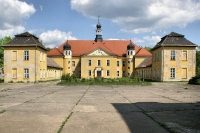
Halfway between Eilenburg and Bad Düben, an imposing castle has shaped the townscape of Hohenprießnitz for over 300 years.
The history of the castle begins in 1699, when Baron Anton Albrecht von Imhoff, who came from the Duchy of Brunswick-Wolfenbüttel, probably had it built by Hermann Kolb. In 1702, after moving to Hohenprießnitz in Saxony, Imhoff entered the service of Augustus the Strong and became Chamber President. During the Nordic War, the Baron was commissioned to negotiate a peace treaty. Because the result in no way corresponded to the Elector's ideas, Imhoff had to languish for seven years in Königstein Fortress. His son Anton Ulrich continued the Hohenprießnitz affairs after his father's death.
Hohenprießnitz finally passed into the possession of Peter Hohmann on April 14, 1724, whom Emperor Charles VI ennobled in 1717 with the title "Edler und Pannerherr von Hohenthal". Hohenprießnitz was his first country estate, which he only ever visited in summer. It was not until Georg Wilhelm von Hohenthal that the castle was likely expanded as a main residence.
At the end of World War II, the Counts of Hohenthal also had to leave their property. While displaced persons still inhabited the buildings during the transitional period, the conversion into an educational institution soon followed.
The appearance of the castle remained largely preserved. The H-shaped floor plan of the main building is extended by the two-story entrance area. In the transition areas to the two single-story side wings are round stair towers (1894) with Welsch hoods. The side wings finally lead into two-story pavilion-like end buildings, which were once also crowned with small towers. Colored pilaster strips and coffers structure the castle's facade. The two coats of arms in the gable triangle above the main entrance show those of Hohenthal and Carlowitz. An almost 30-hectare park completes the castle ensemble.
Inside the castle, remnants of the historical furnishings can still be found. Although numerous art objects were lost, magnificent wooden elements have been preserved in some rooms. Fireplaces from various eras and stucco ceilings enrich the interior. In the exceptionally magnificent ceiling fresco of the ballroom, created by Johann Heinrich Ritter, Hohenthal is depicted receiving the "Crown of Immortality" from Zeus.
Behind the castle, shady paths in the castle park lead to the monument of Carl Dietrich Lothar Graf von Hohenthal. The Count - a grandson of Field Marshal Gneisenau - was severely wounded on August 16, 1870, in the Franco-Prussian War and succumbed to his injuries. The monument was erected in his honor on a meadow.
Take Mobile History with you
You are reading this text for free. Premium adds what matters on the road: descriptions read aloud, sites found through your camera, whole regions taken offline.
- Every description, including the ~17,700 Premium sites
- Audio guide: have descriptions read to you on location
- AR finder: see sites through your camera, with distance and bearing
- Unlimited saved sites
14 days free, then from €2.99 a month. Cancel anytime.
Source: Wikipedia · Licence: CC BY-SA 4.0
This description draws on the facts documented in the linked Wikipedia article; Wikipedia content is licensed under CC BY-SA 4.0. Wording and editing: Mobile History.
Location: 51.5313, 12.5984