Museum
CastleHagen-Hohenlimburg
Hohenlimburg Castle
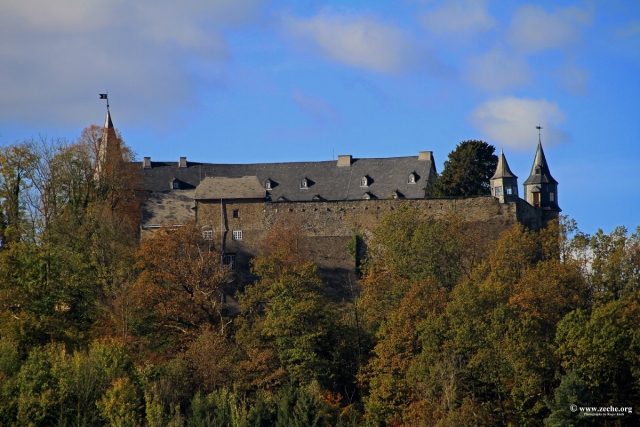
Hohenlimburg Castle is a former hilltop castle on the so-called Schlossberg in the Hohenlimburg district of Hagen, North Rhine-Westphalia.
The complex dates back to the 13th century. Until 1807/08, the castle formed the political center and administrative seat of the then existing County of Limburg. Significant reconstruction measures took place around the middle of the 16th century and in the first half of the 18th century, when the castle was a seat of the Counts of Bentheim-Tecklenburg. After 1816/17 until around 1830, the castle served as the main residence for the princes; it was subsequently moved back to Rheda Castle, which remains the residence of the Prince of Bentheim-Tecklenburg-Rheda to this day; Hohenlimburg Castle is also in his possession and houses the German Cold Rolling Museum.
Hohenlimburg Castle is one of the few hilltop castles in Westphalia that has largely retained its original architectural form. It is located at the entrance to the Lenne Valley, which features further castles and noble residences on its way into the Sauerland. The closest intact hilltop castle on the Lenne, albeit in an architectural style renewed in the historicist style until 1914, is Altena Castle.
Count Dietrich I of Altena-Isenberg had the castle, situated on a mountain spur above the Lenne Valley, built around or shortly after 1240. In the course of the 13th century, it developed into the residence of the main line of this comital house. It was also the nucleus of the County of Limburg, with which the heir of the executed Friedrich von Isenberg had to be compensated in a peace treaty with the Counts of the Mark on May 1, 1243. The castle was first mentioned in a document in 1242.
Some local historians suspect that Dietrich I of Isenberg-Limburg had previously built a palisade-enclosed ringfort, the remains of which are now located about 400 m further south, the Sieben Gräben on the Schleipenberg. However, there are no archaeological or written sources for these conjectures. The type of construction of this castle also suggests an older dating. Furthermore, it was customary in medieval castle construction to fortify the intended and most suitable building site for a castle to prevent an opposing foundation at this location by, for example, enemy troops. Therefore, it is probable that the site of today's Hohenlimburg Castle was also the founding place of the medieval Limburg.
In 1288, Count Eberhard I of the Mark conquered the Limburg. In 1300, the knight Sobbo de Svirte took the castle, but later returned it to the Counts of the Mark. Only in 1304 was the Limburg returned to Count Dietrich III of Limburg. In a feud between the Counts of Limburg-Broich and the Counts of Neuenahr, who had inherited the property through marriage from the last representative of the then extinct older main line of the comital house of Limburg, the Limburg was besieged and taken in 1459 by troops of the Counts of Limburg from the House of Broich and their allies.
Since 1460, the comital houses of Limburg-Broich and Neuenahr shared ownership, which in the case of Limburg-Broich fell to Count Wirich V of Daun-Falkenstein between 1509 and 1542. From 1542 to 1589, the Counts of Neuenahr were sole rulers, and from 1592 to 1807/08, the castle and county belonged to the Counts of Bentheim-Tecklenburg. In 1584, the Hohenlimburg and the territory were conquered by Electoral Cologne troops and remained occupied until 1610.
During the Thirty Years' War, the Hohenlimburg was besieged in 1633 by imperial troops under Generalwachtmeister Lothar Dietrich von Bönninghausen and served as quarters until 1636. The outer bailey and the buildings located there, including the medieval half-tower, were destroyed by fire when the troops withdrew.
In the 17th century, the transformation from a castle complex to a castle primarily focused on representation took place. Nevertheless, Hohenlimburg Castle was still counted among the fortresses in the Prussian sphere of influence during the Seven Years' War. In 1762, there was a cannonade by troops of the Duke of Brunswick-Hanover. At that time, the castle was occupied by French units.
The castle is still owned by the Bentheim-Tecklenburg family today. The castle's battlement was the monument of the month in Westphalia-Lippe in August 2005.
Museums+
Today, the outer bailey and main castle, and in particular the palas, the gatehouses, the curtain walls, and the keep from the 13th and 14th centuries, as well as various residential and working buildings from the 16th to 18th centuries, are preserved.
For decades, the castle has been an important excursion destination in the Southwestphalia region, to which the annual castle games also contribute. Since the beginning of 2005, the castle has operated as a non-profit GmbH, which also presents "courtly living culture" and the history of the Counts and Princes of Bentheim-Tecklenburg in the castle museum.
A famous exhibit is the intentionally mummified "Black Hand". According to legend, Count Dietrich von Isenberg-Limburg had this hand cut off his son because he had struck his mother. In reality, it is a medieval or early modern body part (here: a dead hand) that was, for example, severed from murder victims for evidence. However, severed hands were also a sign of a castle peace, which was concluded, for example, after feuds between parties. Such legal contracts are also documented several times for the Limburg in the late Middle Ages. The finding place of the "Black Hand", the old archive of the tower destroyed by lightning in 1811, supports both theses. Radiocarbon dating showed that the hand dates from the 16th century. The year 1546 plus/minus 60 years was determined, a more precise dating is not possible. Scientists found that it is a right hand, probably that of an adult man. All finger phalanges are missing, as well as part of the carpal bones. A remnant of cord on the thumb, according to the researcher, indicates an older labeling. The scientists did not find any hacking marks, cuts, diseases, or ulcers. This rather indicates that it is the hand of a victim, not a perpetrator.
The privately operated German Cold Rolling Museum, housed in the former economic building and the medieval palas, connects to the history of wire drawing. Even today, about 70% of German cold-rolled products are produced in the Lenne Valley east of Hagen.
Take Mobile History with you
You are reading this text for free. Premium adds what matters on the road: descriptions read aloud, sites found through your camera, whole regions taken offline.
- Every description, including the ~17,700 Premium sites
- Audio guide: have descriptions read to you on location
- AR finder: see sites through your camera, with distance and bearing
- Unlimited saved sites
14 days free, then from €2.99 a month. Cancel anytime.
Source: Wikipedia · Licence: CC BY-SA 4.0 · Image: http://www.zeche.org/
This description draws on the facts documented in the linked Wikipedia article; Wikipedia content is licensed under CC BY-SA 4.0. Wording and editing: Mobile History.
Location: 51.3451, 7.5707