To be privately owned
CastleRadebeul - Zitzschewig
Hohenhaus Castle
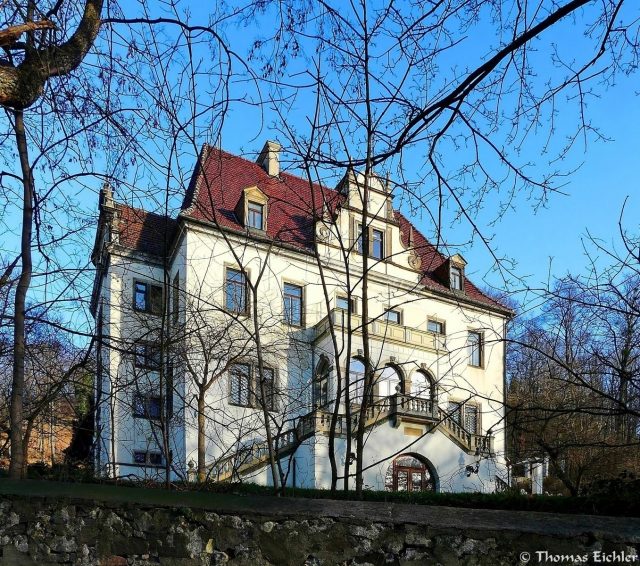
Hohenhaus (the High House), until around 1830 Bischoffsberg, is a former vineyard estate with a manor house, now a listed building, in the Zitzschewig district of the Saxon city of Radebeul. The property, already listed in Gurlitt's Kunstdenkmälern von Dresdens Umgebung in 1904, is located in the Radebeul Historic Vineyard Landscape conservation area, and was also protected during GDR times.
The park estate of Hohenhaus, now largely forested, is located in the western part of Radebeul on the Barkenberge hills, which reach up to 211 m. The property covers an area of 11 hectares and has elevation differences of about 80 meters. It is considered a work of landscape and garden design and is located in the Lößnitz nature reserve.
In addition to the building at Barkengasse 6, also known as Schloss Hohenhaus in the 19th century, directly opposite the Zechstein manor house, there is another residential building along with the estate's heating house at Mittlere Bergstraße 20, and the nursery buildings at number 22.
The playwright Gerhart Hauptmann, who frequently stayed in what he called the "nest of paradise birds" in the 1880s, married one of the daughters of the then owner Thienemann, as did his brothers Carl and Georg. On these occasions, his early works Liebesfrühling and Der Hochzeitszug premiered there. Some later works also refer to his time at Hohenhaus.
Manor House
The castle-like, two-story main house is situated on a south-facing slope, which gives the impression of three stories due to the basement level. The building is topped by a high hip roof with gable dormers.
On the south-facing slope side, there is an extension with a round-arched gate in the basement as an entrance to the large cellar vault. Above it, on the ground floor, the extension is designed as a solid, three-axis glazed veranda, with an exit on top. In front of the veranda is an open staircase leading down into the garden on both sides. High up in the roof is a large transverse gable.
On the west side of the building, facing the street and the entrance gate, stands a gable-crowned risalit with a side portal. To its left is an attached round stair tower with an oriel window and a hood.
On the mountain side, the entrance portal is a round-arched door with a console-supported canopy.
Outbuildings
The outbuildings, also listed, a residential house and the nursery buildings along with the estate's heating house, are located on Mittlere Bergstraße.
Park
The large park of Hohenhaus is considered a work of landscape and garden design, located in the Radebeul Historic Vineyard Landscape conservation area as well as in the Lößnitz nature reserve. The Osage orange (Maclura pomifera), native to North America, growing in a sheltered location on the east side of Hohenhaus, is of dendrological rarity. Its large, round fruits with a yellow-green color and textured surface are striking in autumn.
Directly in front of the south facade of the manor house stands a Japanese pagoda tree (Styphnolobium japonicum). This tree species, originating from East Asia, is very decorative due to its late flowering in August.
A characteristic feature of Hohenhaus Park are the hackberry trees (Celtis occidentalis) with beautiful golden-yellow autumn foliage. They belong to the elm family. Their home is North America. Hackberry trees can grow up to 35 m high and form very wide crowns. The silvery-gray, deeply furrowed bark is also striking. In the southern part of the park stands an ancient specimen, from which the other younger hackberry trees in the park probably originate.
Southeast of the goldfish pond is a ginkgo tree (Ginkgo biloba), which, however, was planted at a later date.
In the area of the tennis court stand large specimens of the American red oak (Quercus rubra), which were probably planted in connection with the construction of the tennis court after the acquisition of the property by the Stechow family (from 1885). The specimen of Jeffrey's pine (Pinus jeffreyi) in the lower part of the property (nursery grounds) was planted in 1887 under the then owner, along with other conifers that are no longer preserved. It is native to the USA, especially California. Its needles, up to about 20 cm long, and very large cones are distinctive.
Among the native species, an old sycamore maple (Acer pseudoplatanus) and some stately European white elms (Ulmus laevis) next to the gardener's house and in the lower part of the park are particularly noteworthy. Interesting old field maple specimens (Acer campestre) stand on a stone rib next to Barkengasse.
The slope was already mentioned as a vineyard in the 14th century, in 1373 in the possession of Bishop Konrad II of Meissen. There was already a wine press on the property. The summer residence of the Meissen bishops was built there on the Bischofsberg in the 15th century. The last episcopal lords at the time of the Reformation were Johann VIII von Maltitz until 1549, then Nicolaus II von Carlowitz until 1555, and Johann IX von Haugwitz until after 1575.
In 1584, the Naundorf farmer Simon Clauß acquired both the so-called Bischofsberg and the Simon Clauß Press, later named after him by Matthias Oeder, which is today's Bischofspresse. Before 1602, Abraham Bock acquired the property and kept it until after 1619.
During the 17th century, under Grand Marshal and Grand Chamberlain Johann Georg von Rechenberg, owner from 1654, an existing vintner's house was converted. In particular, the peculiar fireplace systems on the 1st floor date from the Rechenberg era; one of the fireplaces still shows the Rechenberg coat of arms. The striking Renaissance gable and the high roof behind it probably also date from that time: the reason for the beginning of the name change from Bischofsberg to Hohes Haus. His wife Rachel Freiin von Werthern, daughter of Dietrichen von Werthern zu Frohndorf, owner of Triestewitz Castle, added the vineyard below the Hohenhausweg to the property, which from then on comprised sixteen contiguous hillside sections. After her husband's death in 1664, she acted as guardian for her sons Hans Dietrich and Hans Georgen.
In 1699, Field Marshal Heino Heinrich von Flemming, elevated to Imperial Count the following year, acquired the Hohenhaus property. He was succeeded by his son Adam Friedrich von Flemming, who had the property auctioned in 1748. The property was acquired by the court fodder marshal Grundmann, who then sold the Werther vineyard to two Zitzschewig farmers.
In 1821, the property belonged to the appellate court clerk Lehmann.
The merchant August Thienemann bought Hohenhaus in 1832. He died on the property in 1853, which was then taken over by his nephew Hermann. The development of the property since 1864, when the Berlin wool wholesaler Berthold Thienemann acquired the property from his brother Hermann as a summer residence, was probably decisive for the creation of the park and the effect of the entire complex in its current form. Already in 1865, Thienemann had all the stable and shed buildings rebuilt by the master mason August Große from Kötzschenbroda.
In connection with the expansion of the building as a country estate, a spacious park, now forested, was created, which was equipped with numerous elements of small architecture. Existing tree stands were supplemented by new plantings and opened up with an extensive system of paths. The park was enhanced by the arrangement and design of numerous viewpoints and small experiential areas.
The later playwright Gerhart Hauptmann frequently stayed at Hohenhaus between 1881 and 1885 and called it a "nest of paradise birds."
For the wedding of his brother Georg to Adele, one of the five Thienemann daughters from Hohenhaus, in September 1881, Gerhart Hauptmann wrote the short play Liebesfrühling, which premiered on the eve of the wedding. At this wedding, he met Marie Thienemann, Adele's sister, with whom he secretly became engaged.
His brother Carl Hauptmann married Martha Thienemann, another of the five sisters, in 1884.
On May 5, 1885, Gerhart Hauptmann married Marie Thienemann. He immortalized Radebeul life in the novella Die Hochzeit auf Buchenhorst and in his early work Die Jungfern vom Bischofsberg.
After the sale of Hohenhaus by the Thienemann heirs in 1885, the new owner, Dr. Walther Stechow, had the building converted in the Neo-Renaissance style by the Dresden architectural firm Giese & Weidner. A spiral tower was added to the west of the house and a large balcony to the south. His son, the zoologist Eberhard Stechow, born in Berlin in 1883, grew up in Hohenhaus.
In 1945, the owners were forcibly expropriated and expelled by the communists. Afterwards, the city of Radebeul used the house.
The writer, literary scholar, and Hauptmann collector Hansgerhard Weiss (1902–1982) moved into Hohenhaus in 1947. There, on November 14, 1948, the Hauptmann memorial was opened, within which Weiss operated a Hauptmann workshop. Weiss's large collection of Gerhart Hauptmann and Carl Hauptmann works, biographical documents, letters, and autographs, as well as additional secondary literature about these two, formed the basis for the Radebeul Hauptmann Archive, opened in Hohenhaus on June 6, 1949, which Hansgerhard Weiss initially also directed. The private collection of Alexander Münch (1900–1984) was added. The archive was operated under the patronage of the Radebeul local group of the Kulturbund. In 1950, Weiss moved to West Germany.
With Weiss's departure, Alexander Münch took over the management of the research archive in 1950. Through Münch's further collecting activities, through exhibitions, lectures, and publications, the archive gained international recognition. In 1960, it was first moved to the Kavaliershaus of Hoflößnitz and in 1961 to Villa Steinbach in Bennostraße.
From 1960 to 2004, Hohenhaus then housed the puppet theater collection of the Staatliche Kunstsammlungen Dresden. After renovation work between 1982 and 1985, Hohenhaus was opened as a museum.
Currently, Hohenhaus is being revitalized by an entrepreneur who moved from Hamburg and acquired the property from the Stechow heirs in July 2003. Literary evenings, concert performances, and historical lectures are held there. Together with the current owner, the Radebeul writer Thomas Gerlach, who was honored in 2006 for his "special commitment to Hohenhaus," regularly conducts guided tours through Father Thienemann's now forested park, showing the viewpoints created for the mother who died too young, where young Gerhart and his older brother Carl Hauptmann also worked.
On September 22, 2007, Marie Hauptmann's former tombstone was erected as a memorial stone on the Hohenhaus grounds.
Take Mobile History with you
You are reading this text for free. Premium adds what matters on the road: descriptions read aloud, sites found through your camera, whole regions taken offline.
- Every description, including the ~17,700 Premium sites
- Audio guide: have descriptions read to you on location
- AR finder: see sites through your camera, with distance and bearing
- Unlimited saved sites
14 days free, then from €2.99 a month. Cancel anytime.
Source: Wikipedia · Licence: CC BY-SA 4.0 · Image: Thomas Eichler
This description draws on the facts documented in the linked Wikipedia article; Wikipedia content is licensed under CC BY-SA 4.0. Wording and editing: Mobile History.
Location: 51.1211, 13.6106