IB-University Berlin
CastleCoburg
Hohenfels Castle
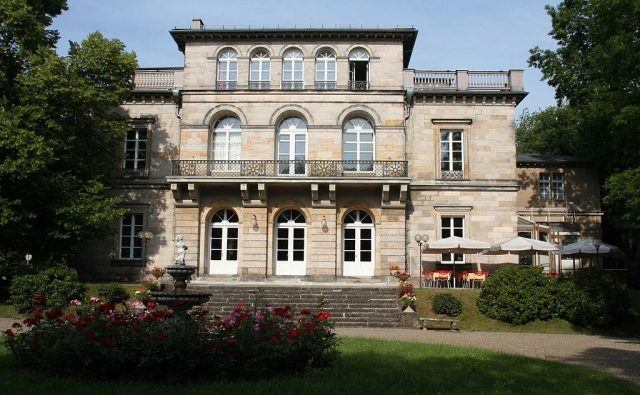
Hohenfels Castle on the Ernsthöhe in Coburg, above Callenberger Straße, has stood here since 1840. It was planned at the same time as the ducal Saxon court theater by Carl Balthasar Harres and was the residence for 50 years of the opera singer Natalie Frassini, ennobled as Baroness von Grünhof.
Duke Ernst Alexander of Württemberg (1807–1868), a nephew of Duke Ernst I of Coburg and brother of Duchess Marie, commissioned the architect Balthasar Harres – a student of Karl Friedrich Schinkel – in 1837 to build a castle-like country estate for himself and his future wife on the green hill of the former animal park. After Harres' departure in 1838, Vincenz Fischer-Birnbaum completed the building in the Classical style in 1840. The castle and park were named Ernsthöhe after their builder.
Ernst Alexander of Württemberg later fell in love with the then-famous opera singer Natalie Frassini, whom he had met at the Kassel Court Theater. Duke Ernst Alexander persuaded the Hessian Landgrave Ferdinand to elevate Natalie, whose real name was Eschborn and who derived her stage name from her discoverer and trainer Gioacchino Rossini, to the nobility as Baroness von Grünhof (after a family estate near Mitau in present-day Latvia) to reduce the difference in status to a tolerable level. The wedding followed in Hamburg on August 18, 1860.
Duke Ernst II of Coburg had met Frassini in London during one of her performances. He, who was very enthusiastic about opera and its attractive representatives (see Ketschendorf Castle), persuaded her to accept a guest contract at the Coburg Court Theater. Here she portrayed Gilda in Rigoletto with great success and was so taken with the quiet residential city on the Itz that she asked her future husband to move their shared residence to Coburg. After the death of Ernst of Württemberg in 1868, who was buried in the ducal mausoleum in the Coburg cemetery on Glockenberg, she lived as a widow on the Ernsthöhe until 1890. She moved to Berlin and left the property to her daughter Alexandra. She sold it in 1893 to the factory and estate owner Julius Heinzel from Łódź, who was later ennobled as Baron Heinzel von Hohenfels, thus transforming the Ernsthöhe into Hohenfels Castle. Heinzel built a stud farm not far from the castle, which produced the winners at the Hoppegarten trotting track in Berlin in 1906 and 1907.
In 1918, Heinzel sold the entire estate to the Berlin electrical entrepreneur Sigmund Bergmann († 1927), who had the house adapted to his needs by the Berlin architect Otto Rehnig.
On November 1, 1932, the castle, stud farm, and park became municipal property. From September 1933, the outbuildings were repurposed as a women's labor camp. From May 1934 to 1944, the castle housed the first Reichsschule of the NS-Frauenschaft. A Reich Labor Service camp for female youths was annexed in 1939. From 1945 to 1954, the estate stood empty.
Current Use+
In 1954, the private school for gymnastics, known as the Medau School since 1929, moved from Berlin to Hohenfels Castle. Since 1979, Germany's only school with integrated gymnastics and physiotherapy training has been located here, to which a vocational school for speech therapy was added in 1999. In 2004, the "Fachhochschule Schloss Hohenfels, state-recognized private university for specialized therapies in healthcare" was additionally founded, which offered two bachelor's degree programs until its relocation to Bamberg in 2010. The Medau School with its training courses continues under the same name. Since autumn 2010, the IB-Hochschule Berlin has been offering the Health Sciences degree program alongside vocational training. The study events take place as in-person classes once a month on weekends in the school's premises.
Take Mobile History with you
You are reading this text for free. Premium adds what matters on the road: descriptions read aloud, sites found through your camera, whole regions taken offline.
- Every description, including the ~17,700 Premium sites
- Audio guide: have descriptions read to you on location
- AR finder: see sites through your camera, with distance and bearing
- Unlimited saved sites
14 days free, then from €2.99 a month. Cancel anytime.
Source: Wikipedia · Licence: CC BY-SA 4.0
This description draws on the facts documented in the linked Wikipedia article; Wikipedia content is licensed under CC BY-SA 4.0. Wording and editing: Mobile History.
Location: 50.2671, 10.9542