To be privately owned
CastleSchwanewede - Löhnhorst
Hohehorst Castle
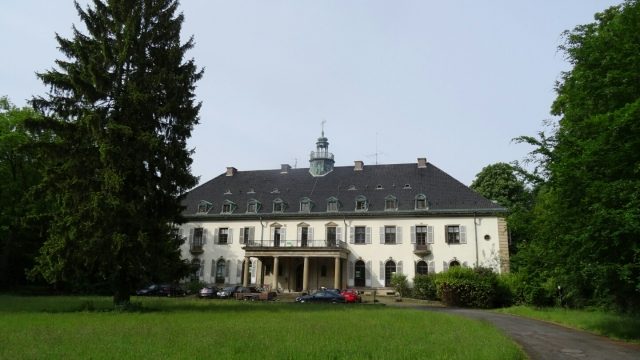
Hohehorst Manor, also known as Hohehorst Castle, is a manor house on the Hohehorst estate near Schwanewede-Löhnhorst in the Bremen Switzerland region. It was built in 1928/1929 by the industrialist G. Carl Lahusen as a country and summer residence for his family and became part of the bankruptcy estate in 1931 after the collapse of the Nordwolle Group, operated by the Lahusen entrepreneurial family. During the National Socialist era, it was then used as a Lebensborn home and in the post-war period, among other things, as a hospital. Until the end of 2012, it served as a drug therapy center. The property has been for sale ever since.
Villa, Manor House
In 1869, a country villa, the so-called Hohehorst Castle, was built in the "English style" in the Bremen Switzerland region on the "Hohehorst Estate". The adjoining Karlshorst Estate to the northeast and the Heidhof Estate (580 ha) to the north also belonged to the overall complex. Today, the Bundesautobahn 27 runs between Hohehorst and Karlshorst.
The industrialist Carl Lahusen (Nordwolle) had the castle demolished and from 1928 to 1929 had the new Hohehorst Manor built as his family's summer residence at a cost of three million Reichsmarks. The large park area was laid out in Löhnhorst, now part of the municipality of Schwanewede. The planning and construction measures were managed by the architect Otto Blendermann. In addition to seven architects, eight sculptors, four painters, and six masters of artistic weaving were involved. The stately home consisted of 107 rooms and 12 bathrooms. The estate included a park and a farmyard. Approximately 80/90 park workers were employed to maintain the facilities. The "castle" was equipped with the most modern technology of the time. All rooms, including the children's rooms, had telephone connections.
After the bankruptcy of the Nordwolle Group, with losses amounting to between 180 and 240 million Reichsmarks, Carl Lahusen was liable with his private assets and all real estate in 1931. Hohehorst Manor with all its facilities was also auctioned off. In September 1934, the district court of Lesum awarded the Hohehorst estate with the manor house to the Bremer Landesbank for 500,050 Reichsmarks, and at the end of 1934, the Karlshorst estate (249 ha) for 100,000 Reichsmarks. The Heidhof estate was largely taken over by the Prussian Treasury. In August 1935, the Reichsumsiedlungsgesellschaft mbH Berlin (Ruges) acquired the Hohehorst-Karlshorst estate, including all buildings and inventory.
Lebensborn
In 1937, the SS-owned organization Lebensborn bought the property for 60,000 Reichsmarks. This corresponded to about one-tenth of its market value. The villa was converted and put into operation in early 1938 as "Heim Friesland", a mother and maternity home for approximately 34 mothers and 45 children. The home was primarily available to Nazi dignitaries. Due to increasing bomb attacks on Bremen, part of the residents were evacuated to a Bavarian home in 1941, and an auxiliary hospital for female Wehrmacht members was also set up. The Lebensborn home continued to operate from 1944 until the end of the war.
Post-war period
British troops occupied the area in early May 1945. The site was taken over by the US Army, which set up a casino in the main building. Refugees and bombed-out families lived in the outbuildings.
Hospital
The Red Cross (DRK) leased the site in 1948 and established a TB sanatorium by 1954. After a period of vacancy, the city of Bremen became the owner in 1958 and turned Hohehorst into a clinic for internal medicine. The Hohehorst specialist hospital for internal diseases was affiliated as an external department of the Internal Clinic of the Bremen-Nord Central Hospital in 1972 and closed in 1978 for economic reasons.
In 1981, Drogenhilfe Bremen e.V. took over the facilities as the leaseholder.
Therapy Center
HOHEHORST gGmbH, whose shareholder is Drogenhilfe Bremen e.V., offered outpatient and inpatient care in the field of medical rehabilitation at Hohehorst as the Hohehorst Therapy Center until August 2014.
Today
The manor house is for sale and is inhabited by students who have received affordable housing here and, in return, protect the building from vandalism and decay.
With the exception of the manor house and other buildings, the grounds with the park and ponds are largely publicly accessible.
Museum Reception+
The Northwest German Museum of Industrial Culture on the former Nordwolle factory site in Delmenhorst, which is primarily dedicated to the history of Nordwolle and the Lahusen entrepreneurial family, as well as industrialization in the 19th and 20th centuries, also features a smaller exhibition area on the history of Hohehorst Manor and its uses as a country estate and Lebensborn home.
Since August 2007, there has been an exhibition project, supported by the municipality of Schwanewede, in the Wilhelmine Barracks (An der Kaserne in Schwanewede) of the Neuenkirchen Local History Association on the Lebensborn - Haus Friesland and the Nazi history of the region.
Since June 2010, one of the two gatehouses has housed an exhibition on the construction history of the manor house and the history of the Lahusen family.
Take Mobile History with you
You are reading this text for free. Premium adds what matters on the road: descriptions read aloud, sites found through your camera, whole regions taken offline.
- Every description, including the ~17,700 Premium sites
- Audio guide: have descriptions read to you on location
- AR finder: see sites through your camera, with distance and bearing
- Unlimited saved sites
14 days free, then from €2.99 a month. Cancel anytime.
Source: Wikipedia · Licence: CC BY-SA 4.0 · Image: Jörg Heldt
This description draws on the facts documented in the linked Wikipedia article; Wikipedia content is licensed under CC BY-SA 4.0. Wording and editing: Mobile History.
Location: 53.2120, 8.6363