Holiday apartments
CastleHofstetten
Hofstetten Castle
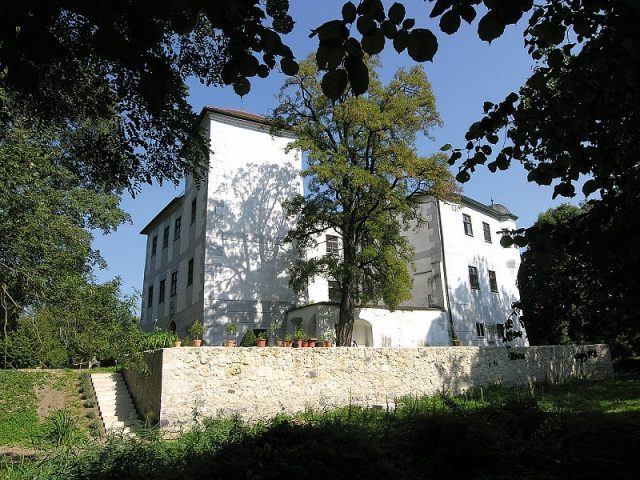
At its core, and still palpable today, Hofstetten Castle is a former ministerial castle of the Eichstätt bishops. The founding of the village, as a clearing in the dense forest, can probably be traced back to the middle of the tenth century. The name Hofstetten, derived from Hof (farm/court) and Stätte (place/site) (meaning a farm with a well), strongly suggests the village's founding at the end of the early Middle Ages.
The Lords of Hofstetten were originally not nobles but unfree. As ministeriales (vassals), they served the Eichstätt bishops, whose property they managed. The first fortification, which has not yet been archaeologically explored, was likely built of wood, typical for the time. Common at this time was a so-called motte (an earth mound with a wooden or stone tower, surrounded by palisades and perhaps water, as protection against attacks).
The Lords of Hofstetten entered the written world in 1122. In a document issued at a Bamberg court day of Emperor Heinrich V, "Purchhard de Hovestete" first brought the place and the lineage of the "Hofstetter" into the light of historical tradition and gave the village its "founding date."
During this time, the first parts of the castle may have been built in stone. The Hofstetten parish church, with its preserved Romanesque tower, which strongly resembles the castle's keep in terms of building volume, was consecrated by Bishop Otto of Eichstätt between 1183 and 1188.
The oldest parts of the complex
Hofstetten Castle, in addition to the keep and the partially dismantled shield wall, contains other wall sections that likely date from this period.
The still visible, though Baroque-modified, structure of the building clearly reveals a lowland castle surrounded by a moat, enclosing an inner courtyard protected by a shield wall and equipped with a well, between the palace and the keep. The entire complex is located on a terrace, bounded by a ring wall approximately 125 meters long. The surrounding moat is now dry and was originally somewhat deeper.
The ring wall features three later added corner bastions, but its core likely still belongs to the Romanesque expansion phase.
The castle reverts to the Prince-Bishopric
After the Lords of Hofstetten owned only a part of the complex at the beginning of the 15th century, it fell into the hands of Ulrich Hemberger in 1423, whose son of the same name sold the property in 1466 to Bishop Wilhelm von Reichenau of Eichstätt (1464/96). There is a biography of this famous bishop, who had many of the castles in his dominion additionally fortified and to whom the later famous humanist Willibald Pirckheimer was entrusted for education, written after his death. This text mentions that, among many other castles, he also had the one in Hofstetten fortified. The corner bastions of the ring wall, as well as the outer, still visible building cube, in which various former buildings were probably merged, are likely attributable to von Reichenau.
The first further clues to the building's design were left by one of his successors, Prince-Bishop Johann Euchar Schenk von Castell (1685/97), who had the castle transformed into a Baroque hunting lodge. In 1694, his court architect Jakob Engel completed the work. The Latin inscription on the contemporary coat of arms states that the Prince-Bishop "restored the house from ruins and rubble to its present form."
Transformation into a Baroque hunting lodge
Since further sources on the building history are missing and the building plans from this period are lost, one must rely on conjecture here as well. However, previous findings on the ground floor show that the former castle was gutted down to a few walls, or that the rising masonry inside no longer existed at all. Jakob Engel, at least, established a completely new sequence of rooms, with the exception of the keep. Just like the staircase, which he excellently placed between two medieval building parts, he used the existing outer shell to create something new. He probably adopted a late Gothic bay window, structured the building with his still striking architectural painting, created a new roof construction, and had it covered with limestone slabs. He halved the height of the shield wall, thereby giving the inner courtyard sunlight. He reduced the ring wall and made it a decorative element, and he enlarged and rhythmized the window openings. His greatest independent intervention was probably the creation of connecting corridors on the respective floors. Here, Engel added a building element and reduced the size of the inner courtyard by two meters to the north. Arcades facing south on the ground floor and the windows of the upper floors effectively illuminate the staircase and corridors, giving them their Baroque "lightness." In its present form, Hofstetten Castle still gives a vivid impression of the construction methods of that time. Furthermore, it is an eloquent example of the will to rebuild in the diocese for the period after the Thirty Years' War. Fifty years after its end, the damage in the area, devastatingly destroyed by the Swedes, was still widely visible. With apparently limited available funds, a prince in Hofstetten attempted to realize a nevertheless representative hunting lodge. Thus, the castle has no frescoes, the exterior is adorned with architectural painting and not, as was customary in the residential city of Eichstätt, with sculptural decoration. The stucco ceilings are kept simple, valuable floor coverings are completely absent, and finally, the roof of the building was covered with limestone slabs. This "poor man's material" actually had no place on the roofs of princely-episcopal representative buildings.
Today, this sparse renovation can be seen as a stroke of luck, as it helped preserve the castle character of the complex.
Economically strengthened again, the successors on the bishop's throne expanded the former Hirschberg Castle into their hunting lodge. This building still shows today what the master builders between Baroque and Rococo were capable of when the financial conditions were right.
The Jesuits and Napoleon's Stepson
Hofstetten Castle subsequently fell into a Sleeping Beauty slumber. Although the Eichstätt Jesuits were allowed to spend part of their autumn holidays in the castle from 1729, no further sources of castle use can be found for the subsequent period.
From 1817, parts of the former Prince-Bishopric of Eichstätt, including Hofstetten Castle, came into the possession of Eugène de Beauharnais, Napoleon's stepson. As the son-in-law of the Bavarian King, Max I Joseph, he had to be provided for appropriately after Napoleon's fall. The former Viceroy of Italy also received the title "Duke of Leuchtenberg" from the Bavarian King. This anachronism of Bavarian history lasted until 1833 or 1855, when the Bavarian state bought back the remaining possessions of the Leuchtenbergs for three million guilders.
Whether Eugène, who was an enthusiastic hunter, or one of his descendants, ever visited Hofstetten Castle with its extensive hunting grounds, cannot be gathered from the archives.
The castle becomes a Royal Bavarian Forestry Office and the time thereafter
In 1861, the Bavarian state, through the Royal Building Authority Eichstätt, subjected the castle to a precise inventory and subsequently established a forestry office within it. This forestry office survived the end of the Bavarian monarchy and continued to exist until 1959. The English Ladies (today: Congregatio Jesu) acquired the area in 1962 and set up a holiday residence in the castle. They separated a part of the property, the former orchard and tree garden, to build a farm on it. When the castle was sold to our family in 1974, not much of its former purpose as a hunting lodge was recognizable. The building was in great need of renovation, and the years of renovation began, restoring the former beauty of the complex.
Source text: www.schloss-hofstetten.de
Take Mobile History with you
You are reading this text for free. Premium adds what matters on the road: descriptions read aloud, sites found through your camera, whole regions taken offline.
- Every description, including the ~17,700 Premium sites
- Audio guide: have descriptions read to you on location
- AR finder: see sites through your camera, with distance and bearing
- Unlimited saved sites
14 days free, then from €2.99 a month. Cancel anytime.
Source: Wikipedia · Licence: CC BY-SA 4.0
This description draws on the facts documented in the linked Wikipedia article; Wikipedia content is licensed under CC BY-SA 4.0. Wording and editing: Mobile History.
Location: 48.8729, 11.3279