To be privately owned
CastleSteindorf - Hofhegnenberg
Hofhegnenberg Castle
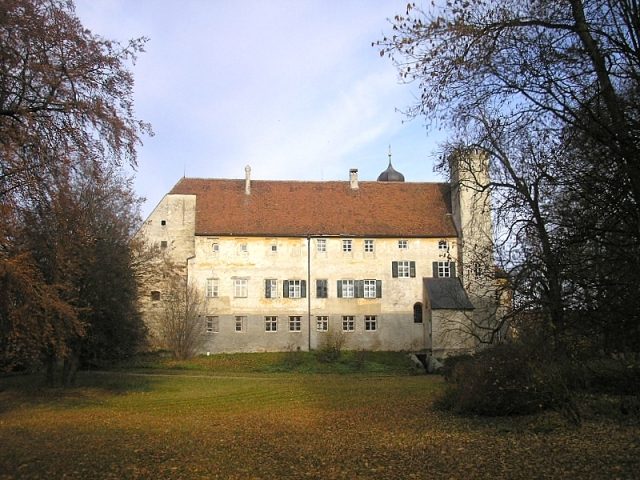
Hofhegnenberg Castle is located on the edge of the Steindorf district of Hofhegnenberg on a hill in the south of the Aichach-Friedberg district (Swabia). The well-preserved noble residence dates back to a high medieval castle complex, of which the stump of the keep is still visible.
High Middle Ages
The Lords of Hegnenberg originally probably came from Upper Swabia. At the end of the 12th century, Engelschalk and Hermann von Hegnenberg appear as Welf ministeriales in written sources. The namesake seat of this ministerial family was the small motte-and-bailey castle (Burgstall Althegnenberg) on the southern edge of the nearby Althegnenberg in today's Fürstenfeldbruck district.
Around 1300, the Hegnenbergers left their ancestral seat in the village and built a larger castle on the widely visible ridge about four kilometers away. In the late High Middle Ages, such a relocation of a ministerial seat to a higher elevation can often be observed. The originally mostly unfree ministerial families had by then established themselves in the lower nobility and wanted to document this with a representative hilltop castle.
Possibly the new castle construction was also started by ducal order. In 1296, the Bishop of Augsburg had Kaltenberg Castle near Geltendorf destroyed to curb the expansionist ambitions of the Wittelsbachs. The Hegnenbergers were then part of the retinue of the new Duke Rudolf. The castle should therefore also be interpreted as a symbol of power and border fortification against the Prince-Bishopric of Augsburg.
The first written evidence of the hilltop castle dates from 1354. In this document of October 24, the knight Winhart von Rohrbach bequeathed to the Prince-Bishopric of Augsburg, among other things, tithe income from nine Juchert of arable land "located behind the castle at Haegniberg". The mention of the still common field name "Roßberg" in this document proves that the mentioned castle is to be equated with the predecessor of today's castle.
Late Middle Ages
In 1399, Arnold the Elder von Hegnenberg sold the ducal fief with the castle to the Friedberg administrator Hans the Pflaumdorfer. The agreed purchase price was 1800 new Hungarian gulden. The purchase deed for the first time recorded the total extent of the Hofmark, which remained unchanged until the 19th century.
In 1405, Pflaumdorfer passed the lordship on to Jörg von Ersingen and "Paul the Aersinger" the Younger. Already in 1411, "Paul Aeresinger" sold the property back to Duke Wilhelm III.
In 1462, Dukes Johann and Sigismund appointed Heinrich Adelzhauser as administrator of Hegnenberg. The Dukes were then in constant financial difficulties and also owed Adelzhauser 1,000 gulden. Until the full repayment of the loan, the lordship of Hegnenberg was left to the administrator for use.
Early Modern Period
In 1515, Raphael Sättelin is mentioned as administrator in the "Salbuech des Schloß Hägnenberg". Around 1540, the medieval castle seems to have been very dilapidated.
In 1542, Duke Wilhelm IV enfeoffed his illegitimate son Georg with the Hofmark Hegnenberg. Georg, born around 1511, became the progenitor of the family von (Hof)Hegnenberg-Dux, whose last male descendant from a collateral line died in 1902. The main line died out already in 1786 with Baron Georg Ignaz Peter.
The "Golden Knight" (Order of the Burgundian Cross) Georg had to have large parts of the residence renewed. In 1557, the reconstruction and new construction were completed. However, the high medieval southwest tower continued to dominate the building complex. It was only capped around 1790, when the western castle entrance was also changed. The old state is documented in an engraving by Michael Wening (1701). The high southwest tower (probably the former keep) then had a high tent roof, the two round turrets on the gatehouse had onion domes.
19th Century to the Present
The "Dolllingische Branche" of the Lords of Hegnenberg was elevated to the rank of Imperial Count in 1790. Through the daughter of the last count, the lordship finally passed in 1902 to the family of her husband Otto Wilhelm Freiherr von Gebsattel. The von Gebsattel family inhabited the large castle building until the present day. The estate is surrounded by a large English park and is not publicly accessible.
Since 1988, the old Hofmark castle served as the backdrop for the television series Forsthaus Falkenau as the fictional Bernried Castle in Küblach in the Bavarian Forest. After a large part of the main actors left the series in 2006, including the fictional residents of the castle, it was no longer shown or mentioned in the series. The castle also served as a backdrop in other television series.
At the end of 2008, the last noble castle lord sold the complex to the Starnberg entrepreneur Peter Löw. The new owner wants to use and renovate the property as his family's residence. Some alterations are planned for this purpose. These measures will be gradually coordinated with the monument preservation authorities. At the beginning of the renovation, the fence around the estate, which had been dilapidated for decades, was renewed. After approval by the monument preservation authorities and the municipal council, the reconstruction of the southwest tower was started and completed in early 2012.
Building Description+
The castle is located within a park enclosed by old trees on the Roßberg above Steindorf. To the northeast, there is a large, rectangular farmyard, whose buildings in their current form largely date from the 19th century.
Main Castle
The extensive four-wing complex of the main castle is arranged around a rectangular inner courtyard. The two- to three-story wings are topped with gabled roofs. In the northwest and southeast, two square corner towers rise above the complex. The northeastern tower has an octagon with an onion dome, the southeastern one has neo-Gothic battlements.
The western gatehouse was also altered in neo-Gothic style around 1790. A long passage leads into the inner courtyard. Above the gate, a coat of arms (1557) is embedded. The representative gatehouse on the east side dates from the 18th century and shows simple Baroque stylistic forms.
The outer walls are structured only by the simple rectangular window openings with shutters. The round-arch arcades of the eastern and western courtyard facades are bricked up.
The bossed ashlar of the presumed keep stump at the southwest corner still recalls the high medieval castle complex. The tower is the most important testimony to high medieval noble culture in the district.
Michael Wening's engraving from 1701 documents an extensive Baroque bastion fortification around the castle district. In the terrain, some earthworks of these redoubts and a brick vault can still be seen.
Castle Chapel St. Maria
The former pilgrimage chapel St. Maria is located on the ground floor in the southeast corner of the castle quadrangle. The square room (side length approx. 10 meters) with its four groin vaults over a central column was built in the 16th century during the castle renovation. In 1751, the southern extension was added (Wilgefortis side chapel).
The vault frescoes (around 1740) illustrate scenes from the pilgrimage history. One can see, among other things, a Swedish soldier who wants to throw the miraculous image of St. Mary into the fire during the Thirty Years' War. Noteworthy is the castle view in the background, which, like the Wening engraving from 1701, shows the west side of the noble residence.
The miraculous image in the center of the high altar is dated to the second half of the 15th century. The seated Madonna is surrounded by a Baroque halo. Eight putti sit on cumulus clouds in the arcade arch. The altar structure dates from 1739. The two side figures of Saints George and Nicholas are works by Bartholomäus Kriechbaum.
In the three-sided closed extension, the large red marble epitaph of Georg von Hegnenberg-Dux from the former Franciscan church in Munich has been placed since the 19th century. The progenitor of the Counts of Hegnenberg, who died in 1589, stands in a self-confident posture in armor in a Renaissance aedicule.
Take Mobile History with you
You are reading this text for free. Premium adds what matters on the road: descriptions read aloud, sites found through your camera, whole regions taken offline.
- Every description, including the ~17,700 Premium sites
- Audio guide: have descriptions read to you on location
- AR finder: see sites through your camera, with distance and bearing
- Unlimited saved sites
14 days free, then from €2.99 a month. Cancel anytime.
Source: Wikipedia · Licence: CC BY-SA 4.0 · Image: https://commons.wikimedia.org/wiki/File:Schloss_Hofhegnenberg_5.jpg
This description draws on the facts documented in the linked Wikipedia article; Wikipedia content is licensed under CC BY-SA 4.0. Wording and editing: Mobile History.
Location: 48.2177, 11.0215