To be privately owned
CastleKarsbach-Höllrich
Höllrich Castle
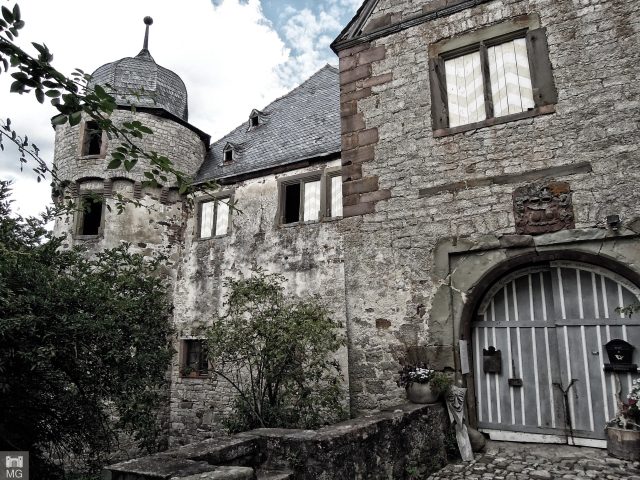
In the year 1331, Andreas, Dietz, Lutz, and Albrecht von THÜNGEN, the patriarchs of the main Thüngen line, with the "knowledge and will" of Bishop Wolfram von Würzburg, erected the REUSSENBURG, located on the EICHELBERG near the village of "HILDERICH". The Thüngen family promised, "that we and our descendants on the Reussenburg shall be loyal and true to our Lord Bishop and his foundation for all eternity and shall open this castle to him in all times of need against all his enemies."
Below the castle, the Reussenberg estate was established. Repeatedly, disputes arose between the Bishop of Würzburg and the Thüngen family. In 1438, Bishop Johann II, with 3000 foot soldiers and 1000 horsemen, besieged the castle in vain. During the Peasants' War in 1525, the Reussenburg was stormed and set on fire by the rebellious peasants. The castle ruins and the Reussenberg estate (disappeared in 1945) are now located within the Hammelburg military training area.
In place of the castle, the Thüngen family built a moated castle in the middle of the village of Höllrich, which was completed around 1561. The three-winged castle complex with four corner towers (only the two southern towers remain) is surrounded by a 10 m wide and 6 m deep moat (now dry). The west wing was redesigned in Baroque style in 1720. In 1883, the Thüngen'sche Rentamt Zeitlofs sold the entire inventory to the Berlin National Museum. The castle was inhabited until 1961, then gradually fell into disrepair. For several years, a private individual has been trying to restore it. The agricultural lands are managed by the Barons from their main seat in Thüngen.
The owners of the castle and the lords of the village of Höllrich changed frequently. In 1601, Höllrich, Hessdorf, and the Reussenberg estate came into the possession of Martin von der Tann. Other owners included the Berlichingen, Stein, Johann Georg Schenk zu Schweinsberg, Fulda, and the Knightly Canton Rhön-Werra. It was not until 1744 that all of Höllrich returned to Philipp Christoph Dietrich von Thüngen. After 1765, Höllrich was declared a Fideikommissgut of the Lutz line of the Thüngen family. Due to the Handlohnzahlung (a fee upon sale), a lengthy dispute between the Thüngen family and the Juliusspital in Würzburg occurred from 1731 to 1792.
For over 200 years, the farmers of Höllrich argued with the Thüngen family over their forest rights, but could not enforce recognition of their property rights. From 1782 to 1810, the Höllricher Geschirrfröner also litigated with the Thüngen family over excessive corvée services. Initially without success, they eventually achieved a redemption of the corvée services for 6700 guilders.
Initially, Höllrich belonged to the original parish of Eussenheim-Aschfeld. It was probably then a filial church of Karsbach until it became an independent parish in the 14th century. Otto Wilhelm von Thüngen is usually referred to as the "Reformer" of Höllrich. The REFORMATION was probably introduced here around 1556. At times, Höllrich and Hessdorf were served by the pastor in Bonnland. Since 1642, the respective clergyman has been the pastor of Höllrich and Hessdorf. The patronage rights for Höllrich were held by the Lutz line, and for Hessdorf, jointly by the Lutz and Andreas lines of the Thüngen family.
Take Mobile History with you
You are reading this text for free. Premium adds what matters on the road: descriptions read aloud, sites found through your camera, whole regions taken offline.
- Every description, including the ~17,700 Premium sites
- Audio guide: have descriptions read to you on location
- AR finder: see sites through your camera, with distance and bearing
- Unlimited saved sites
14 days free, then from €2.99 a month. Cancel anytime.
Source: Wikipedia · Licence: CC BY-SA 4.0 · Image: Mobile Geschichte
This description draws on the facts documented in the linked Wikipedia article; Wikipedia content is licensed under CC BY-SA 4.0. Wording and editing: Mobile History.
Location: 50.0675, 9.7945