To be privately owned
CastleWaizenkirchen-Inzing
Hochscharten Castle
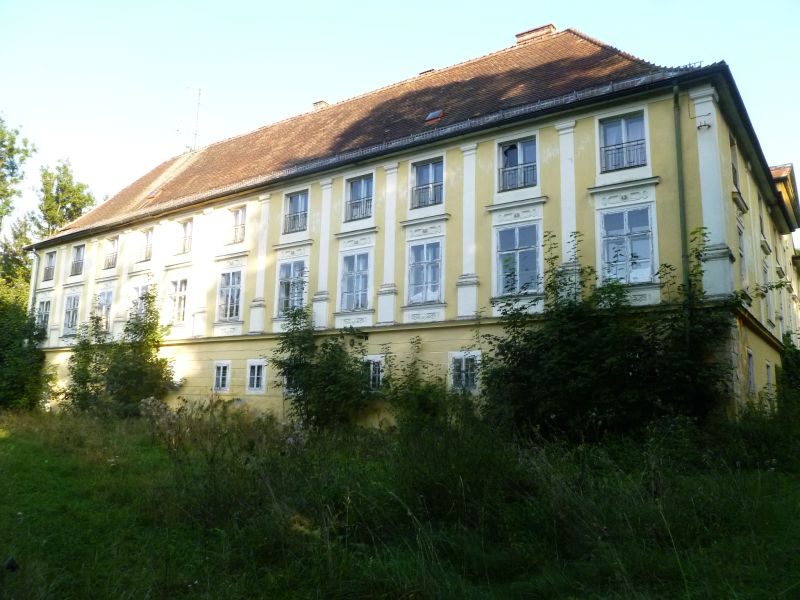
Schloss Hochscharten is located in the Inzing district of the municipality of Waizenkirchen in the Grieskirchen district in the Hausruckviertel region of Upper Austria.
Schloss Hochscharten dates from the early 19th century. It emerged from a farm, the Hochschartnergut, which was originally the Meierhof (manor farm) of the noble seat of Inzing. The former administrator of Schloss Weidenholz, Johann Saxinger, had the farm converted into a two-story residential building. His successor was the municipal doctor Dr. Karl Esterle, who added another floor and a clock tower. In 1864, the property was sold to Baron Gustav von Krieg, a brother-in-law of the Austrian Feldzeugmeister Ludwig August Ritter von Benedek, who acted unsuccessfully against the Prussians in the Battle of Königgrätz. In 1868, the property was sold to Count Johann Taxis von Bordogna-Valsassina. He had the castle extended by two side wings, creating a castle courtyard facing the hill. His son Hans sold the castle in 1896 to Botho Graf Coreth. In 1910, Coreth had the previous flat roof replaced by the hip roof that still exists today. Above the castle, a building for the Count's horses was erected, which is mistakenly referred to as Schloss Inzing. In 1942, after the death of Botho Coreth, the family had to sell Hochscharten.
For a short time, the castle served as a maternity home. From 1945, it was used as barracks by the American occupation troops. Between 1954 and 1957, Hochscharten belonged to the Chamber of Commerce for Upper Austria, which operated a boarding vocational school there. The subsequent owner since 1988, the Wels industrialist Robert Wimmer, is described as a supporter of the right-wing extremist scene, as he made Schloss Hochscharten available as a training venue to the "Freundeskreis für Kultur- und Zeitgeschichte" (Circle of Friends for Cultural and Contemporary History). Recently, the castle was sold to a real estate developer from Peuerbach.
Schloss Hochscharten Today+
Schloss Hochscharten is a three-story, three-winged building with a gable mansard, located on the side facing the park. Below the empty gable field is a stucco cartouche depicting the coat of arms of Upper Austria. The tall windows are framed with stucco. The facades are structured by stucco half-columns. Another structuring element of the facade is a cornice that separates the two upper floors from the somewhat simpler lower one.
The castle is located in an extensive park. Both the castle and the park are in an unkempt and overgrown state. Due to tree growth, the view of the castle's inner courtyard is barely possible.
Take Mobile History with you
You are reading this text for free. Premium adds what matters on the road: descriptions read aloud, sites found through your camera, whole regions taken offline.
- Every description, including the ~17,700 Premium sites
- Audio guide: have descriptions read to you on location
- AR finder: see sites through your camera, with distance and bearing
- Unlimited saved sites
14 days free, then from €2.99 a month. Cancel anytime.
Source: Wikipedia · Licence: CC BY-SA 4.0 · Image: Luckyprof (Luckyprof (talk)) / CC BY-SA 3.0 at via Wikimedia Commons
This description draws on the facts documented in the linked Wikipedia article; Wikipedia content is licensed under CC BY-SA 4.0. Wording and editing: Mobile History.
Location: 48.3340, 13.8620