Hospital
CastleHirschstein
Hirschstein Castle
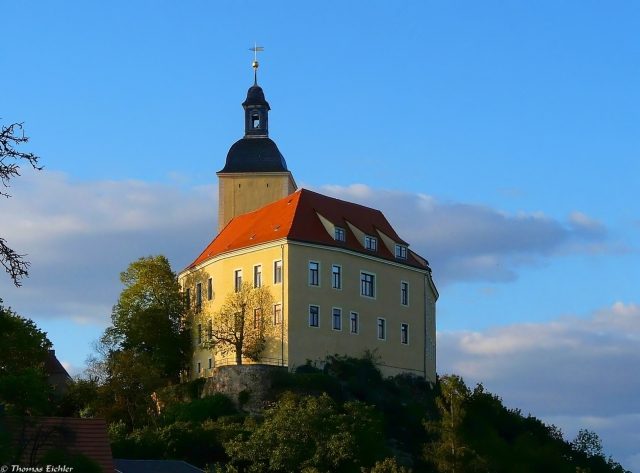
Hirschstein Castle (also Neuhirschstein) is a castle that emerged from a medieval fortress in the municipality of Hirschstein in the district of Meißen. It rises imposingly on a 25-meter-high rock on the left bank of the Elbe, opposite Neuseußlitz.
As early as 1205, a fortress was mentioned at this location, which probably already existed in the 10th century. It was not until 1497 that the term castle was used in connection with the complex. In a document from 1551, the name Nau Hirstein is mentioned. The owners of the castle changed several times, mainly including nobles from the Dresden court. Around 1590, the castle was acquired by Hartmann Pistoris of the ennobled scholarly family Pistoris and remained in family ownership until and including the lifetime of Johann Ernst Pistoris. In the 17th century, an expansion of the complex took place. A settlement grew up around the castle, taking the name Hirschstein. A feudal estate developed, to which the inhabitants of the villages of Althirschstein, Bahra, Böhla, Blattersleben, Fichtenberg, Kobeln, Leckwitz, Weißig and Windorf had to render corvée services.
In 1892, the Hussar Captain Max Crusius from Großenhain bought the castle and had it rebuilt and modernized in 1893/94. After his death in 1907, his widow lived in the castle. During the Second World War, art treasures from the Dresden art collections were stored here. On October 7, 1943, the SS confiscated the castle. When the Allies landed in France on June 6, 1944, the Belgian King Leopold III and his family were arrested on Himmler's orders and housed as state prisoners under strict SS guard at Hirschstein Castle until March 6, 1945. After the war, the complex housed a Red Army hospital. Subsequently, the castle was used as a children's recreation home from 1949 to 1955, then from 1957 as a children's sanatorium and rehabilitation clinic. Most recently, from 2000 to 2006, it served as a rehabilitation clinic for children and adolescents with psychosomatic disorders. Since 2009, it has been owned by the district of Meißen.
An old escape passage from the 15th century is said to exist from the castle, leading under the Elbe to the now non-existent Zottewitz Castle. However, it is largely filled in.
Take Mobile History with you
You are reading this text for free. Premium adds what matters on the road: descriptions read aloud, sites found through your camera, whole regions taken offline.
- Every description, including the ~17,700 Premium sites
- Audio guide: have descriptions read to you on location
- AR finder: see sites through your camera, with distance and bearing
- Unlimited saved sites
14 days free, then from €2.99 a month. Cancel anytime.
Source: Wikipedia · Licence: CC BY-SA 4.0 · Image: Thomas Eichler
This description draws on the facts documented in the linked Wikipedia article; Wikipedia content is licensed under CC BY-SA 4.0. Wording and editing: Mobile History.
Location: 51.2518, 13.4003