To be privately owned
CastleWeilheim-Hirschberg am Haarsee
Hirschberg Castle
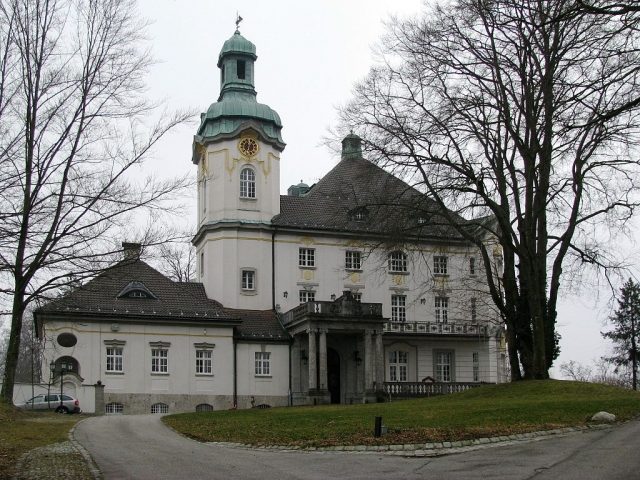
Hirschberg Castle is located on Lake Haarsee in the Upper Bavarian district of Weilheim-Schongau. The castle, in "Art Nouveau Baroque" style, was built from 1907 to 1909 according to plans by Carl Hocheder for the von Hirschberg family near Weilheim in Upper Bavaria.
The von Hirschberg Family
Friederike Albertine Sophie von Faber (* November 7, 1878 in Stein; † September 14, 1951 in Hirschberg am Haarsee) married Karl Rudolf von Hirschberg (* December 7, 1855 in Ingolstadt; † June 12, 1927 in Gossenhofen near Weilheim), Royal Chamberlain and Major General, Commander of the 4th Royal Bavarian Cavalry Brigade, on March 26, 1906. In 1906, they acquired estates in Haarsee, Gossenhofen, and Rothsee. On August 18, 1907, the foundation stone was laid for a castle on Lake Haarsee, which was intended as their family seat and cost approximately one million Goldmarks. The construction lasted two years, and the building was equipped with the most modern technology of the time, including central heating, a passenger elevator, and a swimming pool in the basement.
In 1923, the von Hirschberg family faced economic difficulties, partly due to hyperinflation and war bonds that had become worthless, and could no longer afford to live in the castle themselves due to high maintenance costs. It was rented to the Jewish Berlin banking family von Bleichröder. Primarily Alwine Maria Emma von Bleichröder, née Soydt (* 1894; † 1981), wife of James von Bleichröder, resided there. In 1927, Karl Rudolf von Hirschberg died. His widow moved back into a part of the castle in 1933.
Their daughter Sophie Dorothee von Podewils married Clemens von Podewils on September 26, 1932, in Rothsee near Weilheim. Their son Rüdiger von Hirschberg married Marina von Ditmar on January 12, 1938, in Rothsee.
State Ownership
During the Second World War, the secluded castle was confiscated and used as a "guest house of the Reich Foreign Ministry." It was given the code name Waldbichl. Subsequently, a sale to the "Greater German Reich" for 1.5 million Reichsmarks was agreed upon with the von Hirschberg family, with 1.3 million Marks accounted for by exchanged properties. However, the sale only became legally effective after the war in 1953.
Guest House of the Reich Foreign Ministry
On September 14, 1943, at 2:30 PM, after Operation Oak, Benito Mussolini and Adolf Hitler met at the Wolf's Lair. On September 19, 1943, Benito Mussolini, his wife Rachele, Romano Mussolini, Anna Maria Mussolini, and Filippo Anfuso moved into Hirschberg Castle. Mussolini's daughter Edda Ciano, her husband Galeazzo Ciano, and children were accommodated in a villa in Allmannshausen on Lake Starnberg and intended to emigrate to Argentina. On September 23, 1943, Karl Wolff drove Mussolini to an airport in Munich. From Munich, Mussolini partly flew the plane to Aeroporto di Forlì. From Forlì, Wolff and Mussolini drove to Rocca delle Caminate in Meldola. Wolff continued to Rome, where he engaged Rodolfo Graziani as Minister of Defense for Salò in the Italian Social Republic at the German Embassy. Edda Ciano traveled by train to Salò on September 27, 1943. On October 17, 1943, SS man Wilhelm Höttl brought Galeazzo Ciano and children to Salò.
From October 18, 1944, to May 1, 1945, Miklós Horthy, with his wife and daughter-in-law, was accommodated at Hirschberg Castle under the care of Walter Hellenthal. On May 8, 1945, Horthy was taken to Augsburg and introduced to General Patch in Göppingen. On May 11, he was flown to Manoir de Lébioles, where he recorded text with Franz von Papen and Walther Darré into the rosettes around the ceiling lamps. From May 21 to December 17, 1945, he was interned in a hotel opposite Camp Ashcan in Bad Mondorf under Burton C. Andrus in the run-up to the Nuremberg Trials. On June 25, 1945, he spoke text with Gustav Adolf Steengracht von Moyland and Friedrich von Boetticher.
From December 1945 to September 1948, the Horthys lived at Pollinger Straße 25 in Weilheim. On December 7, 1946, the Horthy family applied for German identity cards.
Ukrainian Seminary and Late Vocations School
From May 1, 1946, to 1961, the building was used by the US government. From February 1946 to 1948, at the initiative of the apostolic visitor Mykola Vojakovs'kyj, 72 Ukrainian students studied Catholic Theology at the castle. For financial reasons and due to the beginning emigration of Ukrainians, it was relocated to the Netherlands.
On April 26, 1948, the newly founded St. Joseph Late Vocations School of the Oblates of St. Francis de Sales moved into the building, where it remained until spring 1960.
Federal Intelligence Service
From 1961 to June 2000, the Federal Intelligence Service used the building for training. The Federal Real Estate Office then offered the castle for sale. Various uses were discussed. However, a buyer was only found in 2004.
Take Mobile History with you
You are reading this text for free. Premium adds what matters on the road: descriptions read aloud, sites found through your camera, whole regions taken offline.
- Every description, including the ~17,700 Premium sites
- Audio guide: have descriptions read to you on location
- AR finder: see sites through your camera, with distance and bearing
- Unlimited saved sites
14 days free, then from €2.99 a month. Cancel anytime.
Source: Wikipedia · Licence: CC BY-SA 4.0
This description draws on the facts documented in the linked Wikipedia article; Wikipedia content is licensed under CC BY-SA 4.0. Wording and editing: Mobile History.
Location: 47.8084, 11.2170