Jailhouse
CastleHindelbank
Hindelbank Castle
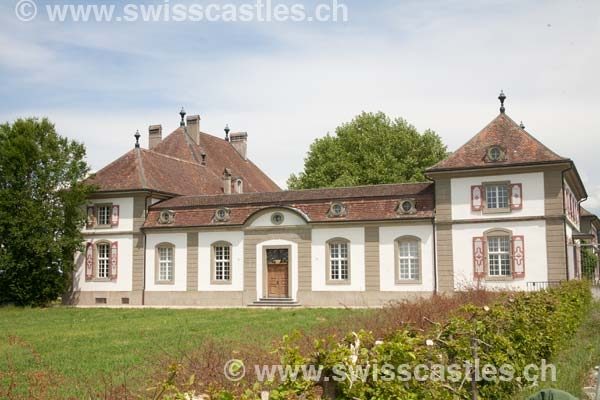
From 1866, the former Erlacher family property (Castle/1725) served as a poorhouse, and from 1896 as a "forced labor institution" for women. From 1912, it was operated as a labor and penal institution for women.
In 1958, the Steinhof transitional home in Burgdorf (half-freedom for women and men), affiliated with the institutions, was opened. It was closed in 1998 and reopened in 1999 as an external living group (open prison, half-freedom).
In 1959, the Concordat institution with first-time and recidivist departments was built. The institution received its current name: "Institutions in Hindelbank". From 1983, the entire operation underwent a total reorganization for the purpose of introducing a new concept (introduction of care-oriented group enforcement). In the years 1986-1989, the planning and project design for the overall renovation took place. Approval for a partial renovation was granted by the Grand Council of the Canton of Bern in 1993. Between 1995 and 1997, the penal institution, the only one for women in German-speaking Switzerland, was partially renovated at a cost of over 16 million Swiss francs.
Enforcement of prison and penitentiary sentences between 30 days and life imprisonment, enforcement of criminal measures, implementation of welfare-based deprivation of liberty, and early enforcement of sentences and measures.
In Hindelbank, a total of 94 places are available, 88 of which are in the five living groups for normal enforcement and six in the living group for mother+child. In addition, the institutions operate the external living group Steinhof in Burgdorf with 14 places, where inmates are specifically prepared for social reintegration; women who serve the last part of their sentence in half-freedom (with an external workplace) can also be admitted there.
The admitted women work in the laundry, cardboard packaging, gardening, tailoring, pottery, and the employment workshop, as well as in the kitchen, house service, technical service, and the internal cleaning service of the living groups.
In Hindelbank, women aged 18 and over from around 25 nations are accommodated; approximately two-thirds of the inmates are of foreign origin. The proportion of women convicted of drug offenses is of a similar magnitude.
Care-oriented group enforcement, focused on resocialization, is practiced. During the day, inmates can move freely in the living groups or at their workplaces; from 9:30 PM to 6:30 AM, they are locked in individual cells. Social work is integrated into the care service.
Inmates can complete an apprenticeship or vocational training, attend courses, use the library, and participate in leisure activities. Pastoral care is guaranteed.
The director and the heads of the departments (care, health service, trade, security and visitor service, administration) together form the management team. Approximately 110 employees (of whom about 85 are women) share 73.5 full-time positions. The annual operating expenses amount to more than ten million Swiss francs.
Take Mobile History with you
You are reading this text for free. Premium adds what matters on the road: descriptions read aloud, sites found through your camera, whole regions taken offline.
- Every description, including the ~17,700 Premium sites
- Audio guide: have descriptions read to you on location
- AR finder: see sites through your camera, with distance and bearing
- Unlimited saved sites
14 days free, then from €2.99 a month. Cancel anytime.
Source: Wikipedia · Licence: CC BY-SA 4.0
This description draws on the facts documented in the linked Wikipedia article; Wikipedia content is licensed under CC BY-SA 4.0. Wording and editing: Mobile History.
Location: 47.0331, 7.5411