Cultural Events
CastleMetten
Himmelberg Castle
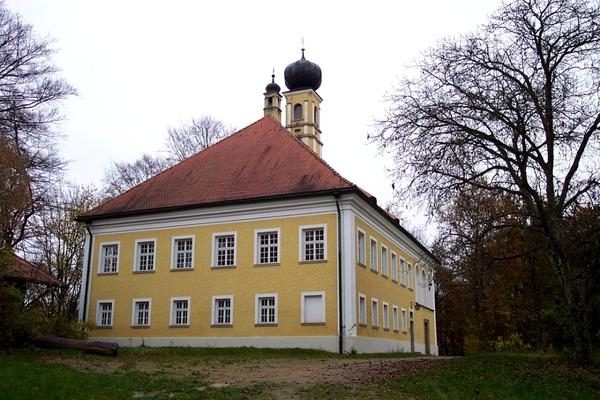
Himmelberg Castle near Metten in Lower Bavaria served as a summer residence for the abbots of the nearby Benedictine abbey of St. Michael in the 18th century.
The current castle was built in 1757 on behalf of Metten's Abbot Adalbert Tobiaschu according to the plans of the lay brother and architect Albert Schöttl as a replacement for an older summer house. The eastern part of the building houses the two-story chapel. In the western part, the ground floor contains the utility rooms, above which on the first floor are a large hall and a cabinet.
During secularization, the castle was assigned to the last abbot of Metten, Cölestin Stöckl, as his residence; however, for health reasons, he was soon allowed to return to his familiar surroundings in the former abbey, where he remained until his death in 1807. Himmelberg Castle, along with other buildings of Metten Monastery, came into the possession of Johann von Pronath. Later, the building was repurchased by the re-established monastery.
In the years 1984/85, the small castle was fundamentally renovated and restored. The ballroom of the castle is now used for concerts as part of the "Concerts in Metten Monastery" event series.
Castle Chapel+
The small castle chapel boasts rich furnishings from the Rococo period. The altar with the side figures of Saints Peter and Paul, as well as the pulpit, were created by the Passau sculptor Joseph Deutschmann, who also worked for the monastery in the churches of Rettenbach and Michaelsbuch. The altarpiece and the frescoes are by Martin Speer from Regensburg, who also painted the monastery's ballroom and supplied several altarpieces for the monastery church.
Ballroom+
The ceiling of the ballroom features rich Rococo stucco work, created by a member of the Modler family (probably Johann Baptist Modler). Stylistically, they are closely related to their works in the New Residence in Passau and in Aldersbach Abbey. The central field depicts Saint Benedict, who is supplied with bread in the solitude of Subiaco by the monk Romanus from a nearby monastery. The central field is surrounded by depictions of the four seasons and the four elements.
Take Mobile History with you
You are reading this text for free. Premium adds what matters on the road: descriptions read aloud, sites found through your camera, whole regions taken offline.
- Every description, including the ~17,700 Premium sites
- Audio guide: have descriptions read to you on location
- AR finder: see sites through your camera, with distance and bearing
- Unlimited saved sites
14 days free, then from €2.99 a month. Cancel anytime.
Source: Wikipedia · Licence: CC BY-SA 4.0
This description draws on the facts documented in the linked Wikipedia article; Wikipedia content is licensed under CC BY-SA 4.0. Wording and editing: Mobile History.
Location: 48.8580, 12.8998