To be privately owned
CastleBad Friedrichshall-Heuchlingen
Heuchlingen Castle
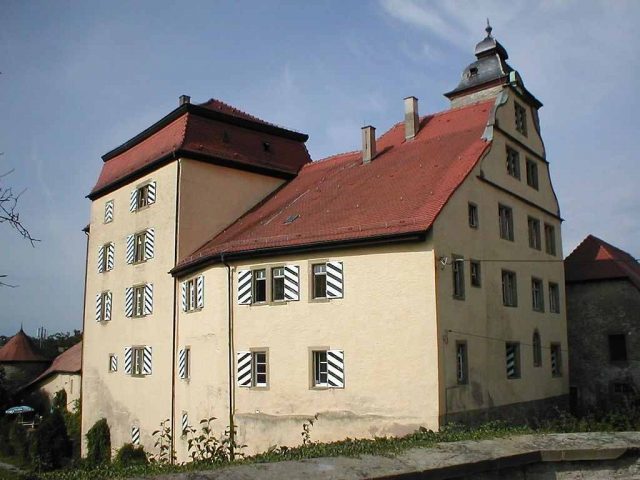
Heuchlingen Castle is an agricultural state domain in Bad Friedrichshall in the Heilbronn district in northern Baden-Württemberg. The complex, originally dating back to the 12th century, is located outside Bad Friedrichshall in the district of Duttenberg.
The complex was probably built as a castle in the 12th century and was first mentioned in 1222, along with a mill, as a noble castle seat. Early lords of the castle were the Lords of Huchelheim. Later, the castle was divided among several owners, including early on the Imperial Abbey of Ellwangen and around 1290 the Lords of Goltstein, whose shares passed to the Greck von Kochendorf in the 14th century. In 1449, the castle was burned down by citizens of Wimpfen in the so-called "City War".
In 1484, the Teutonic Order acquired the Vogtland in six surrounding villages and shortly thereafter also parts of the castle, which was renovated by the Order and became the seat of a Teutonic Order office responsible for the surrounding villages. During the Peasants' War in 1525, Heuchlingen Castle was destroyed again. Under the Grand Master of the Teutonic Order Walther von Cronberg, reconstruction in the Renaissance style began in 1530. As elsewhere, the construction work was carried out by subjects performing corvée labor.
The castle received its current Baroque appearance through various reconstruction measures in the late 18th century under the Teutonic Order Master Karl Alexander von Lorraine, whose coat of arms adorns the castle wall, and the master builders Georg Philipp Wenger (1701–1763) and Johann Hornstein (1740–1818). The oldest records of the structural form of the complex come from Wenger's survey, which was created around 1750, at which time the complex was so dilapidated that Wenger's initial plans practically envisioned a complete new building. Wenger submitted several plan changes, but construction had not yet begun by 1761, so the planning and execution of the current complex are essentially due to Wenger's employee Hornstein.
After the dissolution of the Teutonic Order, the estate fell to the Kingdom of Württemberg as a state domain, which used the complex, among other things, as a cameral office and barracks. Since around 1900, the estate has been leased to Südzucker AG or its predecessors as an agricultural estate; until 1994, there were employee apartments there, and since 2002, some renovated areas in the residential buildings have been sublet as offices and apartments. A partial area of the domain (20 ha) was allocated in 1954 to the State Teaching and Research Institute for Viticulture and Fruit Growing in Weinsberg, which established a fruit growing experimental farm there, now 34 ha in size.
The complex is normally not accessible and can only be visited occasionally on special occasions such as the Open Monument Day.
The complex consists of a three-part, Baroque-looking residential building with outbuildings, cellars, gatehouse, and towers, surrounded by walls and moats. Outside the walls are other, partly stately, outbuildings. An underground escape tunnel once connected the castle well with the basement of the gate tower.
The complex impresses primarily with its Baroque exterior. Since the building was inhabited by Teutonic Order commanders for only about 20 years after the last renovations in 1781, and then used militarily and agriculturally for 200 years, there is no splendor inside. Only in the Knights' Hall were remnants of historical wall paintings uncovered.
Take Mobile History with you
You are reading this text for free. Premium adds what matters on the road: descriptions read aloud, sites found through your camera, whole regions taken offline.
- Every description, including the ~17,700 Premium sites
- Audio guide: have descriptions read to you on location
- AR finder: see sites through your camera, with distance and bearing
- Unlimited saved sites
14 days free, then from €2.99 a month. Cancel anytime.
Source: Wikipedia · Licence: CC BY-SA 4.0 · Image: https://commons.wikimedia.org/wiki/File:Heuchlingen-schloss-5.JPG
This description draws on the facts documented in the linked Wikipedia article; Wikipedia content is licensed under CC BY-SA 4.0. Wording and editing: Mobile History.
Location: 49.2517, 9.2145