Conference center
CastleOttendorf-Okrilla-Hermsdorf
Hermsdorf Castle
The Hermsdorf area, not far from the A4 on the northern outskirts of Dresden, was already densely populated in prehistoric times. On the edge of the Rödertal valley, there is a large Bronze Age burial ground dating from the 12th to 9th centuries BC.
Both by name and by its original village form, the place is a German settlement. It was first mentioned in 1350 as Hermansdorf (= Hermann's village). In the early 15th century, Hermsdorf belonged to the knight's seat of Wachau. The establishment of a manor in the village seems to have only occurred through Otto von Carlowitz in 1461, when it was said to be "seated in Hermannstorff". The von Carlowitz family resided here for over 100 years. From 1553 to 1575, Christoph von Carlowitz built Hermsdorf Castle.
A moated castle can be presumed in the area of Hermsdorf Castle. More clearly than with Moritzburg Hunting Lodge, the original 16th-century layout has been preserved here: a rectangular plateau with walls and a moat, as well as round towers at the four corners. The castle stands freely on it, an elongated, three-story building with a mansard roof. Of the originally four round, low corner towers in the surrounding wall, three towers are still preserved.
In 1586, ownership changed to Hans von Zschieren. In the 17th century, the castle was briefly owned by the electoral house, but Elector Johann Georg II ceded the knight's estate to his court marshal Johann Georg Freiherr von Rechenberg in 1657. After the Freiherr's death in 1699, Adam Friedrich Graf von Flemming acquired the castle. In 1729, it partially burned down, which the then owner took as an opportunity to expand the estate into a magnificent castle complex with the participation of the Dresden city architect Georg Bähr.
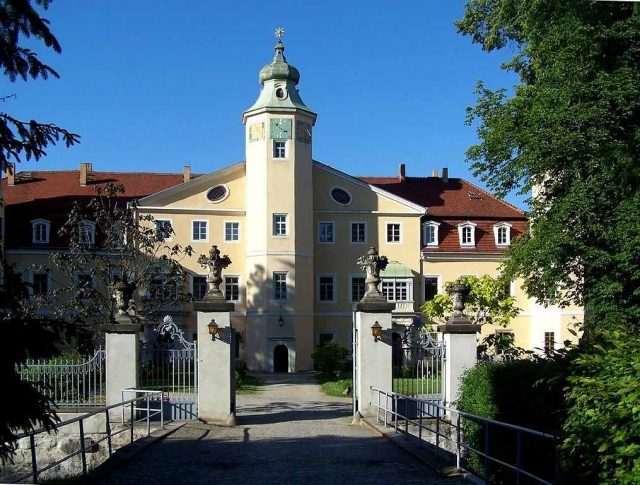
Hermsdorf Castle has everything one expects from an old manor: three towers on the south side, festive interiors, and an extensive castle park with water features. The large, almost rectangular castle wing is laid out on a slightly curved floor plan. Its main facade is structured by two side towers and a central stair tower, as well as a simple triangular gable with oval windows.
Inside, visitors are greeted by a spacious hall, from which the other rooms on the ground floor are accessed. While most rooms were divided into small chambers in 1946 to allow use as a retirement home, and the furnishings were lost, the ballroom on the upper floor is once again presented in its old splendor. Its Rococo stucco work was created after 1890. Unfortunately, the castle is only open on Heritage Day or for occasional concerts.
After the death of Count von Flemming in 1744, the widowed Countess Charlotte Sophie von Hoym acquired the estate. She lived here for more than 50 years and in 1777 received permission to have a chapel installed in the right corner tower, seen from the entrance. From the outside, the small round tower does not reveal the splendor hidden within. But the chapel is magnificently decorated with stucco work. Herm pilasters support the ceiling. Eight angels play music on the surrounding cornice; in the vaulted dome, seven angels hold an image of God the Father. After the Countess's death in 1808, ownership changed several times. Finally, Georg Prinz von Schönburg-Waldenburg acquired the castle in 1865, which was to remain in the family's possession until shortly before the end of World War II. In 1945, the owners were forcibly expropriated and expelled by the communists.
Adjoining the castle is the park, surrounded by a rubble stone wall. The front part, laid out in the French style around 1730, was extended in the English style in 1764. Unlike other French Baroque gardens, its main axis, a canal fed by the Große Röder with two islands, relates to the narrow front of the castle. In addition to Baroque geometric forms, the spacious park already contains elements of an English-style landscape park. Of the valuable sculptures, a group of three playing children and the very beautiful larger-than-life sandstone figure of Apollo have been preserved. All artworks can be attributed to the period around 1730.
Take Mobile History with you
You are reading this text for free. Premium adds what matters on the road: descriptions read aloud, sites found through your camera, whole regions taken offline.
- Every description, including the ~17,700 Premium sites
- Audio guide: have descriptions read to you on location
- AR finder: see sites through your camera, with distance and bearing
- Unlimited saved sites
14 days free, then from €2.99 a month. Cancel anytime.
Source: Wikipedia · Licence: CC BY-SA 4.0 · Image: http://de.wikipedia.org/wiki/Datei:Hermsdorf_Schloss_1.jpg
This description draws on the facts documented in the linked Wikipedia article; Wikipedia content is licensed under CC BY-SA 4.0. Wording and editing: Mobile History.
Location: 51.1645, 13.8198