To be privately owned
CastleDresden - Helfenberg
Helfenberg Castle
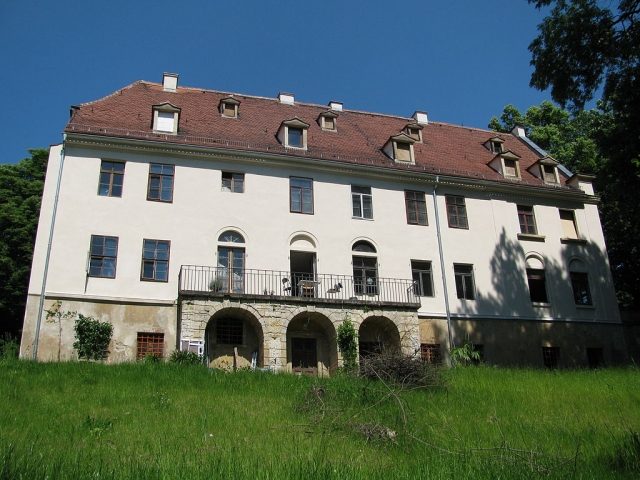
Helfenberg Castle is a castle in the east of the Saxon state capital Dresden in the Helfenberg district. The building ensemble consisting of the manor house and castle park, farm buildings of the estate, estate building with courtyard entrance, remains of walls and retaining walls is a registered cultural monument.
In earlier times, the neighboring Helfenberg Castle, of which only ruins remain, was also called by this name. After the construction of a manor house in an outwork belonging to the castle, the name was transferred to the present castle.
Helfenberg Castle+
Helfenberg Castle was located west of the present-day Helfenberg locality. It was first mentioned in 1350 as Castrum Helfenberg in districtu Dresden situm, but is probably more than 100 years older. This motte-and-bailey castle dates from the time of the German Ostsiedlung. In 1397, a document refers to the castle as czum Helffenberge; in 1410, it is called sloss Helffinberg. The name zum Helffenberge is documented from 1505. At times, the castle was also called Helfenstein and Hilfenburg.
The fortification was located on a mountain spur at the edge of the Helfenberger Grund. Towards the hinterland, in the direction of Gönnsdorf, it was secured by ditches and ramparts. The early inhabitants primarily used it as a watchtower and refuge. The castle was only a few 100 m² in size and developed into the center of a small manorial estate and a knight's seat. According to legend, the cruel robber knight Barbaricy temporarily found refuge here.
In the 14th century, the Helfenberg lordship belonged to the Burgraves of Dohna. From 1397, it was owned by the Lords of Ziegler; already around 1400, it passed to the then Margrave of Meissen, Frederick IV, and became a crown estate. The influential Dresden burgher family Kundig received the knight's estate in 1445, and from 1510, the noble family Karras exercised manorial rights. In 1535, the Lords of Carlowitz became the new owners, before Elector Moritz transferred the Helfenberg lordship to Hans von Dehn-Rothfelser in the early 1550s. His heirs held tithe rights here until 1760.
The end of Helfenberg Castle was initiated around 1535 by the construction of a manor house to its east in the present-day Helfenberg locality. Although the castle remained habitable for a time, the main seat of the knight's estate was moved to the new, more representative building in the mid-16th century. The castle served only as a refuge. In 1631, during the Thirty Years' War, the lords of the manor retreated here from the attacks of the Croats.
Even around 1700, Helfenberg Castle was mentioned as an old castle, but was only rarely used. In the 18th century, it fell into disrepair. In 1775, the castle ruins were used to obtain building material for the construction of a new manor house and were largely demolished in the process. In 1878, only a Gothic archway remained to commemorate the former castle. To this day, remains of the ruins, including parts of walls and sections of the rampart, have been preserved. Archaeologists recovered medieval ceramics here.
Helfenberg Manor House+
To facilitate the management of the lands belonging to Helfenberg Castle, an outwork was built to its east. It was first mentioned in 1420 as forwergk Helffenberg. It probably represents the nucleus of the present-day Helfenberg district.
Around 1535, a new manor house in Renaissance style was built on the grounds of this larger estate. When Helfenberg was expanded into a large knight's estate under Hans von Dehn-Rothfelser, his family moved their main residence from the castle to the manor house, which was enlarged at that time, in 1547. It was subsequently inhabited by one of Dehn-Rothfelser's seven sons, the Elector's stable master Ernst Abraham von Dehn-Rothfelser. His only son, the Imperial Master of the Hunt Hans Dippold von Dehn-Rothfelser, died in Helfenberg Manor House in 1665.
In 1775, this manor house, which has since been increasingly referred to as Helfenberg Castle, was rebuilt according to plans by Johann Gottfried Kuntsch. For this two-story building, which was executed with a half-hipped roof, Kuntsch used demolished stones from the now ruined Helfenberg Castle as building material.
Already around 1800, Gottlob Friedrich Thormeyer carried out a redesign in the style of Classicism. The building was extended to the east; the facade has since been divided into nine, rather than seven, axes and was equipped with three reliefs created by Thaddäus Ignatius Wiskotschill. They are called "Painting", "Sculpture" and "Apollo and the Muses" and were originally located on Camillo Marcolini's residence in Wilsdruffer Gasse in Dresden's Old Town. The entrance to the manor house was placed on the east side during the renovation, and a wide flight of steps was added in front of it. The castle received a gable roof and the three gable windows a common circular blind. The gate pillars at the courtyard entrance were decorated with sandstone urns.
A park adjoins the manor house to the south. It was probably laid out at the beginning of the 17th century and has been altered several times. Its current form dates back to the early 19th century. Between 1806 and 1811, the lord of the manor, James Ogilvy, 7th Earl of Findlater, had it redesigned in the English style. During this time, valuable trees were planted, such as several false cypresses, a tulip tree, and two weeping beeches. The latter have been protected since 1958; due to their special size and form, they are designated as natural monument ND78. The park is characterized by the contrasting alternation of large deciduous and coniferous trees and is traversed by the Elbe hillside hiking trail.
After Findlater's death in 1811, the estate passed to his life partner and private secretary Johann Georg Christian Fischer, who lived in Helfenberg until his death in 1860. The Albertines, the Saxon royal house, acquired the Helfenberg and also the neighboring Gönnsdorf knight's estate in 1878. It was managed by various tenants. After the abolition of the monarchy, the Hausverein albertinischer Linie e. V. managed the estate and thus also the manor house, whereby the Wettins remained the landlords. After the Second World War, they were then dispossessed as part of the land reform.
In 1948, the planned demolition of the castle in favor of new farmsteads was prevented. The former manor house later served as a school, as the administrative seat of an LPG, which joined the Bühlau LPG Neues Leben in 1970, and as a repair shop. A large part of the estate was used for agriculture until 1990. The preserved buildings, including the manor house, are listed as historical monuments. Most of them are empty; after the sale of the castle in 2006, its gradual renovation into a residential building began.
Take Mobile History with you
You are reading this text for free. Premium adds what matters on the road: descriptions read aloud, sites found through your camera, whole regions taken offline.
- Every description, including the ~17,700 Premium sites
- Audio guide: have descriptions read to you on location
- AR finder: see sites through your camera, with distance and bearing
- Unlimited saved sites
14 days free, then from €2.99 a month. Cancel anytime.
Source: Wikipedia · Licence: CC BY-SA 4.0 · Image: http://commons.wikimedia.org/wiki/File:Herrenhaus_Helfenberg.jpg
This description draws on the facts documented in the linked Wikipedia article; Wikipedia content is licensed under CC BY-SA 4.0. Wording and editing: Mobile History.
Location: 51.0370, 13.8638