Educational institution
CastleHeitenried
Heitenried Castle
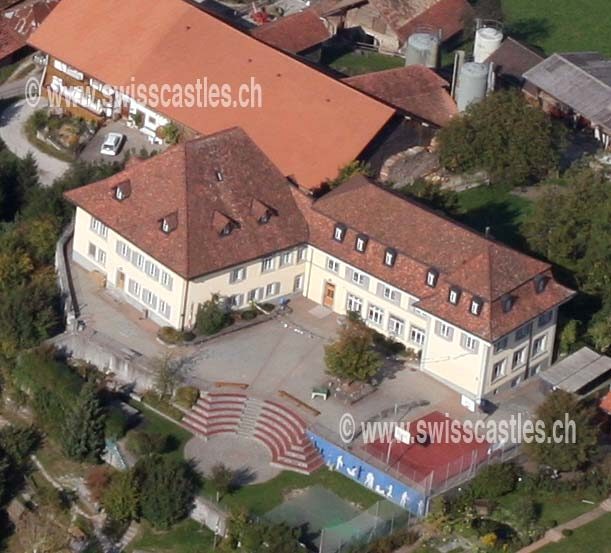
Heitenried is first mentioned in 1228 in the "Cartulare Lausannense", written by Conon von Estavayer, Provost of the Cathedral Chapter. Among the churches of the Deanery of Fribourg, one finds the name Essert, which corresponds to the German "Ried". But how did Heitenried come about? "Ried" means cleared, swampy land. So this name was very common in our area. They had to be specified more precisely. So they were given the name of the ruler and owner. A Lord Heito is listed in our region. Our settlement "Ried" thus received its name from him. The name "Heitenried" first appears in documents in the 14th century, and its spelling has undergone various changes.
The Owners of Heitenried
In the 13th century, a family "von Ried" is first mentioned. In 1257, Sir Konradus von Ried is spoken of. In 1278, Ulrich von Ried resided in Heitenried. Knight Heinrich von Ried is mentioned in documents in 1326. In the 14th century, Heitenried was temporarily in the possession of the wealthy Counts of Thierstein. However, they cared little for their possessions with us. Presumably, the yields were not noteworthy enough. Thus, in 1369, the lordship passed as a fief to the Fribourg family Velga, and in 1442 they acquired it by purchase. The last representative of the Velga family, Knight Wilhelm, left only his daughter Dorothée. She married Jean-Rodolpho von Erlach, Lord of Spiez. Their daughter "Marie von Erlach" married Niklaus von Diesbach from Bern. She inherited this land, which was valued at 8169 pounds. Niklaus von Diesbach sold it in 1579 to his nephew, Georges von Diesbach from Fribourg for 3300 coins. Count Jean-Frederic von Diesbach married Marie-Elisabeth von Steinbrugg from Solothurn, the last of this lineage, on November 26, 1675. From then on, the name Steinbrugg was added to the older branch of the Diesbach family. It was thus von Diesbach Steinbrugg. His son Francois-Philippe was an excellent soldier. He became Field Marshal and Colonel of a Swiss regiment in France. He had one son and two daughters. He married one to Louis d'Affry, later Landammann of Switzerland, and the other to Conrad de Féguely von Vivers. The son was Count Francois-Philippe Louvrier, "last ruler of Heitenried".
The Castle Building
The origin of the castle is a refuge castle. This can be proven by the walls. This was gradually rebuilt and extended; the result of which is the current so-called "Old Castle". It is massive, tall, slender, and covered with a hip roof. It preserves within its walls the remains of feudal rule. The "New Castle" with its many windows and its four-gabled roof is reminiscent of the Louis XV architectural style. A wooden gallery, supported by heavy columns, connected the two wings. Access to the chambers was also from this arbor. Heating was also from the outside. A vault, closed by an iron-clad door, led into the courtyard, where a chapel once stood, which was later converted into a chicken coop. The building, which today has no uniform architecture, has undergone several profound renovations. Nevertheless, it is reminiscent of beautiful bygone times. During such changes, the allegorical frescoes by Locher, which depicted the four seasons, were also destroyed. The red marble fireplace also found no mercy, as did the salon, which was decorated with painted canvas. In the courtyard, a approximately 20 m deep well ensured the water supply. It protruded one meter from the surface and was secured with wooden planks. The well trough, which is now next to the church, must also have been located here. Part of today's school square was loosened up by a French garden. Access to the settlement was from the farms. Initially, there was no path from the village. Remains of the access walls are still visible today.
The Fate of the Castle and its Current Use
In 1840, a family Josef Siegfried-Bersier was the owner. In 1856, the castle and its estates were sold to A. Schneeli from Glarus, and in 1878 we find it in the possession of Bank Tschann-Zeeleder & Co. in Bern. Pastor-Dean Spicher made every effort to bring the castle and estates back into the hands of the people of Heitenried. To this end, with admirable energy, he founded the Castle Society with 19 proven men and conducted negotiations with the Bernese bank. On June 10, 1878, the memorable deed of purchase, which had been made for the sum of Fr. 200,000, took place in the rectory in Heitenried. Over the years, the estates were sold to private individuals. The old castle building could be transferred to the MUNICIPALITY OF HEITENRIED AND THE PARISH OF TAFERS for the price of Fr. 20,000. Of this purchase sum, the municipality of Heitenried had to pay Fr. 10,000, the parish of Tafers Fr. 9,000, and the Canton of Fribourg Fr. 1,000. However, at the time of sale, the Castle Society also committed to having the castle, a building from the 16th/17th century, converted into a schoolhouse, i.e., two spacious halls, apartments and kitchens for male and female teachers, a dining room for the children, toilets, etc., were installed. This very difficult work was undertaken by master builders Müller, Alterswil, and Johann Brügger from Holzacker at a cost of Fr. 9,000.
On October 24, 1880, in the afternoon after vespers, the solemn inauguration of the new schoolhouse took place. The deserving Pastor Spicher writes in the chronicle: The boys' school was then opened with 70 pupils under the newly elected teacher Mr. Stephan Zosso from Winterlingen and the girls' school with 80 pupils under the Theodosian Sister Desiderata Nager from Hospenthal/Uri. - We want to hope that God's blessing will rest upon the school. In 1920, the so-called Summer Castle from the 17th/18th century was also converted for school instruction. The entire, magnificently situated castle building, which for centuries was a unique seat of power for many noble and distinguished people, today serves the education and upbringing of our dear youth.
Take Mobile History with you
You are reading this text for free. Premium adds what matters on the road: descriptions read aloud, sites found through your camera, whole regions taken offline.
- Every description, including the ~17,700 Premium sites
- Audio guide: have descriptions read to you on location
- AR finder: see sites through your camera, with distance and bearing
- Unlimited saved sites
14 days free, then from €2.99 a month. Cancel anytime.
Source: Wikipedia · Licence: CC BY-SA 4.0
This description draws on the facts documented in the linked Wikipedia article; Wikipedia content is licensed under CC BY-SA 4.0. Wording and editing: Mobile History.
Location: 46.8280, 7.2994