Nursing home
CastleSiegburg
Haus zur Mühlen Castle (Siegburg)
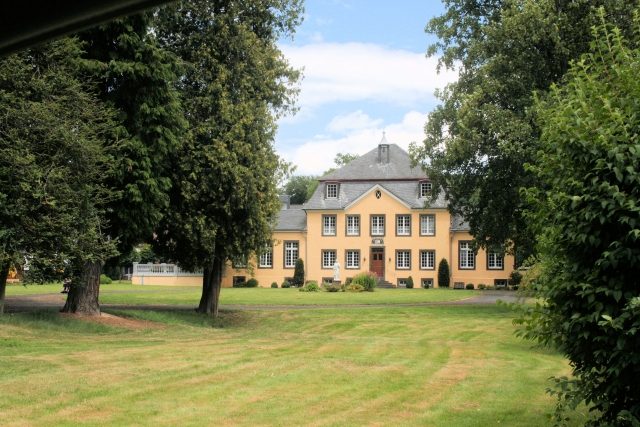
Haus zur Mühlen is a district of the city of Siegburg. It is a mill complex made of tufa stone, equipped with towers, which was first mentioned in 1312 as being owned by Michaelsberg Abbey. Until about 1806, the house had the right to a seat in the Bergisch Landtag and was admitted to the Rhenish provincial estates as a manor in the 19th century. Today, after being used as a monastery, the estate serves as a retirement home.
Since the house was located outside the Siegburg castle ban and the Wolsdorf Vogtland in the territory of the Blankenberg office, the property may have been owned by Michaelsberg Abbey since its foundation. In 1369, the owner, Knight Johann von Attenbach, received the milling rights for the judicial district of Wolsdorf and the villages of Kaldauen, Schneffelrath, the farms at der Heide, Rodenbach, Schmitthof, Leyhorst, and Junkersbroich from the Duke of Berg.
When the Knights of Attenbach died out, the fortified house fell to the Lords von der Reven in the 16th century, who in turn sold it in 1618 to the Lords von Gevertzhagen, who had by then become the new Lords of Attenbach. After the last scion of the family died in 1690 during the siege of Kaiserswerth, the inheritance fell to Philipp Adolf von Wittmann after the death of his widow. However, he became mentally ill, the appointed administrator ran the estate into the ground, and it had to be auctioned off. The new owner on April 26, 1735, was Raban Wilhelm von Wecus. His heir was his daughter Elise, who was married to the Cologne art collector Everhard Oswald Freiherr von Mering. Her son, the historian Dr. phil. Friedrich Everhard von Mering, described the house where he spent his childhood as follows: "One can only reach the front door over a stone bridge." He dates the house, built in Empire style, which he describes as being surrounded by a large garden and ponds, to the year 1760. After it fell as an inheritance to his son-in-law, the Russian staff captain von Kezelli, it came into the possession of Johann Neuhöffer in 1827. The carousel of owners now spun ever faster, for in 1845 it was the topographer J. P. Weyer, in 1846 the von Klitzing, and in 1857 the Princes of Salm-Horstmar.
On July 1, 1930, the estate was bought for 300,000 Goldmark by the Cologne Alexian Brothers as an agricultural and livestock farm. In the same year, the community began building a chapel, which was then consecrated to Saint Joseph on April 2, 1931. A new farm building, a monastery building, and a dormitory for about 100 patients were completed shortly thereafter. At that time, the buildings were completely dilapidated and regularly fell victim to smaller fires. Former Neuss patients and residents were now accommodated in the cloister wing located above an archway, so that a closed cloister area was only re-established in the 1980s, but now on the second floor of the manor house. After the agricultural buildings finally fell victim to the flames, a retirement home for about 100 residents was built on the site of the former farm, and the manor house, built in Empire style, was converted into a pure cloister building. When the convent broke up in the first third of the 1990s due to departures and transfers, the province moved the novitiate to Aachen in March 1994.
Take Mobile History with you
You are reading this text for free. Premium adds what matters on the road: descriptions read aloud, sites found through your camera, whole regions taken offline.
- Every description, including the ~17,700 Premium sites
- Audio guide: have descriptions read to you on location
- AR finder: see sites through your camera, with distance and bearing
- Unlimited saved sites
14 days free, then from €2.99 a month. Cancel anytime.
Source: Wikipedia · Licence: CC BY-SA 4.0
This description draws on the facts documented in the linked Wikipedia article; Wikipedia content is licensed under CC BY-SA 4.0. Wording and editing: Mobile History.
Location: 50.7995, 7.2415