Nursing home
CastleWartberg ob der Aist
Haus Castle
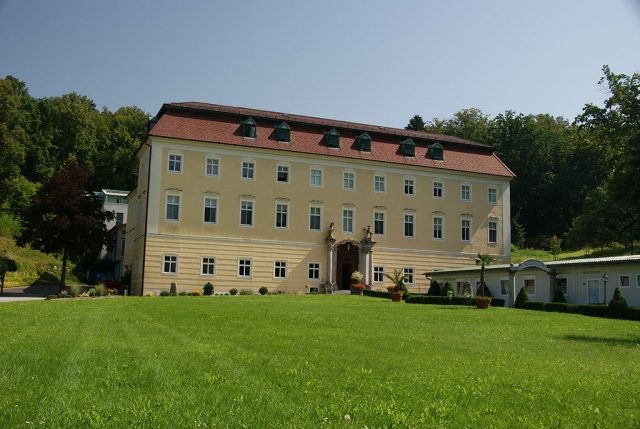
Schloss Haus is a former castle complex in Upper Austria, located south of the town of Wartberg ob der Aist in the Mühlviertel region. The predecessor building was a castle that belonged to the Lords of Haus. The current three-winged building dates from the 18th century and has served as a nursing and care home for the Province of Upper Austria since 1947.
The castle is named after the Hauser family, who were burgraves in Steyr. Ulrich von Haus was first mentioned around 1291. It is presumed that the first Burg Haus was located closer to the Aist river; the place name Altenhaus points to this location. In the 13th century, Burg Haus was feared because the Hausers were robber knights. They sometimes deceived the numerous merchants by shoeing their horses with the horseshoes reversed. The path from Pregarten to Mauthausen was an important trade route at that time.
In the 14th century, the castle was a princely fief of the Freistadt dominion. The first documented owner was Andre Hauzenberger, who owned the castle in 1391. Around 1452, Knight Hannes von Sinzendorf appears as the owner. After the male line of the Sinzendorfers died out, Haus came into the possession of the Schweinböck family (also: Schweinpeck) through marriage. Adam Schweinböck sold the castle in 1542 to Georg von Landau. His son Hannes (1535–1575) was elevated to the rank of baron with the title Baron zu Haus und Rappottenstein through the ownership of Burg Rappottenstein. Hannes von Landau is buried in the parish church of Wartberg.
Haus remained in the Landau family, who had converted to Protestantism, until 1620. Due to their participation in the noble uprising and in the course of the Counter-Reformation, the family lost the castle through confiscation, and in 1621, Count Leonhard Helfrich von Meggau, who was a regional judge in Freistadt, bought it. Due to an inheritance dispute, the castle fell to Count Cavriani. In 1708, Count Gundaker Thomas von Starhemberg took over the castle, had it demolished, and rebuilt. Between 1721 and 1729, the current three-winged castle was built by the Linz master builder Michael Pruckmayr. Before 1750, the castle became the official seat of the Freistadt dominion and administered the markets of Gutau, Perg, and Pregarten. In the 19th century, some alterations were made to the castle. It remained in Starhemberg ownership until 1948, even after the castle lost significance with the abolition of manorialism in 1848. In 1872, a Schloss Haus stop was built as part of the construction of the Summerauer Bahn; the stop is located about 300 meters southwest of the castle.
Schloss Haus was leased to the painter Jakob Weeser-Krell in 1896. The art institution he established existed until 1911. After that, the castle was available for welfare purposes. A military hospital was set up in the castle during the First World War. From 1920 to May 1945, it was used as an orphanage. It was occupied by the Soviet forces as barracks and purchased by the Province of Upper Austria in 1947. In 1947, the castle was converted into a nursing and care institution.
Construction+
The castle is a two-story building. The entrance area is characterized by two lions, each standing on a column. These lions stand on their hind legs and hold a coat of arms. Above the entrance is the Upper Austrian provincial coat of arms; the Province of Upper Austria is the current owner.
In the reception hall, there is an old knight's armor, and the inner courtyard has an arcaded walkway.
Take Mobile History with you
You are reading this text for free. Premium adds what matters on the road: descriptions read aloud, sites found through your camera, whole regions taken offline.
- Every description, including the ~17,700 Premium sites
- Audio guide: have descriptions read to you on location
- AR finder: see sites through your camera, with distance and bearing
- Unlimited saved sites
14 days free, then from €2.99 a month. Cancel anytime.
Source: Wikipedia · Licence: CC BY-SA 4.0 · Image: http://commons.wikimedia.org/wiki/File:Schloss_Haus.JPG
This description draws on the facts documented in the linked Wikipedia article; Wikipedia content is licensed under CC BY-SA 4.0. Wording and editing: Mobile History.
Location: 48.3433, 14.5089