Restaurant
To be privately owned
CastleHartberg
Hartberg Castle
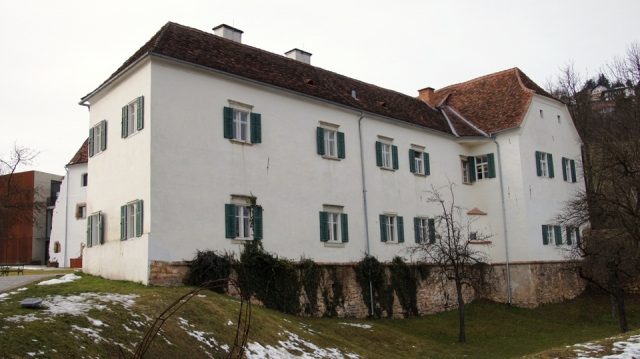
Hartberg Castle, also known as Paar Castle, is a castle complex in the district capital of Hartberg in the Austrian state of Styria.
The castle is located at the foot of the Ringkogel in the northwest of Hartberg's old town. It is surrounded by parts of the city's defensive wall and the Reckturm defensive structure. To the west is the city park, to the south the castle park and Herrengasse.
First mentioned in a document in 1147, the castle served as border protection from the 12th century onwards and was integrated into a chain of fortifications built by the Traungau family on behalf of the regional princes at the highest point of present-day Hartberg. The settlement that grew up around the castle complex developed into the city that exists today. In addition to a manor farm, the complex also included a mill and the St. John's Chapel.
In 1469, the Austrian military leader Andreas Baumkircher attacked Hartberg and abducted the castle lord Anton von Herberstein to Schlaining in Burgenland. After the conquest of the city in 1487 by the Hungarian King Matthias Corvinus, Baumkircher's son Wilhelm received the city and castle as a fief, which he held until its reconquest by the Roman-German King and later Emperor Maximilian I in 1490. After Hartberg had been owned by the regional prince until 1529, it was sold by Emperor Ferdinand I to Governor Siegmund von Dietrichstein. In the following decades, the ownership changed hands several times.
From 1576 to 1584, under the court postmaster and quartermaster Johann Baptist von Paar, who had owned the castle since 1571, the complex was converted into a Renaissance-style castle. Hartberg Castle was entered into the family fideicommiss of the Paar family in 1626. After economic difficulties in 1634, it was seized and ownership was transferred to Hans Albrecht von Herberstein, who in turn passed the castle on to Governor Karl Graf von Saurau in 1641, until it was bought by Georg Adam Graf von Lengheimb in 1682. The new owner had the castle expanded and an office building erected instead of the manor farm.
After more than a century, the Paar family regained control of Hartberg Castle in 1756. The family, residing in a Viennese palace at the time, appointed administrators to manage it. In 1850, Karl Prince Paar offered the castle for sale to the municipality, but the deal failed due to the excessively high purchase price. Only after the sale of the Viennese Palais Paar in 1937 and the loss of properties in Bohemia in 1945, the very dilapidated castle was ceded to the city of Hartberg in 1981. Today, after a general renovation, it is rented first to the city savings bank, then to the cosmetics manufacturer Ringana, and serves as an education and event center.
Architecture and Design+
Hartberg Castle is first mentioned in a document in 1147 as Hartberg Castle, although construction probably began shortly after 1122 under Konrad Bertha von Hartberg, appointed by Margrave Leopold I. The associated castle chapel was probably demolished sometime after the 16th century, as today only remnants of the former St. John and Magdalene Chapel can be found. The castle itself was built from Romanesque ashlar stones. Around 1128, the first market was also established, today's Herrengasse. In the next centuries, the castle was expanded several times with outbuildings, some of which are still preserved today. In the 16th century, the entire castle was redesigned in the Renaissance style. A century later, the distinctive arcaded wing was also built.
The Palas with the pointed arch gate has been preserved as the last remnant of the former princely castle complex. Its northern part dates from the Middle Ages. At this point, archaeological excavations have uncovered foundations of the former keep with a floor plan of 9.8 x 11 meters. The external staircase on the courtyard side is equipped with a bay window and double windows in Renaissance style and is dated 1576.
On the second floor of the castle is the Knights' Hall, a large state room with a stone Renaissance fireplace, the double coat of arms of the Paar-Haim families, and remnants of wall paintings. The wing adjoining the Knights' Hall wing to the north has a medieval core. However, a renovation took place at the end of the 16th century, during which the outer wall of the east wing was also erected. This has two-story arcades on the courtyard side, whose arches are currently glazed. In 1958, Baroque wall paintings from the 17th century were uncovered on the first floor. At the park gate on Herrengasse, an inscription tablet of Johann Baptist von Paar and his wife Afra, née Haim, with the years 1584 and 1598 has been preserved. It comes from the demolished castle chapel.
Current Use+
The castle complex is currently used by a cosmetics manufacturer, who has established its administrative headquarters here. Exceptions are a catering establishment in the former stables and the Knights' Hall, which is still accessible for public events.
Take Mobile History with you
You are reading this text for free. Premium adds what matters on the road: descriptions read aloud, sites found through your camera, whole regions taken offline.
- Every description, including the ~17,700 Premium sites
- Audio guide: have descriptions read to you on location
- AR finder: see sites through your camera, with distance and bearing
- Unlimited saved sites
14 days free, then from €2.99 a month. Cancel anytime.
Source: Wikipedia · Licence: CC BY-SA 4.0 · Image: http://www.wehrbauten.at
This description draws on the facts documented in the linked Wikipedia article; Wikipedia content is licensed under CC BY-SA 4.0. Wording and editing: Mobile History.
Location: 47.2816, 15.9664