Uninhabited
CastleHarbke
Harbke Castle
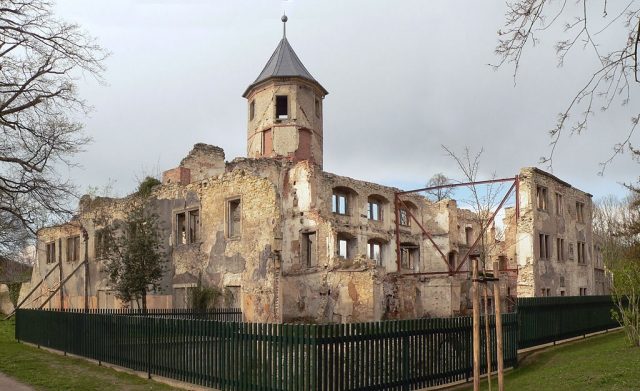
Harbke Castle is a stately home built on the foundations of a medieval circular castle in the municipality of Harbke, Saxony-Anhalt, which today only remains as a ruin. The castle and its predecessor were built by the noble family Veltheim in the 14th century. The estate remained in family ownership until their forced expropriation by the communists at the end of the Second World War.
In 1308, the manorial rights over the village of Harbke passed to Bertram and Ludolf von Veltheim. They then built the moated castle "Hertbike" in a water-rich hollow on the outskirts of the village, which was protected by a double water and ditch system. Between 1572 and 1586, Achaz von Veltheim built a Renaissance castle complex on the foundations of this circular castle. The new castle was characterized by two three-story wings, angled to each other, connected by a polygonal stair tower with a pointed roof in the southeastern castle area. The coat of arms of the Veltheim family and of Saldern, from which the wife originated, still adorns the remains of the castle facade.
On October 26, 1731, the building, except for the main building of the castle, was significantly damaged by a fire, so that from 1733, major restoration work had to be initiated on the outbuildings. Between 1751 and 1759, extensive alterations were carried out by the ducal master builder of the Principality of Brunswick-Wolfenbüttel, Martin Peltier de Belfort. The northwestern part of the courtyard was enclosed in the Baroque style, and an oval basin was laid out in the inner courtyard. From this time on, a closed four-wing complex existed.
Under Friedrich August von Veltheim, from 1740, the castle park was redesigned into a Baroque garden, supplemented with sculptures and a niche wall, the so-called "Chinese Wall". The botanist Johann Philipp Du Roi worked on the estate for several years and published his important dendrological treatise in 1771 under the title "Harbkesche wilde Baumzucht" (Harbke's Wild Tree Cultivation). This scientific work, among other things, prompted the botanically interested poet Johann Wolfgang von Goethe, accompanied by the Helmstedt university professor and Veltheim family doctor Gottfried Christoph Beireis, to visit the castle for several days in August 1805.
In 1825, a neo-Gothic library building was added to the castle ensemble.
At the end of the Second World War and after the invasion of the Red Army, the last owner of the castle, Karin von Veltheim, was expropriated. This ended a 637-year manorial rule of the Veltheims in Harbke.
During the GDR era, the castle was used as an orphanage until 1955 and then stood empty. The adjacent outbuildings were used by an Agricultural Production Cooperative (LPG). However, the main building of the castle was severely neglected, so it increasingly fell into disrepair and today only remains as a ruin.
Castle Park+
The park adjacent to the castle was laid out in the 18th century by Friedrich August von Veltheim with Baroque elements. The ginkgo tree planted in 1758 is considered one of the oldest in Germany. The first conversion measures to an English landscape garden began as early as 1760 by the gardener Daniel August Schwarzkopf, who had learned this design style during a trip to England. This garden redesign was largely completed in 1803 by Rüttger von Veltheim. A special focus was placed on the cultivation of foreign tree species. Harbke developed at that time into Germany's most important plant supplier. The park formerly housed around 300 rare woody species, of which about 100 species are still present in the park.
The "Lustwald" (Pleasure Forest) was created as an extension of the castle park in the middle of the 18th century and was intended to combine elements of economic use through forestry and garden art. Predominantly foreign woody plants were planted in this pleasure forest. According to the origin of the plants, the areas of this forest were called, among others, "Florida", "Lebanon" or "Ukraine".
In the park today there is still a Baroque niche wall from 1745, the so-called "Chinese Wall", with a depiction of Pomona.
The Protestant parish and castle church St. Levin is located in the southwestern park area and was built in 1572 on the rampart of the castle complex as a castle church and as a replacement for the Romanesque predecessor. Like the castle, the church was owned by the Veltheims until 1945 and also served as the family's burial church. The church building only received a square western transept tower with a curved dome in 1719. On the church facade there is a wooden sundial from 1640. The church has a late Baroque organ by Christoph Treutmann from 1727/28, whose pipework partly comes from the pre-organ by Gottfried Fritzsche from 1621/22. The church and the organ have been completely renovated in recent years and are now again available for church community life.
In the years 1830/31, an orangery in neo-Gothic style was built on the site of an old greenhouse. The orangery building in the park was built in the shape of an implied cross and was designed for the cultivation of tropical plants. The three large rooms of the orangery could be heated differently. The gable ends of the roof are provided with four large Gothic tulips. Above the entrance portal, the coat of arms of the von Bülow family was affixed, from which Friederike, the wife of the builder Röttger von Veltheim, originated. In recent years, the building has been extensively renovated and now houses a café during the summer months.
The castle park is part of the "Gartenträume Sachsen-Anhalt" (Garden Dreams Saxony-Anhalt) project.
Take Mobile History with you
You are reading this text for free. Premium adds what matters on the road: descriptions read aloud, sites found through your camera, whole regions taken offline.
- Every description, including the ~17,700 Premium sites
- Audio guide: have descriptions read to you on location
- AR finder: see sites through your camera, with distance and bearing
- Unlimited saved sites
14 days free, then from €2.99 a month. Cancel anytime.
Source: Wikipedia · Licence: CC BY-SA 4.0 · Image: http://commons.wikimedia.org/wiki/File:Schloss_Harbke_%C3%9Cbersicht.jpg
This description draws on the facts documented in the linked Wikipedia article; Wikipedia content is licensed under CC BY-SA 4.0. Wording and editing: Mobile History.
Location: 52.1912, 11.0475