Music school
CastleHeidelberg-Handschuhsheim
Handschuhsheim Castle
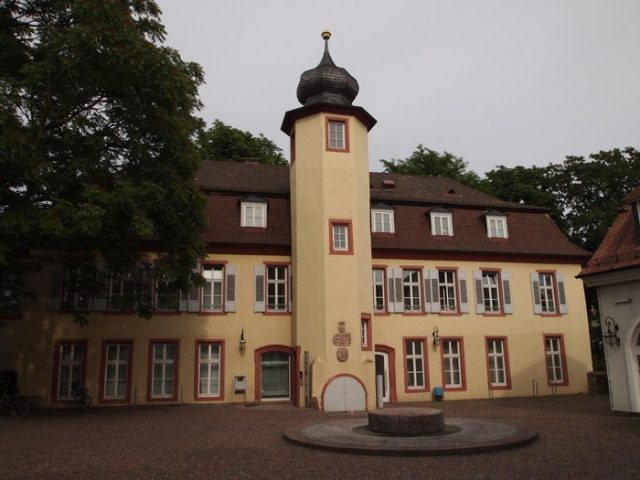
The "Schlösschen" (small castle) in Handschuhsheim dates back to a smaller late medieval noble residence in direct proximity to the Handschuhsheim Tiefburg (moated castle). The listed building has been extensively rebuilt and has a checkered history of ownership. The oldest part of the building is the distinctive stair tower from the early 17th century. The building has been owned by the city of Heidelberg since the First World War and now serves cultural purposes. The orangery of the Schlösschen was named after the painter Carl Rottmann, who was born in Handschuhsheim and whose grandfather once owned the property.
The property next to the Tiefburg was first mentioned in the 15th century as the Knebelhof. The Knebel family belonged to the regional lower nobility. Heinrich V von Handschuhsheim (1405–1431) was married to Margarete Knebel. Barbara von Handschuhsheim († 1588) married Dam Knebel († 1579), who was the owner of the court. From him, the court passed to Philipp Knebel, who was married to Elisabeth von Helmstatt. Their son Dam Philipp Knebel († 1613) had the manor house of the court renovated in 1609. The stair tower from this new building has been preserved to this day. From Dam Philipp Knebel, the court passed to his brother-in-law Pleickard XIV Landschad von Steinach and from him by inheritance to his sister Agnes. After the extinction of the Lords Landschad von Steinach in the male line, the court passed to Pleikard XIV's daughter Ursula Christina, who was married to Philipp Ernst von Venningen. The Lords von Venningen sold the property in 1659 to Friedrich von Landas. In 1674, the court was destroyed. In 1677, the estate passed to Landas' son-in-law, a Mr. von Lenthe, who restored the manor house. In the Palatinate War of Succession, the manor house was again destroyed, with the tower once again holding firm. Around 1700, the house was restored to its present form. In 1701, Colonel Johann Friedrich Strup von Gelnhausen acquired the property and had the manor house extended with an orangery. By inheritance, the property passed to the Counts von Waxenstein, who sold it in 1725 to the government councilor Josef Benedikt von Jungwirth. His descendants sold the estate to the administration councilor Johann Ludwig Harscher, who sold it to his cousin Nikolaus Hummel. From 1769 to 1778, Stephan Gugenmus (1740–1778) was the tenant of the property. He reformed agriculture in Handschuhsheim by abolishing the three-field system and made Handschuhsheim an important vegetable growing location. In 1783, the orphanage administrator Carl Franz Josef Rottmann acquired the property. His grandson Carl Rottmann (1797–1850) was a significant painter. In 1837, Carl Adolf Uhde (1792–1856) acquired the property. As a collector of antiquities and natural objects, he used the building to house his collections and also had the park around the Schlösschen laid out. In 1861, the mine owner John Benjamin Graham (1813–1876) acquired the property. He bequeathed it to his son, the parliamentarian Harry Robert Graham († 1933), who mostly resided in England. The city of Heidelberg had already sought to acquire the Schlösschen before the First World War, but the outbreak of the war brought the negotiations to a standstill. As the confiscation of the English-owned property threatened, Graham's administrator Jakob Pollich acquired the property during the war. In 1916, he conducted renewed purchase negotiations with the city of Heidelberg, which were finally successful. The city used the building as a youth hostel from 1919 onwards. In 1928, some outbuildings were renovated, and subsequently, the Schlösschen was converted into a special school. Since a comprehensive renovation in 1974/75, the Schlösschen has served as a music school, and in 1984/85, the building was structurally extended with modern event rooms.
Take Mobile History with you
You are reading this text for free. Premium adds what matters on the road: descriptions read aloud, sites found through your camera, whole regions taken offline.
- Every description, including the ~17,700 Premium sites
- Audio guide: have descriptions read to you on location
- AR finder: see sites through your camera, with distance and bearing
- Unlimited saved sites
14 days free, then from €2.99 a month. Cancel anytime.
Source: Wikipedia · Licence: CC BY-SA 4.0 · Image: http://www.wehrbauten.de/thread.php?threadid=976
This description draws on the facts documented in the linked Wikipedia article; Wikipedia content is licensed under CC BY-SA 4.0. Wording and editing: Mobile History.
Location: 49.4275, 8.6862