Museum
CastleFußgönheim
Hallberg Castle
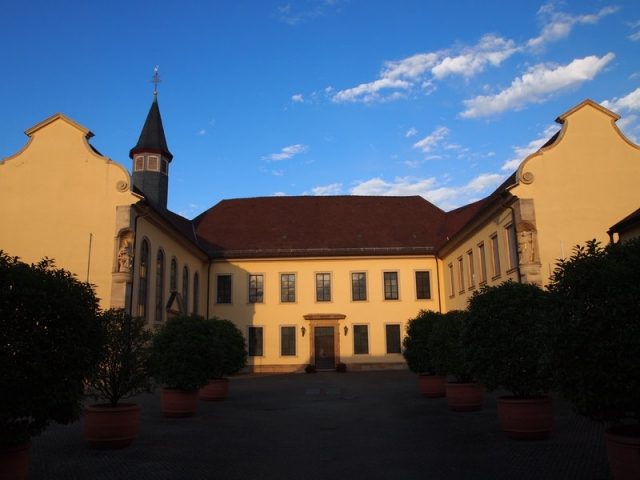
Hallberg Castle (also: Hallbergsches Schloss) is a castle complex in the Rhineland-Palatinate municipality of Fußgönheim in the Rhein-Pfalz-Kreis.
The castle is located on the eastern edge of the village and was built between 1728 and 1731 for the Electorate of the Palatinate Chancellor Baron Jakob Tillmann von Hallberg. The lord of the manor set up an entire wing as a church, opened it as a house of worship for the Catholics of the area, and in 1742, for the first time since the Reformation, established a Catholic parish in Fußgönheim. For the church, he commissioned an altarpiece from Giovanni Antonio Pellegrini, who also painted Mannheim Palace. According to local tradition, recorded by the local pastor Stephan Lederer, Jakob Tillmann von Hallberg is depicted as a figure on it; the only known representation of him. According to the local chronicle, the castle church was completed in 1741. It is the current northwest wing of the entire complex, with a roof turret. Its baroque interior is completely preserved.
From 1788 to 1792, Heinrich Theodor von Hallberg (1725–1792), Electorate of the Palatinate-Bavarian envoy in Vienna, was the lord of the castle.
In 1815, Hallberg Castle was forcibly auctioned and subsequently changed owners several times. It was used as a shop, barn, and warehouse. Among other things, a cigar factory, a prisoner-of-war camp, and a Raiffeisen warehouse were housed in the castle.
In 1972, the castle was acquired by the Catholic parish of Fußgönheim and extensively restored. A large church room was set up in the formerly secular central part and partly furnished with baroque inventory. This is the current Catholic Church of St. Jakobus. The historic castle church now merely forms its side chapel.
The district of Ludwigshafen gratuitously transferred its partial ownership to the Catholic parish. In 1983 and 1984, the former castle garden was restored and made accessible to the public.
The members of the local history and cultural promotion association participated in the renovation of the castle and set up a local history museum in the building.
Hallberg Crypt+
Jakob Tillmann von Hallberg died in 1744 and was buried in the Garrison Church in Mannheim. His wife, who died in 1739, also rested there. The gravestone inscriptions of both were handed down by the state historian Johann Franz Capellini von Wickenburg in the "Thesaurus Palatinus". The Garrison Church was already demolished in 1780, but its floor plan is made visible in the street paving of today's Toulonplatz. The crypt under the church remained preserved and fell into oblivion. It was only discovered in 1979 during construction work. The remains of the Hallberg couple were also found there and reinterred in 2003, in a new sarcophagus, in an unused crypt under the castle church of Fußgönheim. From the castle courtyard, one can look into the crypt through a window, and a memorial plaque was placed there for the builder of the castle, who posthumously found his final resting place here.
Take Mobile History with you
You are reading this text for free. Premium adds what matters on the road: descriptions read aloud, sites found through your camera, whole regions taken offline.
- Every description, including the ~17,700 Premium sites
- Audio guide: have descriptions read to you on location
- AR finder: see sites through your camera, with distance and bearing
- Unlimited saved sites
14 days free, then from €2.99 a month. Cancel anytime.
Source: Wikipedia · Licence: CC BY-SA 4.0 · Image: http://www.wehrbauten.de/thread.php?threadid=1348
This description draws on the facts documented in the linked Wikipedia article; Wikipedia content is licensed under CC BY-SA 4.0. Wording and editing: Mobile History.
Location: 49.4576, 8.2946