To be privately owned
CastleKleinmachnow
Hakeburg Castle
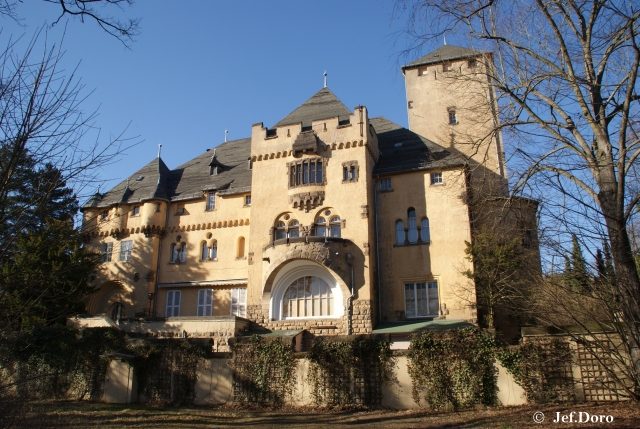
The Hakeburg is a large castle-like country house in Kleinmachnow, a town south of Berlin. It is located on the Seeberg on the north side of Lake Machnow, near the Teltow Canal lock in Kleinmachnow, and offers a view over the Bäkental nature reserve.
The Noble Family of Hake+
The owners of the manor and the Hakeburg, later built in a different location, were the von Hake family. The most famous members of the von Hake family were:
- the "tall" Hake, Hans Christoph Friedrich von Hacke, colonel and adjutant general to Frederick William I, appointed by Frederick II as the first knight of the newly founded Order Pour le Mérite and commander of Berlin. In 1751, in front of the newly built Spandauer Tor, he laid out the "Neue Promenade" and the "Hackescher Markt".
- Hans von Hake (1472-1541), known as Hake von Stülpe, who, according to legend, took Tetzel's money chest (now preserved as the Tetzelkasten in St. Nikolai Church (Jüterbog)) in a wild winter night in the Golmheide between Luckenwalde and Jüterbog, after having acquired an indulgence letter for it.
The Old Hakeburg+
At the beginning of the 14th century, there was already a fortified castle in Kleinmachnow. At that time, the von Löwenberg family and the mint master Thile Brügge, and after them the von Quast family, were the owners of the small Märkisch village. At the beginning of the 15th century, the feudal possession of the estates of Kleinmachnow and Stahnsdorf passed to the von Hake family, who would soon settle on the manor themselves. The manor is located behind a water mill (according to an inscription built in 1695 by Ernst Ludwig von Hake and renovated in 1856 by the von Hake brothers); here, at the entrance to the right of the village road, was the old castle, of which only remnants of the foundations remain.
The Burial Vault of the von Hake Family in the Nearby Church+
Opposite the old manor lies the Old Village Church, shaded by trees, a remarkable Gothic brick building from the 16th century, with a strong tower and cross vault. Inside are various mementos of the von Hake family: remnants of ten flags dedicated by Ernst Ludwig von Hake (1651–1713) to his brothers who fell in the Turkish Wars, a memorial stone erected by the same in memory of his parents, and above it a rapier and two spurs belonging to Herr von Schlabrendorf, who fell in a duel. Furthermore, there is the epitaph of General Friedrich von Hake (died 1743) and several coat of arms panels. Beneath the church lies the burial vault of the von Hake family.
For the old castle, the estate, and the water mill, see: Hake'scher Gutshof with Castle and Palace
The New Hakeburg+
At some distance from the old manor, on the Seeberg on the other side of Lake Machnow, is the so-called New Hakeburg. It was built between 1906 and 1908 for Dietloff von Hake, the cousin of the then lord of the manor, by architect Bodo von Ebhardt in the Neo-Romanesque castle style.
Due to financial problems, the building, including 44 hectares of land, was sold to the Reichspost in 1936, which used the site until 1945 as the residence of Reich Post Minister Wilhelm Ohnesorge and, in parallel, as a research and testing center for various types of aircraft, especially "flying wings," radar systems, transmitting units, control devices, broadband cables, and general radio and television equipment. These projects were managed by the SS Economic and Administrative Main Office (WVHA).
On December 2, 1943, a British Lancaster bomber was shot down over Hakeburg. The Norwegian writer Nordahl Grieg also died in the crash.
In the Soviet Occupation Zone and later in the GDR, the castle served as the SED party school from 1948, with lecturers including Wolfgang Leonhard and Carola Stern. Later, the Hakeburg temporarily housed the Joliot-Curie Intelligence Club and was subsequently converted into a guesthouse for the SED. Statesmen such as Nikita Khrushchev, Fidel Castro, Yasser Arafat, and Mikhail Gorbachev resided here.
After the Peaceful Revolution, the Hotelbetrieb Hakeburg GmbH was founded in May 1990. As determined by the Independent Commission for the Review of the Assets of Parties and Mass Organizations of the GDR (UKVP), it received an operating loan of 50,000 D-Mark from the PDS in 1990 as part of its illegal asset transfers. The money later had to be repaid. After reunification, Deutsche Telekom became the owner of the property. Currently, the Hakeburg is owned by ORCO Germany S.A. and held by a subsidiary, Vivaro GmbH & Co 2. Grundbesitz KG. The latter planned to use the Hakeburg as a hotel, including the construction of a bed house and an underground car park, which was laid down in the municipality's development plan adopted in 2010. Since no reputable hotel operator was found, a new use involving the installation of 16 condominiums has been sought since 2012.
From summer 2005 to August 2006, ZDF filmed the exterior shots for the telenovela Wege zum Glück on the Hakeburg grounds. The Hakeburg served as the exterior motif for Villa Gravenberg.
Since October 1999, the Hakeburg has been claimed by the self-proclaimed exile government of the micronation of Sealand, because they (allegedly) leased it for 99 years.
Take Mobile History with you
You are reading this text for free. Premium adds what matters on the road: descriptions read aloud, sites found through your camera, whole regions taken offline.
- Every description, including the ~17,700 Premium sites
- Audio guide: have descriptions read to you on location
- AR finder: see sites through your camera, with distance and bearing
- Unlimited saved sites
14 days free, then from €2.99 a month. Cancel anytime.
Source: Wikipedia · Licence: CC BY-SA 4.0 · Image: Jörg Dorowski
This description draws on the facts documented in the linked Wikipedia article; Wikipedia content is licensed under CC BY-SA 4.0. Wording and editing: Mobile History.
Location: 52.3989, 13.2194