To be privately owned
CastleHaidenburg
Haidenburg Castle
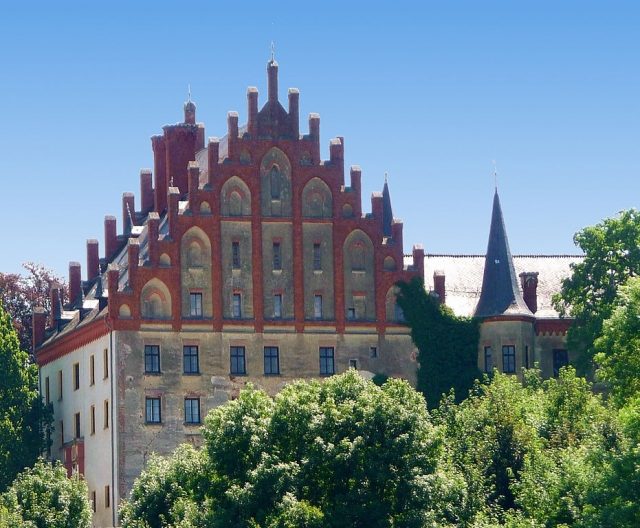
Haidenburg Castle is a former medieval castle and current Renaissance palace complex on the eastern slope of the Sulzbach valley. It is located in the Haidenburg district of the municipality of Aldersbach, Passau district. The castle was once a noble residence, but has been in private ownership since 1972.
The founding of the castle complex is attributed to a vassal of Bishop Patrick of Regensburg. Around the year 1160, Haidenburg came into the possession of the noble free lords of Kamm. From 1189, they named themselves after their inherited possession of Hals near Passau. In 1280, they were elevated to the status of Imperial Counts.
Under the Halsers, the neighboring Aidenbach was granted market rights. However, these could only be used to a limited extent, as the town was subordinate to the lordship of Haidenburg.
In 1375, Leopold von Hals, the last of his lineage, died. His heirs were initially his close relatives, the Landgraves of Leuchtenberg. However, other families soon laid claim to Leopold's extensive inheritance, including the neighboring Imperial Counts of Ortenburg. Heinrich IV von Ortenburg claimed the entire inheritance due to his marriage to a Halser countess. This led to a years-long inheritance dispute, which was only settled in 1379. The Leuchtenbergers and the Ortenburgers contractually regulated how the inheritance was to be distributed. The Counts of Ortenburg received the lordships of Leonberg with Tann, Baumgarten, Haarbach near Geisenhausen, Ganghofen and Hof, as well as tithes in Mamming. The Landgraves of Leuchtenberg received the County of Hals, Osterhofen, Haidenburg with Aidenbach, Göttersdorf, and the estates located on the Vils and Wolfach rivers.
In 1423, Landgraves Johann III and Georg III sold Haidenburg Castle to Knight Johann von Frauenberg. The Frauenberg family died out in the male line in 1508. Since the children from the third marriage of the last Frauenberger were still minors, his son-in-law Alban von Closen, court marshal to Duke Ludwig VII, managed to acquire Haidenburg. Together with his brother, he succeeded through purchase and contracts in definitively securing the lordship and Haidenburg Castle. The castle then remained in the possession of the Closen family until the second half of the 18th century. The family consistently expanded their possessions around the lordship and Haidenburg Castle in the following generations.
Around the year 1503, Wolfgang von Closen, Prince-Bishop of Passau from 1555 to 1561, was born at Haidenburg Castle.
In 1608, Wolf Friedrich von Closen had the old medieval castle complex demolished, except for the castle chapel of St. Anna. Subsequently, Haidenburg was rebuilt in the Renaissance style as a castle on the old foundations. A further expansion of the complex took place around 1730 under Georg Joseph Anton von Closen, who died in 1736. The castle complex was extended by the three-aisled stable and the Nepomuk fountain. In the castle itself, richly decorated rooms and a large ballroom were built on the upper floors.
In 1762, the heavily indebted lordship of Haidenburg was lost by court order from the Closen family to the Counts of Taufkirchen. These sold Haidenburg Castle, including its forest and agricultural land, to Baron Johann Adam von Aretin, brother of Johann Christoph von Aretin. Subsequently, the Barons von Aretin succeeded in establishing a significant lordship with numerous Hofmarken between the Vils and Rott rivers, with Haidenburg as its center, by the mid-19th century.
In 1871, Haidenburg Castle fell victim to a fire, which completely destroyed the roof truss and the upper two floors. The subsequent reconstruction took place in the Neo-Gothic style, in keeping with the spirit of the time.
The Barons von Aretin inhabited the castle until 1962. Subsequently, they built a new and smaller manor house on an adjacent property. Haidenburg Castle was sold by them to Josef Stampfl in 1972. Since then, the Stampfl family has owned the castle complex and is constantly renovating it. Today, the castle is made accessible by them for events.
Take Mobile History with you
You are reading this text for free. Premium adds what matters on the road: descriptions read aloud, sites found through your camera, whole regions taken offline.
- Every description, including the ~17,700 Premium sites
- Audio guide: have descriptions read to you on location
- AR finder: see sites through your camera, with distance and bearing
- Unlimited saved sites
14 days free, then from €2.99 a month. Cancel anytime.
Source: Wikipedia · Licence: CC BY-SA 4.0
This description draws on the facts documented in the linked Wikipedia article; Wikipedia content is licensed under CC BY-SA 4.0. Wording and editing: Mobile History.
Location: 48.5670, 13.0239