Art and Auction House
CastleHagenburg
Hagenburg Castle
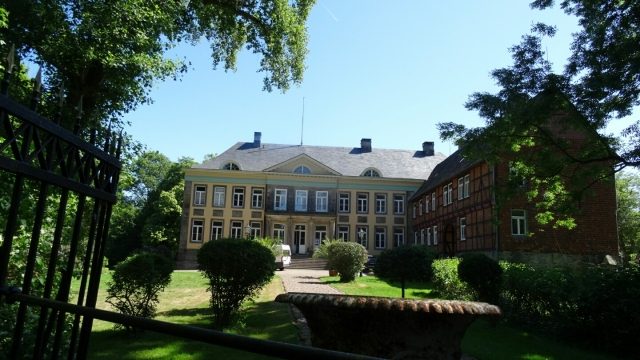
Hagenburg Castle is a small castle complex in Hagenburg/Lower Saxony, which served for a long time as the summer residence of the House of Schaumburg-Lippe. It is connected to Lake Steinhude by the 1.2-kilometer-long Hagenburg Canal on the edge of the Hagenburg Moor.
Hagenburg Castle, as the predecessor of Hagenburg Palace, was first mentioned in a document in 1369 as Hagenborch. It is likely to date back to the Counts of Schaumburg when they gained a foothold on Lake Steinhude in the 14th century. The castle probably served in the early 14th century to secure the settlement of Hagenburg, which emerged in the second half of the 13th century. From the 14th century onwards, the castle was often pledged and later served as the administrative seat of the Hagenburg office, whose owner from 1558 was Ludolf Klencke. In 1558, Klencke had a gatehouse built and the castle renovated. He installed a spiral staircase in the residential wing. His son Ernst Ludolf initiated some renovations and the construction of a sheepfold in 1574.
In 1686, under Friedrich Christian, Count of Schaumburg-Lippe, the complex was extended by the half-timbered south wing with a stone plinth and passage. A short time later, the east wing was added, which gave way to a neoclassical building at the end of the 18th century. After damage to the castle was reported several times in the 1720s, major repair measures were carried out in 1733. Ten years later, the Rentkammer (Chamber of Finance) had a new gatehouse built.
Already towards the end of the 18th century, the buildings no longer seemed to meet the requirements, as Princess Juliane of Hesse-Philippsthal initiated a conversion into a "pleasure palace with convenience". The first designs by the architect Clemens August von Vagedes are said to have been created in the autumn of 1791. On November 17, 1792, Vagedes submitted his building plans, which, however, did not appeal to the princess. Only the drawings submitted in January of the following year found the approval of the client. Construction began in the spring of 1793. In 1794, the interior was expanded, with the execution of the interior decorations only being completed after Vagedes' death in 1795. In the spring of 1798, the furnishing of the interiors began. Princess Juliane did not live to see the completion of her castle, as she died on November 9, 1799, at the age of 38. In 1800, the building was largely completed.
The castle, which could only be maintained with great financial effort, was sold with its outbuildings by the House of Schaumburg-Lippe in 2005. Today it houses an art and auction house.
Building Description+
The current castle building is an L-shaped complex that shows hardly any medieval building fabric, but is said to originate from the 16th century at its core. The castle is likely to reflect the floor plan of the previous castle. The half-timbered south wing, with a passage, rises above a high stone plinth. A coat of arms attached here is marked "1686". The slightly higher east wing is also half-timbered on the south and east sides. However, the half-timbering on the back is not openly visible: it is clad with wood. On the west and north sides, the Corps de Logis is, however, built of stone. The plastered courtyard facade is accentuated by a three-axis central risalit, in front of which a portico with Tuscan columns is placed in the entrance area.
The castle is located at the end of the 1.2-kilometer-long Hagenburg Canal, which leads as a branch canal to Lake Steinhude. It was built in the 1760s to transport building materials for the artificial island Wilhelmstein by boat.
Park+
Hagenburg Castle is surrounded by a publicly accessible landscape park with old trees; a rhododendron avenue lined with swamp cypresses leads directly to the central risalit of the main building. The park offers a suitable habitat for a variety of forest-dwelling birds. Numerous cavity nesters such as spotted flycatcher, pied flycatcher, nuthatch, and several tit species have been identified as breeding birds. Furthermore, green, great spotted, middle spotted, and lesser spotted woodpeckers, as well as golden orioles, have been observed. Tawny owls and common buzzards are also said to breed in the park. The dense undergrowth is inhabited by blackcaps and garden warblers, robins, chiffchaffs, and nightingales. As late as 1964, white storks bred on the central chimney of the main building. The kingfisher is frequently seen on the Hagenburg Canal.
Take Mobile History with you
You are reading this text for free. Premium adds what matters on the road: descriptions read aloud, sites found through your camera, whole regions taken offline.
- Every description, including the ~17,700 Premium sites
- Audio guide: have descriptions read to you on location
- AR finder: see sites through your camera, with distance and bearing
- Unlimited saved sites
14 days free, then from €2.99 a month. Cancel anytime.
Source: Wikipedia · Licence: CC BY-SA 4.0 · Image: Jörg Heldt
This description draws on the facts documented in the linked Wikipedia article; Wikipedia content is licensed under CC BY-SA 4.0. Wording and editing: Mobile History.
Location: 52.4358, 9.3197