To be privately owned
CastleFallbach-Hagenberg
Hagenberg Castle
Ulrich von Liechtenstein reported about a Heinrich von Hakenberc, who accompanied Duke Leopold VI to the Friesach tournament in 1224. He was a ministerialis of the regional prince and probably came from the Kuenringer family.
He is probably identical with Marshal Heinrich von Hackingen, who went to the Holy Land as a comrade-in-arms of Duke Leopold. After his return, he handed over the fortified hill, which had wooden fortifications, to the church and built a "Festes Haus" (fortified house) in the marshy area. The castle was first mentioned in a document in his will, written in 1264. The Hakenbergers died out in 1382 with Heinrich V. The heir was Alber Stuchs von Trautmannsdorf, to whom the Hagenberg fortress had already been pledged.
In 1414, the castle came into the possession of the Nikolsburg line of the Liechtenstein family. Rudolf von Tiernstein had acquired the lordship in 1455, but the Liechtensteins exercised their right of repurchase as early as 1460. Reinprecht von Wallsee also did not own Hakenberg for long. He sold it in 1479 to Görig and Michael Behaimb from Nuremberg. In 1496, they received permission from Emperor Maximilian I to restore the defensive structure, which had been devastated by Hungarian troops. In 1543, Christoph von Kienritz bought the castle. He transformed the building, which still bore medieval features, into a habitable Renaissance castle. During the Thirty Years' War, the devastated castle was temporarily under the administration of Count Siegfried Breuner. In 1650, the Kienritz family sold the lordship to Sigismund Friedrich Graf Sinzendorf, but the estate had probably been administered by him since 1621.
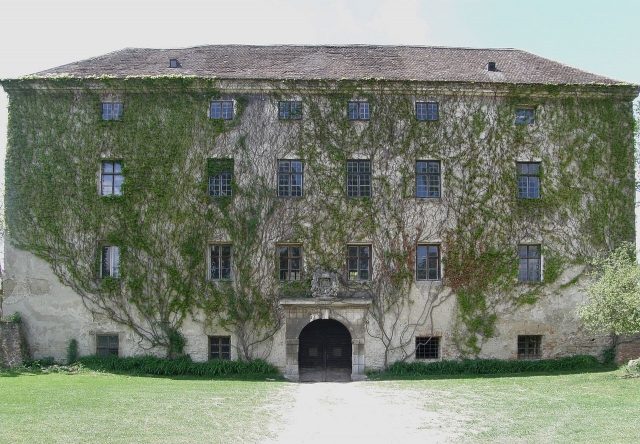
At the time of the Turkish invasions, Hagenberg must have been well-equipped, as it was assigned to the population as a refuge in 1663. At that time, a 30 m wide moat with four bastions was built in place of the old surrounding wall. From 1679, the nephew of Imperial Count Sigismund Friedrich, Theodor Graf Sinzendorf, had the Renaissance castle of the Kienritz family renovated. Imperial Count Prosper von Sinzendorf, who was elevated to prince in 1803, united all the family's entails in one hand. In 1822, Prince Prosper, the last Sinzendorfer, died. His inheritance fell, after a six-year lawsuit, to Imperial Prince Heinrich IV von Reuß-Köstritz, who came from Thuringia. Hagenberg now declined to a mere estate. At the end of the 19th century, the baroque garden was abandoned and used for agriculture. The castle lost its interior furnishings and served as a granary.
In 1945, the estate was confiscated as German property and placed under Russian administration. After the State Treaty of 1955, the Reuß family received Hagenberg back. After the agricultural land was sold in 1959, the building stood empty and threatened to be demolished. In 1974, the castle and moat were finally sold to Captain Josef Steiger, who undertook some improvements to the situation. In 1986, Horst von Wächter took over the complex, which he partially made habitable again. In 1992, the association "Initiative Hagenberg" was founded, which is striving for a revitalization of the complex, which is still far from being completely renovated.
Take Mobile History with you
You are reading this text for free. Premium adds what matters on the road: descriptions read aloud, sites found through your camera, whole regions taken offline.
- Every description, including the ~17,700 Premium sites
- Audio guide: have descriptions read to you on location
- AR finder: see sites through your camera, with distance and bearing
- Unlimited saved sites
14 days free, then from €2.99 a month. Cancel anytime.
Source: Wikipedia · Licence: CC BY-SA 4.0 · Image: https://commons.wikimedia.org/wiki/File:NOE_Hagenberg_Schloss.jpg
This description draws on the facts documented in the linked Wikipedia article; Wikipedia content is licensed under CC BY-SA 4.0. Wording and editing: Mobile History.
Location: 48.6320, 16.4501