Museum
CastleEmmerthal - Hämelschenburg
Hämelschenburg Castle
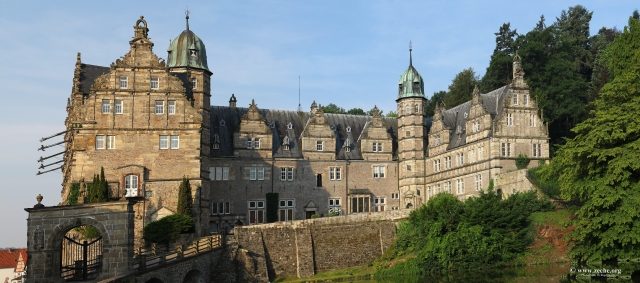
Hämelschenburg Castle in Emmerthal in the Weserbergland region, between Hameln and Bad Pyrmont, is considered a masterpiece of Weser Renaissance architecture. With its art collections, gardens, watermill, farm buildings, and church, it forms one of Germany's most beautiful Renaissance complexes. It is an essential part of the Weser Renaissance Road and is located on the Niedersachsenweg trail.
Origin
Between 1409 and 1414, the Counts of Everstein built Hemersen Castle on Woldau Hill above the Emmer Valley. From 1437, it came into the possession of the knightly family Klencke, who originated from Thedinghausen and can be traced back there to the year 1260. In 1487, the castle became involved in the Great City Feud, siding against the Welfs. It was destroyed under Duke Wilhelm of Braunschweig-Lüneburg. Afterwards, the knightly family Klencke rebuilt Hemersen Castle. The name Hämelschenburg, used from then on, arose from dialect changes of the original name Hemersenburg, which in turn originated from Herrmann sin Burg after Herrmann von Everstein. In 1544, the entire complex, including the lower-lying castle church, burned down completely.
Construction of the Castle
The economic boom between 1520 and 1620 brought lively construction activity to the Weserbergland. On both sides of the Weser, many castles were newly built or significantly redesigned by the nobility and regional rulers. Weser sandstone (yellow and easy to carve from the right bank of the Weser, red and significantly harder from the left bank of the Weser) was a coveted building material for facades, floors, and roof coverings throughout Northwest and Northern Europe. In 1588, Jürgen Klencke (1551–1609; served at the Count's court in Nienburg/Weser and rose to cavalry captain as a mercenary) and his wife Anna von Holle, highly educated niece of the Bishop of Lübeck Eberhard von Holle from Verden and Colonel Georg von Holle, had Hämelschenburg rebuilt as a moated castle in the Weser Renaissance style at a new location directly on the Emmer river. The funds for this came partly from tolls levied on the road crossing the estate and partly from enormous profits from a thriving grain trade.
During the thirty-year construction period, the enclosed farmyard, already built by Jürgen Klencke's uncle, Ludolf Klencke, directly on the Emmer, served the builder and his wife as a modest dwelling until the north wing of the complex, planned as a continuous three-wing building, was completed. The central and south wings, along with two octagonal stair towers built in the Italian Renaissance style, followed gradually. Jürgen Klencke did not live to see the completion of the castle; he died in 1609.
Jürgen Klencke and Anna von Holle had 14 children together, 12 of whom reached adulthood, an extraordinary number for that time with high child mortality. The eldest son took over the castle after his father's death and, together with his mother, had the construction completed.
Alliances
During the Thirty Years' War, Anna von Holle managed to protect Hämelschenburg Castle and its associated St. Marien Chapel through alliances. The courageous lady of the castle rode out to meet the advancing troops under Tilly and negotiated a protection treaty with the general, which forbade his soldiers, under threat of death, from entering Hämelschenburg. She thus saved the entire complex from looting and destruction.
During the Seven Years' War (1756–1763), Hämelschenburg was occupied, and parts of the interior disappeared, but through skillful maneuvering by the castle lords, worse was averted. Thus, the entire complex with its four elaborately designed gables, 17 dormer windows, the two tall, copper-roofed stair towers, two ground-level, double-story bay windows (so-called "Ausluchten"), several portals, and a magnificent access bridge over the carp-filled castle pond has been completely preserved to this day.
Period of National Socialism
During the National Socialist era, the castle lords explicitly opposed the political regime by invoking the principle, documented in their knightly family, of God's supreme rule over worldly powers. This principle was symbolized by the placement of a group of figures. Above the fireplace in the dining room on the ground floor of the west wing, Jürgen Klencke and his wife Anna von Holle kneel with their 14 children (today 13, one was stolen) beneath the crucifix. Surprisingly, this stance was respected by the NSDAP, and the adjacent village of Hämelschenburg also remained without a local group leader. The only affront by the ruling power can be interpreted as the widening of the state road through the castle ensemble around 1939, which served to facilitate the arrival of Nazi supporters for the Reichserntedankfest (Reich Harvest Thanksgiving Festival) on the Bückeberg near Hameln.
In contrast, the castle church was explicitly opened on Sundays for Polish foreign workers employed in the surrounding agriculture to attend divine service.
The financing of the castle during this period was achieved, among other things, by paying noble "holiday guests," who were, however, unequivocally prohibited from making political statements by a four-sided banner hung above the dining table.
Modernization
In the 19th and 20th centuries, Hämelschenburg Castle was adapted to the requirements of modern living. Thus, between 1845 and 1850, the high rampart on the west and east sides was removed, and the moat on the north side was filled in. The red sandstone roofing was replaced by lighter slate roofing by 1974, and additional dormer windows were added. The original plaster was removed, and the rubble masonry was exposed. The formerly external pilgrim hall was moved indoors, and finally, the entire castle was equipped with modern central heating. However, these alterations did not impair the historical appearance.
Presumed Architects
The architects of the castle are not documented by name. The multitude of building lodges and architectural schools of that time only allows for a generalized conjecture. Almost identical stylistic details of Cord Tönnies, the proven master builder of the house Osterstraße 9 in Hameln, who also worked on the castles of Detmold and Schwöbber as well as on the archive house in Rinteln, can be recognized on the facades of Hämelschenburg. Details of the design of the gables of the north and west wings are identical to works by the master builders Eberhard Wilkening and Johann Hundertossen, though the latter is recently disputed again. Hundertossen is considered the master builder of the Münchhausen castles Schwedesdorf in Lauenau and Bevern; the builder in Bevern, Statius von Münchhausen, was a cousin of Jürgen Klencke (their mothers were sisters), Münchhausen's second wife was Jürgen's niece; Statius was demonstrably in close exchange with the Klenckes about their mutual building projects.
Incorporation
On January 1, 1973, the municipality of Hämelschenburg was incorporated into the new municipality of Emmerthal.
Museum+
Since 1973, Hämelschenburg Castle, owned by Lippold von Klencke, has been partially accessible as a private museum through guided tours and contains in this area a completely preserved collection of furniture, paintings, porcelain, glass, and weapons from the Renaissance, Baroque, and Gründerzeit periods. Approximately one-third of the rooms are shown. The others are rented out and inhabited by private individuals.
Remarkable is the front of the "Pilgrim Hall" now integrated into the entrance hall (formerly the living room). Two columns crowned with scallop shells modeled in sandstone frame a serving hatch that promised food and lodging to pilgrims on their way from the north to Santiago de Compostela in Spain. This promise is still upheld today. For example, a Danish pilgrim stayed free of charge at the castle for two days in 2005.
The castle also offers bridal couples civil ceremonies in a historic setting. In the wedding room, there is one of the few surviving self-playing pianolas by Steinway & Sons, operated by pedal pressure.
The nearly hour-long guided tours of the private property begin between Easter and October 3rd, on the hour from 10 am to 12 pm and from 2 pm to 5 pm.
St. Marien Church+
Building History
Nestled within the unique Renaissance ensemble is the castle chapel, built in 1563, which became the parish church of Hämelschenburg in 1652. It was erected on the remains of a chapel consecrated as early as 1409, which also fell victim to the fire of 1544. The Klencke family crypt located beneath the church remained unharmed. Ludolf Klencke had already rebuilt the church on its old foundations in 1563, which explains its somewhat skewed position relative to the overall complex today. The church is thus one of the first churches in Northern Germany built after the Reformation. It is the oldest freestanding Protestant church in Germany, its consecration 450 years ago was commemorated on September 15, 2013.
Furnishings
Jürgen Klencke and his wife Anna von Holle furnished the church with rich Renaissance decorations until 1609, which have remained almost unchanged to this day. The interior is characterized by a reformatory design program: organ, altar, and baptismal font are located at the front of the house of worship.
The altar was carefully redesigned in 1913 during the last major church renovation, incorporating existing elements. The altar mensa still shows the consecration crosses from 1409. The Romanesque-influenced former altarpiece from 1919 was moved to the rear gallery and replaced by an oil print of the Last Supper after Leonardo da Vinci. Above the altar is the "Paradise Garden," created in 1480 by the Hildesheim School, which goes back to the motif "Mary in the Rose Garden."
The baptismal font, consisting of a sandstone column with a bowl and a wooden baptismal font cover, was created well before 1600. The cover is richly decorated with figures in the shape of a crown and is so heavy that it must be lifted with a winch running through the church ceiling. It is never fully lowered onto the baptismal font, so that a "floating state" is always visible to the congregation.
The original single-manual organ from 1672 was located above the altar until 1913 and was then renewed while retaining its baroque character and location, and fundamentally restored in 1970.
The pulpit on the right long side of the church and the so-called "men's gallery" on the left side with the lord of the manor's box beneath it give the church building a certain spaciousness, especially since the gallery balustrade has been adorned with the Klencke coats of arms since 1880. Next to the pulpit is the epitaph of the castle builders Jürgen Klencke and Anna von Holle with a round painting attributed to Lucas Cranach.
Current Use
On special holidays, the communion chalice, richly adorned with figures from Christian doctrine and gemstones, donated by Anne and Georg Klencke in 1604, and the accompanying simple paten are used. Both are made of gilded silver.
St. Marien Church can be visited free of charge under supervision on Saturdays and Sundays from 3 pm to 5 pm. This time restriction is intended to prevent thefts of the interior furnishings, as have occurred in the past.
Take Mobile History with you
You are reading this text for free. Premium adds what matters on the road: descriptions read aloud, sites found through your camera, whole regions taken offline.
- Every description, including the ~17,700 Premium sites
- Audio guide: have descriptions read to you on location
- AR finder: see sites through your camera, with distance and bearing
- Unlimited saved sites
14 days free, then from €2.99 a month. Cancel anytime.
Source: Wikipedia · Licence: CC BY-SA 4.0 · Image: www.zeche.org
This description draws on the facts documented in the linked Wikipedia article; Wikipedia content is licensed under CC BY-SA 4.0. Wording and editing: Mobile History.
Location: 52.0278, 9.3433