Cultural Events
To be privately owned
CastleHaddenhausen
Haddenhausen Castle
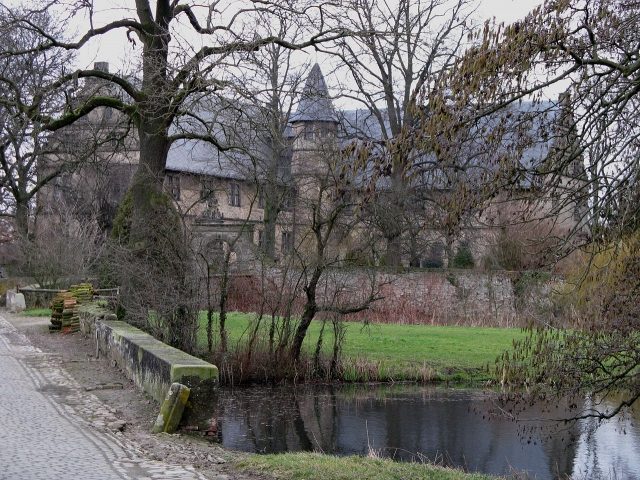
Haddenhausen Castle is a 17th-century castle built in the Weser Renaissance style, located north of the Haddenhausen district of the city of Minden in the Minden-Lübbecke district.
The origins of the estate lie in the 11th century, as the Bishop of Minden acquired the estate as early as 1254. At the end of the 14th century, the castellan of Vlotho, Ludolf von Mönnichhausen (Münchhausen), was pledged possession of the Haddenhausen estate by the Minden Bishop Gerhard III von Hoya.
Around 1460, the estate was destroyed in a feud between the Bishops of Minden and Osnabrück. From 1457, the estate was owned by the von Münchhausen family. When the Reformation was introduced in Minden, Johann von Münchhausen became a champion of Catholicism and instigated armed conflicts with the city of Minden, which ended in 1530 with his defeat and the destruction of the complex. His son Christoph von Münchhausen took over the Haddenhausen estate; his son Johann von Münchhausen was Bishop of Courland and Ösel and canon in Verden.
After a long dispute over ownership and the deterioration of financial circumstances, the estate was sold in 1610 to the von dem Bussche-Lohe family, who were related to the Münchhausens. Johann von dem Bussche then had the castle built in the Weser Renaissance style between 1613 and 1616. The master builder was Eberhard Wilkening, who also built the Pied Piper House in Hameln. It is a two-winged castle complex with a bay window, a stair tower, and many ornaments. South of the castle are farm buildings and the chapel.
Current Use+
The estate is privately used. The castle and castle garden are made accessible to visitors on Open Monument Days or during concerts.
Miscellaneous+
Claus von Amsberg's parents were the farmer Claus von Amsberg and his wife Gosta Freiin von dem Bussche-Haddenhausen.
The name von dem Bussche-Haddenhausen also appears in a report to the Foreign Office dated May 7, 1906: Embassy Councillor von dem Bussche-Haddenhausen rejected the accusations made by the British Embassy in Washington with the words that Oppenheim did not usually receive "official commissions from the imperial government," "as he was not highly regarded in the Foreign Office."
Take Mobile History with you
You are reading this text for free. Premium adds what matters on the road: descriptions read aloud, sites found through your camera, whole regions taken offline.
- Every description, including the ~17,700 Premium sites
- Audio guide: have descriptions read to you on location
- AR finder: see sites through your camera, with distance and bearing
- Unlimited saved sites
14 days free, then from €2.99 a month. Cancel anytime.
Source: Wikipedia · Licence: CC BY-SA 4.0
This description draws on the facts documented in the linked Wikipedia article; Wikipedia content is licensed under CC BY-SA 4.0. Wording and editing: Mobile History.
Location: 52.2802, 8.8318