Museum
CastleGüstrow
Güstrow Castle
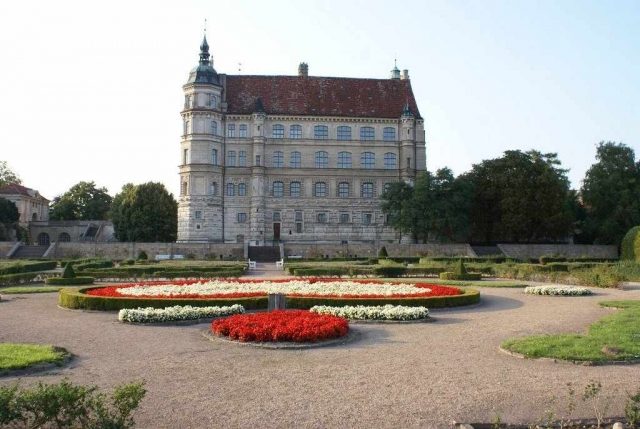
Güstrow Castle is a Renaissance-era castle, now a museum and cultural centre, located in Güstrow, Mecklenburg-Western Pomerania, Germany. Built from 1558 for Ulrich, Duke of Mecklenburg, it is situated towards the town wall, and is quadrangular in shape. The 16th-century castle features stucco decorations and a Baroque-classicist gatehouse, and contains a museum related to the male line of Duchess Elisabeth Sophie of Mecklenburg's family. Art exhibitions and concerts are also put on at the castle.
Construction of the present castle in Renaissance style was begun in 1558 by Ulrich, Duke of Mecklenburg, in place of a medieval castle. Franciscus Pahr was the master builder who constructed the additional south and west wings in a fusion of Italian, French, and German architectural styles—unique for the time and area. In 1657, Gustav Adolf, the last Duke of Güstrow, engaged Charles Philippe Dieussart to refurbish his castle in modern style. The Baroque gatehouse and the castle bridge were built during this time. After the end of ducal control, between 1817 and 1950, the castle became the farm house of Mecklenburg workers. Further restoration took place from 1963 to 1978, when the castle was restored to its original grandeur.
Features+
Güstrow Castle is quadrangular in shape. Some of the old furniture has been removed to Schwerin and other places following the death of Magdalena Sybilla which marked the end of the Güstrow lineage. In one part of the castle, there are well preserved Flemish paintings; one particular painting is of a Dutchman smoking. A theatre is in good shape with well preserved original stucco paintings. The stucco ceilings are retained in their original form in the castle. The banquet hall's ceiling has unique stucco paintings of hunting scenes which are adaptations from Dutch copper engravings. The medieval rooms in the basement of the castle, which are vaulted, have many artifacts of the medieval period of Germany. The art chamber contains exhibits of hunting and ceremonial weapons. The refurbished former dining halls, residential and reception rooms have exhibits of paintings of Cranach, Marten de Vos, and Tintoretto. Antique ceramic vessels and a large number of glass items are on display in the former chamber of the duchess. There are also displays from the 19th to 21st centuries.
The grounds contain stables and a well-tended garden. The garden has been redone with beds of lavender and walkways.
Take Mobile History with you
You are reading this text for free. Premium adds what matters on the road: descriptions read aloud, sites found through your camera, whole regions taken offline.
- Every description, including the ~17,700 Premium sites
- Audio guide: have descriptions read to you on location
- AR finder: see sites through your camera, with distance and bearing
- Unlimited saved sites
14 days free, then from €2.99 a month. Cancel anytime.
Source: Wikipedia · Licence: CC BY-SA 4.0 · Image: Roland Neubert, Halle (Saale)
This description draws on the facts documented in the linked Wikipedia article; Wikipedia content is licensed under CC BY-SA 4.0. Wording and editing: Mobile History.
Location: 53.7907, 12.1772