Home for people with handicap
CastleNeuhofen an der Krems
Gschwendt Castle
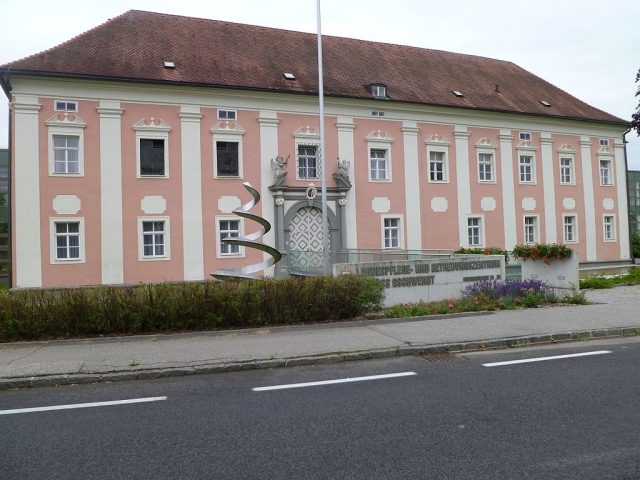
Gschwendt Castle is located in the Gries district of the municipality of Neuhofen an der Krems.
The Gschwendt dominion is first mentioned in a document in 1308 as a Passau fief. Heinrich der Gwschendtner or Heinrich von Volkenstorff is mentioned as the vassal. In 1492, Gschwendt came into the possession of the Losensteiners. The dominion was also associated with the regional court. At the end of the 16th century, the moated castle was included in the list of places of refuge and defense in times of war, which suggests the defensibility of the complex. During the Great Peasant War in 1626, a battle took place near the castle between the peasants led by Achaz Wiellinger and the imperial troops under Colonel Löbl. The poorly equipped peasants allegedly lost more than a thousand men.
In 1692, the male line of the Losensteiner family died out with the passing of the Passau canon Count Franz Anton von Losenstein, who had been elevated to the rank of prince. The heiress was Maria Katharina, the sister of the last count; she was married to Prince Johann Weikhard von Auersperg. Around 1750, the Gschwendt dominion included 502 subjects. Torture was allegedly still used in the castle in 1843, although it had already been abolished in the Habsburg Monarchy in the 18th century.
Gschwendt remained in the possession of the Auerspergs until 1851, when Prince Karl von Auersperg sold the castle to Franz Leuck, the owner of the Hoftaverne (court tavern). The associated lands were parceled out and sold to farmers. In 1893, Gschwendt came into the possession of the State of Upper Austria and has since served as a state healing and care institution.
Nazi Era+
Gschwendt Castle housed a branch institution of the Niedernhart State Asylum in Linz. The euthanasia doctor Rudolf Lonauer served as director. Gschwendt Castle was used for patients who were partly brought from other institutions in the "Ostmark" and could not immediately be transported to the Hartheim killing center.
Even after the transports to Hartheim had ceased, further patients were murdered under the medical direction of Rudolf Lonauer through malnutrition or medication. However, it would be wrong to attribute responsibility for this machinery of destruction solely to the head of the institution. The system could only function with the help of many other assistants, nurses, caregivers, secretaries, drivers, doctors, and other accomplices and accessories.
When the bombing war began in Linz, Lonauer moved with his family to Neuhofen a. d. Krems. He found shelter in Lining, in the house of the housekeeper Hermine Zehetner. Lonauer is said to have had a "close relationship" with her. At the end of the war, one hour before the arrival of the US Army, he first killed his wife with poison, then his two daughters (born 1938 and 1943 respectively) and then shot himself. The family is buried in the cemetery of Neuhofen an der Krems.
After the Second World War, criminal investigations were conducted against 61 participants; only three criminal trials took place. Of these, Anton Schrottmayer (head of the women's department in Gschwendt) killed himself on August 4, 1946, in Ybbs prison. Most of the proceedings were discontinued.
Gschwendt Castle Today+
Originally, Gschwendt was a moated castle surrounded by a double, tower-fortified wall. Three transverse wings connected the front with the rear part of the castle. These structural elements and the surrounding ponds have all disappeared; only the ten-axis main wing, the former manor house of the castle, remains. In place of the former stone bridge, a metal-glass bridge leads over a newly created water surface to the castle. A snail-like metal sculpture rising from the water surface is worth mentioning.
A few years ago, the castle was extensively renovated and, with additional buildings, transformed into a modern Upper Austrian State Care and Support Center for the mentally ill.
In front of the castle, a column erected in 1976 commemorates the battle of 1626.
Take Mobile History with you
You are reading this text for free. Premium adds what matters on the road: descriptions read aloud, sites found through your camera, whole regions taken offline.
- Every description, including the ~17,700 Premium sites
- Audio guide: have descriptions read to you on location
- AR finder: see sites through your camera, with distance and bearing
- Unlimited saved sites
14 days free, then from €2.99 a month. Cancel anytime.
Source: Wikipedia · Licence: CC BY-SA 4.0 · Image: http://commons.wikimedia.org/wiki/File:Schloss_Gschwendt_heute.JPG
This description draws on the facts documented in the linked Wikipedia article; Wikipedia content is licensed under CC BY-SA 4.0. Wording and editing: Mobile History.
Location: 48.1377, 14.2361