Cultural Events
CastleAltdorf bei Nürnberg-Grünsberg
Grünsberg Castle
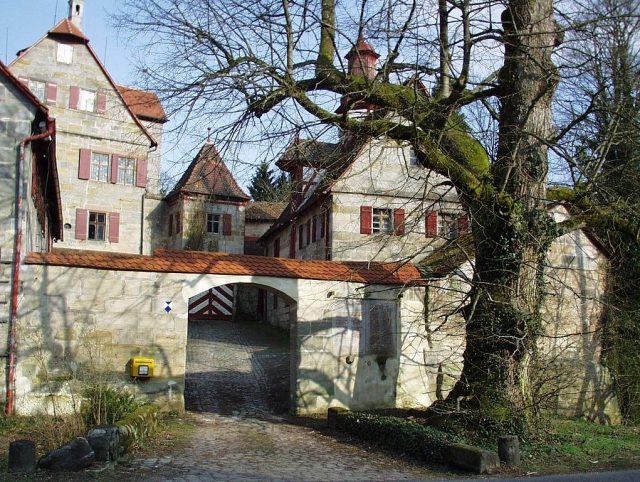
Grünsberg near Altdorf in the Nuremberg region is a castle complex that dates back to the 13th century and was expanded into a representative country estate by various Nuremberg patrician families from the 16th century onwards.
Grünsberg Castle
Grünsberg Castle is situated in a hollow on a hill spur that slopes like a gorge towards the Schwarzach, the "Berg im Grunde" (mountain in the valley), and may go back to a fortified tower that is said to have originated during the Hungarian invasions around 945.
The fortified seat was built before 1231, presumably on behalf of the Empire, on imperial property. The imperial ministerialis Albertus Rindesmule de Nurnberch was enfeoffed with the castle in 1231 and called himself Rindesmule de Grundisperc. Whether he was involved in the construction is not certain. From the inheritance of the last Staufer, Konradin, the imperial fief passed to Ludwig the Strict from the House of Wittelsbach; however, the property remained with the Rindsmaul family.
In 1311, the castle was pledged by Ludwig the Bavarian as liege lord for 350 pounds Heller to the brothers Albrecht, Marquart, and Hartmann Rindsmaul. Of the loan sum, 250 pounds had already been paid out, and another 100 pounds were to be invested in Grünsberg. Given the chronic shortage of money of their liege lords, the Rindsmaul family seemed to have a tangible claim to the free-owned property of the castle. In 1315, Ludwig, disregarding the claims of the Rindsmaul family, transferred the pledge right to the castle to their brother-in-law, the renowned knight Seyfried Schweppermann. He had decisively helped him to victory in the Battle of Gammelsdorf. The pledge of the Schweppermann as "heirs" of the Rindsmaul was confirmed in 1375 by Count Palatine Ruprecht and his successors.
After the extinction of the Schweppermann family, the Freudenberger family took over the castle in 1433, which was besieged and damaged by Nuremberg troops in the First Margrave War. In 1481, the Truchsess von Pommersfelden, who served the Wittelsbach family, followed. In the Landshut War of Succession, the castle was burned down by Nuremberg troops and fell to the Imperial City of Nuremberg in 1504. In 1506, the city leased the entire estate to the Nuremberg merchant Wilhelm Rauscher. He later ceded the property to his creditor Hans Durnhöfer and finally had to return it to the city council in 1518 due to insolvency. In 1529, the Nuremberg patrician family Behaim bought the entire estate for 3000 guilders and committed to opening the castle to the Nuremberg city council and to selling or bequeathing it exclusively to Nuremberg citizens. However, the Behaim family only partially carried out renovations, and the castle was still considered a ruin even before the fire damage in the Second Margrave War of 1552. In 1556, the honorable Oertel family acquired the property and rebuilt the castle. The repair of the damage from both wars dragged on for several years. In 1561, the three-story main Kemenate (stone house) was completed.
After the Ortel family, Nuremberg patrician families alternated as owners. In 1579, the son-in-law Sigmund Haller von Hallerstein inherited the castle. After his death, his son-in-law Johann Paul II. Paumgartner von Holnstein inherited it in 1672. His family subsequently called themselves Paumgartner von Holnstein und Grünsberg.
Grünsberg Palace
The expansion of the castle into a palace complex took place between 1717 and 1723 under the last member of the patrician family Paumgartner, Johann Paul III. Paumgartner. During this time, the complex also received its significant stucco ceilings, the stair tower on the main building, the tower construction at the northeast corner, and in 1723, the gatehouse to the main castle and finally the buildings in the outer bailey. Although Paumgartner undertook fundamental alterations, it is astonishing that he always retained the basic form of the medieval castle – quite untypical for the architectural preferences of his time – and even expanded it in an obviously historicizing manner. Outside the castle, a Baroque garden was created in front of the south wall, which is now severely damaged and therefore cordoned off, the Sophienquelle (Sophie's Spring) and the straight avenue leading to it. The Himmelgarten (Heaven's Garden) was baroqueized and provided with an orangery that has since disappeared. Around 1730, Johann Paul Paumgartner's widow, Sophie Paumgartner (née Nützel von Sündersbühl), married a member of the Haller family. From 1730 to 1766, Grünsberg was again in the possession of the Haller family.
In 1754, Karl Christoph Stromer von Reichenbach married Sophie's daughter from her second marriage, Eleonore Haller von Hallerstein. In 1766, Sophie ceded Grünsberg (and Holnstein Castle in the Amberg-Sulzbach district, sold again in 1813) to her son-in-law, who in return took over her high debts. Since then, Grünsberg Palace has been owned by the Stromer family, one of Nuremberg's oldest and most important patrician families. Between 1909–1912 and 1919–1923, the palace underwent extensive renovations. Until 1954, the damage from the Second World War in the palace's forecourt was provisionally repaired. Comprehensive renovation measures followed from 1990 onwards.
Inventory
Grünsberg Palace houses an extremely valuable "collection of culturally and historically significant objects closely linked to the Imperial City of Nuremberg, spanning the 13th to 20th centuries, which, from both historical and art-historical perspectives, collectively represent a unique overview of patrician self-understanding and living conditions through the centuries." A great peculiarity, in addition to countless historical everyday objects and furniture, high-quality portraits, Nuremberg funeral shields, and valuable glass goblets, is a contemporary construction model of the Venetian Rialto Bridge from the 1580s, which was demonstrably in the possession of Wolf Jacob Stromer, the builder of Nuremberg's Fleischbrücke (Meat Bridge). Whether this model was actually used for the construction of the Fleischbrücke remains controversial. Also from Venice are the so-called "Mondglasscheiben" (moon glass panes), some of which have been preserved, especially on the second floor of the palas. The late medieval portable altar of the council master builder Endres Tucher, which contains several tiny relic pouches, was consecrated by the Archbishop of Accon according to the inscription.
Stromer Cultural Heritage, Monument and Nature Foundation
The last owner of Grünsberg Palace, Professor Dr. Wolfgang Freiherr Stromer von Reichenbach, stipulated in his will the conversion of the estate and palace into a public charitable foundation under civil law. This was implemented in 2000 to preserve this regionally significant monument with its valuable inventory for posterity and to make it accessible to the public as far as possible. Since her father's death, Rotraut Freifrau von Stromer-Baumbauer, as administrator of the Stromer Cultural Heritage, Monument and Nature Foundation, has been overseeing the renovation work. Since 2003, benefit concerts have been held in the castle courtyard and in the small concert hall in the former castle chapel, the proceeds of which are used for the renovation work. On July 10, 2006, the "Förderverein Burg Grünsberg e. V." (Friends of Grünsberg Castle Association) was founded to support the efforts. Grünsberg Palace can be visited on the first Sunday of every month or by appointment with a guided tour. In 2009, the Stromer Foundation was awarded the Bavarian Monument Protection Medal for the general renovation of Grünsberg Castle, and in 2010, the Silver Hemisphere, the most important award of its kind at the national level.
Surroundings
In the vicinity of Grünsberg Palace is the Sophienquelle (Sophie's Spring), the largest enclosed Baroque spring complex north of the Alps (built between 1724–26 by Johann Paul Paumgartner in honor of his wife Sophie Nützel von Sündersbühl, based on an Italian model), which also needs to be preserved by the Stromer Cultural Heritage, Monument and Nature Foundation. The entire complex also includes a Baroque tithe barn, which adjoins the Renaissance-Baroque garden called Himmelgarten (Heaven's Garden) with originally seven terraces, now used as an animal cemetery. The foundation also manages the surrounding forest, which was included in the EU's FFH list in 2004 as particularly worthy of protection, with the Rhaetian sandstone gorge Teufelskirche (Devil's Church).
Take Mobile History with you
You are reading this text for free. Premium adds what matters on the road: descriptions read aloud, sites found through your camera, whole regions taken offline.
- Every description, including the ~17,700 Premium sites
- Audio guide: have descriptions read to you on location
- AR finder: see sites through your camera, with distance and bearing
- Unlimited saved sites
14 days free, then from €2.99 a month. Cancel anytime.
Source: Wikipedia · Licence: CC BY-SA 4.0 · Image: http://de.wikipedia.org/wiki/Datei:SchlossGruensberggross.jpg
This description draws on the facts documented in the linked Wikipedia article; Wikipedia content is licensed under CC BY-SA 4.0. Wording and editing: Mobile History.
Location: 49.3714, 11.3272