Charlotte von Gaisberg Foundation
CastleGroßheppach
Großheppach Castle
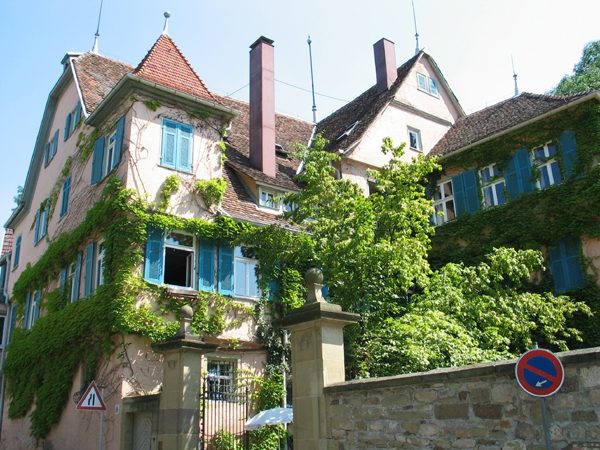
Großheppach Castle (also known as the Castle without a Name) is a 16th-century Renaissance castle. It is a landmark of the Remstal district of Großheppach in Weinstadt, Baden-Württemberg.
The first elements of the castle were built in 1592 by the Württemberg Chancellor Martin Eichmann from a burgher's house. In this first construction phase, the main building had a square floor plan. In addition, a defensive wall and two gatehouses were built. One of these included a prison, as at that time the lower jurisdiction lay with the owners. Both the defensive wall and the gatehouses have been preserved to this day, even if they have undergone various modifications. Their current state corresponds to the Biedermeier period.
In 1655, the second construction phase of the complex began. The main building now received a rectangular floor plan and was first depicted pictorially in a painting by Kieser in 1682.
The castle acquired its current form in 1750, when further side wings were added. At this time, various outbuildings were also erected.
In 1893, the fourth construction phase began, during which a final neo-Gothic extension was built, the staircase was constructed in neo-Gothic style, and the towers followed the historicist style. The old small stable was converted into a garden house, and a new three-story stable was erected.
After 1930, the complex was largely left to itself, and various buildings fell into disrepair.
From 1980, renovation began and continues to this day. The stable was renovated and converted into a residential building. The gatehouses and outbuildings were restored. The walls and roofs were repaired, and the buildings were equipped with heating. Monument protection was of utmost importance during this process. For example, care was taken to ensure that the bricks of the buildings consisted of original hand-drawn beaver tails from the corresponding period. In its current state, the complex is not yet fully renovated, but it no longer shows any major damage. The park's condition is based on an English park, meaning it is close to nature but well-maintained. This provides a retreat for many animals. Particularly noteworthy is the redwood tree within the park, which was planted at the same time as the redwoods of Stuttgart's Wilhelma.
Owners+
The castle had many different owners, none of whom were Württemberg or Swabian families; instead, they came from Mecklenburg, Holland, Hanover, Weimar, Franconia, Bavaria, and Austria. The long construction history is explained by the fact that the property was always inherited through the female line. Thus, while the owners' name always changed, the castle remained in family possession. The men who married into the family then made the property their family seat and remodeled it according to their ideas.
The owners were primarily not nobles, but rather members of the "Ehrbarkeit," i.e., the bourgeois upper class. Between 1650 and 1750, the property was a free estate with frequent changes of ownership.
However, from 1749, the property was owned by the Stockmayer family, whose descendants still own it today. The current owners are the great-great-great-grandchildren of Johann Friedrich Stockmayer. Due to inheritance through the female line, representatives of the Eichmann, Stockmayer, and Abel families lived on the property over the centuries. The property reached its greatest extent around 1800, when many houses in Großheppach and all the vineyards belonged to the castle.
From 1865, the property decreased in size and experienced a new temporary peak around 1900, when Baron von Gaisberg-Helfenberg married into the family.
Usage+
Today, the property is owned by the non-profit Charlotte-von-Gaisberg-Stiftung, named after Charlotte Freifrau von Gaisberg-Helfenberg, born von Göben. The aim of this foundation is to preserve the property in its traditional state and to carry out careful renovations. All buildings are in use. The main house is still inhabited by the owners. In addition, the city archive is located on the castle grounds. At the same time, the property is to be made accessible to the public, which is realized through guided tours on the occasion of Monument Day, the Night of the Cellars, or the annual Castle Garden Concert. Furthermore, lectures are held in favor of aid projects in developing countries.
Take Mobile History with you
You are reading this text for free. Premium adds what matters on the road: descriptions read aloud, sites found through your camera, whole regions taken offline.
- Every description, including the ~17,700 Premium sites
- Audio guide: have descriptions read to you on location
- AR finder: see sites through your camera, with distance and bearing
- Unlimited saved sites
14 days free, then from €2.99 a month. Cancel anytime.
Source: Wikipedia · Licence: CC BY-SA 4.0
This description draws on the facts documented in the linked Wikipedia article; Wikipedia content is licensed under CC BY-SA 4.0. Wording and editing: Mobile History.
Location: 48.8179, 9.3905