Cultural center
CastleGroßenhain
Großenhain Castle
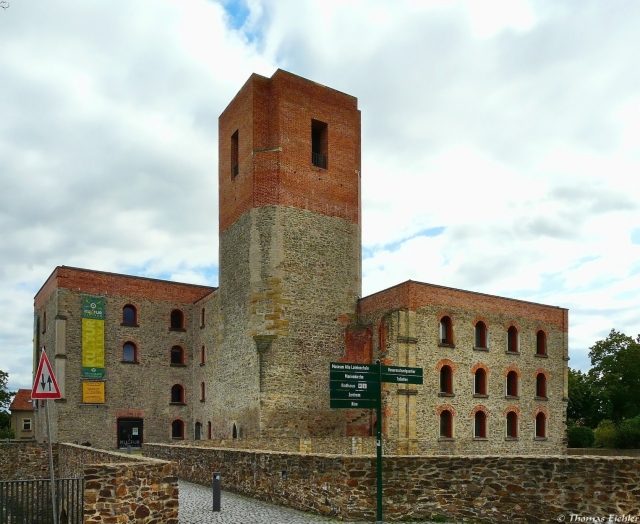
Schloss Großenhain is a historic building in Großenhain, Saxony, which is now known as the Großenhain Cultural Center Kulturschloss and houses numerous rooms for culture, art, conferences, and events. Classical theater performances as well as large symphony concerts, but also cabaret, chanson, and jazz evenings take place there.
In 1289, the building was described as "one of the most important in the Hayner Pflege". The castle was also the residence of the sons Friedrich and Dietzmann of Landgrave Albrecht the Unruly. In 1291, due to its proximity to Brandenburg, the castle was fortified as a border house, and in the 13th century, a keep was built as a freestanding tower.
On June 26, 1547, the castle was destroyed during a city fire. In 1557, Elector August ordered the reconstruction of the building, but it was besieged and destroyed again by the Swedes in 1637 and 1642 during the Thirty Years' War. In 1662, Elector Johann Georg II had the ruin repaired. Wolf Caspar von Klengel then bought "the old castle at Hayn". In the 17th century records, the building was mentioned as "Schloss" in Großenhain. On May 31, 1663, Elector Johann Georg II appeared in Großenhain to inspect the reconstruction of the building. However, the building was again damaged in 1704 during the Nordic War and on June 8, 1744, by a city fire. In 1745, the castle was surrounded by a moat; its walls were six meters thick and considered impregnable. From 1780-1800, the powder bastion and gate were demolished. In 1802, Baron von Odeleben acquired the property, which from 1833 operated a brewery in the castle. In 1835, ownership passed to the Eckhardt family, who continued to operate the brewery. In 1856, the castle burned down and was subsequently rebuilt. After this, ownership changed in 1900 to Herrmann Bernhard August Schneider and in 1901 to the company Goetz & Co. From 1914-1918, the factory produced yarns for powder bags. In 1929, the factory had to close due to the Great Depression. In 1933, a labor camp was established in the castle, where a spinning mill was operated.
In 1945, the owners were expropriated by the communists. After this, from 1951, VEB Ofenbau used the castle. From 1967, the castle stood empty. In 1968, the castle was severely damaged by a storm. After this, some outbuildings were demolished. In 1981, a fire devastated the castle so badly that it was not rebuilt afterwards.
In 1992, the former owners were able to reacquire the property. In 1998, the city of Großenhain bought the old castle and had it developed into a cultural center in 2000. It was then inaugurated two years later and is used for culture, art, conferences, and events of all kinds. The former keep functions as an accessible observation tower.
Take Mobile History with you
You are reading this text for free. Premium adds what matters on the road: descriptions read aloud, sites found through your camera, whole regions taken offline.
- Every description, including the ~17,700 Premium sites
- Audio guide: have descriptions read to you on location
- AR finder: see sites through your camera, with distance and bearing
- Unlimited saved sites
14 days free, then from €2.99 a month. Cancel anytime.
Location: 51.2901, 13.5337