Priest's office
CastleSimmelsdorf-Großengsee
Großengsee Castle
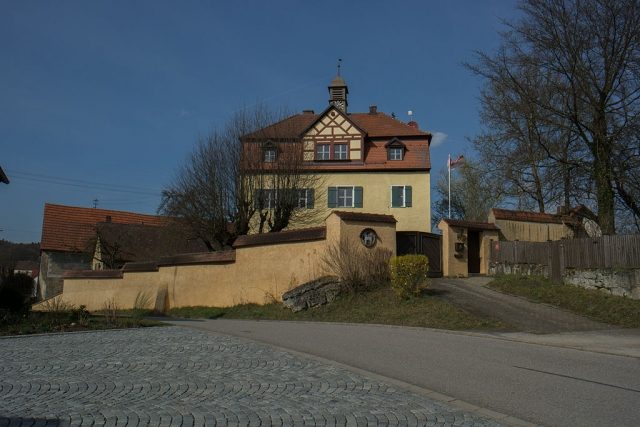
Only a note from the archive of the Barons of Tucher from 1630 mentions a "castle" in Großengsee that had already disappeared by that time. No documentary mention of this complex has been found so far. When the village of Großengsee was sold by the Burgrave of Nuremberg to the Wildensteiners in 1342, no seat appears. On March 9, 1450, Nuremberg troops burned down not only Kirchensittenbach and Winterstein, but also the village of "Gsee", but there is no mention of a castle in the tradition. The exploration of the rural area, which was carried out on behalf of the Nuremberg Council before the outbreak of the Landshut War of Succession in 1504, also does not list anything of the kind there. Gustav Voit and Volker Alberti surmised a new building by the owner of Wildenfels Castle, the Laufer Pfleger Christoph von Lentersheim, in the early 16th century. Voit justified the fact that the Lentersheim seat is not mentioned in any source with its presumably rapid destruction in the Second Margrave War in 1553.
After Großengsee had briefly been in the possession of Hans von Furtenbach, the Nuremberg family foundation of Dr. Lorenz Tucher acquired the village of Großengsee, St. Helena and the three Naifermühlen. It was only under Georg V. Tucher (1579–1644) as administrator of the Tucher Foundation that the construction of a new manor house began in September 1630 to accommodate the Tucher administrator and Voit. Possibly the upper floor was also intended for occasional stays of the gentry. It was only in this context that the builder spoke of the reconstruction of the old castle site, which began in September 1630. After its completion around 1631/32, the manor house was used for its intended purpose for some time. Christoph Bonaventura I. Tucher, who needed accommodation for the new pastor of St. Helena as patron, finally had the manor house in Großengsee converted into a rectory by August 1672. As such, the two-story former manor house, covered by a half-hipped roof with a roof turret, is still used today.
Take Mobile History with you
You are reading this text for free. Premium adds what matters on the road: descriptions read aloud, sites found through your camera, whole regions taken offline.
- Every description, including the ~17,700 Premium sites
- Audio guide: have descriptions read to you on location
- AR finder: see sites through your camera, with distance and bearing
- Unlimited saved sites
14 days free, then from €2.99 a month. Cancel anytime.
Source: Wikipedia · Licence: CC BY-SA 4.0 · Image: http://de.wikipedia.org/wiki/Datei:Herrensitz_Gro%C3%9Fengsee_01.jpg
This description draws on the facts documented in the linked Wikipedia article; Wikipedia content is licensed under CC BY-SA 4.0. Wording and editing: Mobile History.
Location: 49.6375, 11.3571