To be privately owned
CastleGroß Leuthen
Groß Leuthen Castle
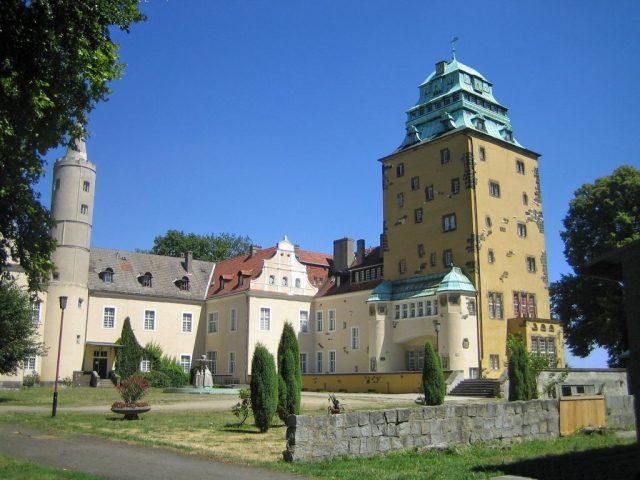
Groß Leuthen Castle is a moated castle in the Spreewald (southeastern Brandenburg). It is located in Groß Leuthen on the shore of Groß Leuthen Lake, 15 kilometers northeast of Lübben. Its oldest parts date back to the Middle Ages. The predominant part of the building fabric consists of a Renaissance building with a stair tower and a residential tower built in the Historicist style by Bodo Ebhardt in 1913.
In 1368, Leuthen was first mentioned with "Tammo von deme Luthen". At that time, it still belonged to the Burgraviate of Lübben. In the course of the Middle Ages, its own dominion developed, to which in the 16th century the villages of Groß Leuthen, Bückchen, Dollgen, Guhlen, Klein Leine, Klein Leuthen, and Ressen belonged.
After several changes of ownership, Wilhelm Schenk von Landsberg acquired Groß Leuthen in 1517. His descendants Carl Albrecht Schenk von Landsberg and his brother Ludwig Alexander auf Teupitz died childless in 1721.
In 1779, Countess Podewils, daughter of Heinrich Graf von Podewils, was the owner of the castle. She was married four times, first to Legation Councillor von Marschall, then to Count Haeseler, then to the officer Emanuel Friedrich von Bredow, and finally to Lieutenant General Count Johann Ludwig von Hordt, who was a companion at the Round Table of Frederick the Great and commander of the Spandau Citadel. Although Groß Leuthen was only operated as a secondary estate, the Countess visited frequently. After her death, her son from her second marriage, August Ferdinand von Haeseler, inherited the castle and died there in 1838. Later, the castle came into the possession of Emil von Gutzmerow, who was, among other things, chamberlain to Queen and later Empress Augusta.
In 1906, the Berlin chemical manufacturer Johann Abraham von Wülfing, who had become wealthy through globally exported lactose and milk protein products, including the breast milk substitute "Albulactin", acquired the castle. He came from an old merchant and civil servant family from Barmen and hoped to obtain a patent of nobility by acquiring the old knight's estate. In 1908, a patent of nobility was subsequently issued by Wilhelm II. This was followed by an elaborate renovation of the castle by the architect Bodo Ebhardt from Berlin-Grunewald. After the restoration of the old castle, Ebhardt designed a diverse extension with a new entrance hall, reception rooms, a landing staircase by the lake, a large terrace, and the characteristic six-story residential tower. In 1927, Johann Abraham von Wülfing died, and his son Rudolf inherited the property.
In 1945, Rudolf von Wülfing was dispossessed and expelled under the Soviet military administration. In the following years, the estate was initially used as an orphanage and later as a "special children's home," a precursor to the youth work camp.
After the reunification, the Großes Militärwaisenhaus Foundation became the owner of the castle but could not carry out the necessary repairs. From 1999 to 2006, the castle was used for the art exhibition "Rohkunstbau" and was privately resold in 2007.
Take Mobile History with you
You are reading this text for free. Premium adds what matters on the road: descriptions read aloud, sites found through your camera, whole regions taken offline.
- Every description, including the ~17,700 Premium sites
- Audio guide: have descriptions read to you on location
- AR finder: see sites through your camera, with distance and bearing
- Unlimited saved sites
14 days free, then from €2.99 a month. Cancel anytime.
Source: Wikipedia · Licence: CC BY-SA 4.0
This description draws on the facts documented in the linked Wikipedia article; Wikipedia content is licensed under CC BY-SA 4.0. Wording and editing: Mobile History.
Location: 52.0380, 14.0447