Cultural Events
CastleBad Grönenbach
Castle Grönenbach
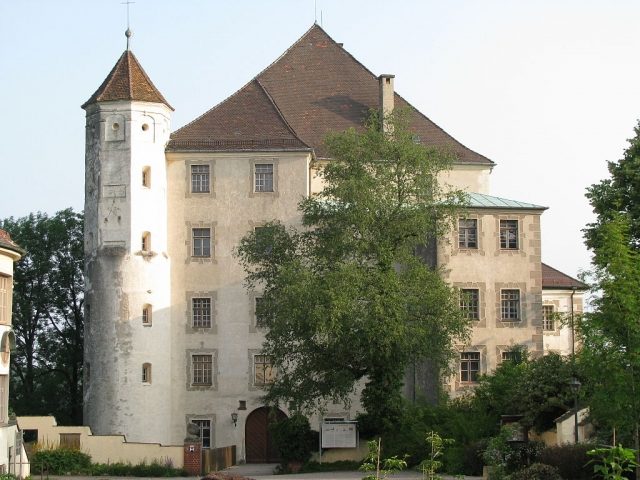
The Hohe Schloss (High Castle) is the landmark of the Central Swabian Kneipp spa town of Bad Grönenbach in the district of Unterallgäu. It stands on a steep mountain spur on the western edge of the village on a Nagelfluh rock. The Hohe Schloss in Bad Grönenbach is on the list of monuments of the Bavarian State Office for Monument Preservation.
The Hohe Schloss in Bad Grönenbach is built around a Nagelfluh rock. Individual structural components are even carved out of it, which is still visible on remnants of the rock face on the first floor. In all probability, the oldest part of the castle was built around 1280 by Heinrich Ludwig von Rothenstein on the site of an earlier refuge castle. The latter served as the seat of the Lords of Grönenbach until 1260. After the death of Ludwig von Rothenstein, the castle came into the possession of the Pappenheim family in 1482. During the Peasants' War, it was besieged and damaged in 1525. In 1612/1613, the castle passed by inheritance to the Fugger von Kirchberg-Weißenhorn family. In 1690, Paul Fugger had the northeastern extension built. In 1695, the castle returned to the Princely Abbey of Kempten, which had previously granted it as a fief. During the War of the Spanish Succession, the Hohe Schloss was stormed by Bavarian and French troops in 1703.
In 1803, a Royal Bavarian District Court moved into the castle; all interior furnishings had already been sold or auctioned off by this time. The District Court moved from the Hohe Schloss to Memmingen in 1878. In 1881, the Hohe Schloss first came into the possession of the Hessian court photographer Wilhelm Cronenberg, and was then acquired by Dominikus Ringeisen in 1901. Between 1947 and 1951, the Ursberg Sisters carried out an interior and exterior renovation of the castle. After the Ursberg Sisters left, the Hohe Schloss was acquired by the market town of Bad Grönenbach on December 20, 1996.
Since its acquisition by the municipality, the buildings have been used for exhibitions, guided tours, concerts, lectures, festivals, and civil weddings. In 1998, a district educational garden was laid out around the castle.
Architectural Description+
The shape of the castle was largely determined by its location on a Nagelfluh rock. The rock extends partly into the first upper floor. The west front of the castle is five-story and consists of seven window axes. On the east side there is a round tower stump. The eastern extension, known as the Fugger extension, added in 1690, is three-story and covered with a hip roof. The south front is divided into two parts in terms of the number of floors, with five stories to the west and four to the east. The tower located at the southwest corner of the castle is round up to the third upper floor and then octagonal. The gate entrance is in the south of the castle and is accessible via a bridge.
Interior Furnishings+
The cellar beneath the Fugger building consists of two groin vaults. The castle chapel was originally located in the northern part of the basement. However, no interior furnishings of the chapel remain in the castle. The room contains a stucco ceiling with leaf tendrils and a large shell. The stucco ceiling was created around 1710–1720. The staircase with a wooden baluster railing was also created in the period 1710–1720. On the first upper floor there are several magnificent rooms with stucco ceilings and fantastic landscape vedutas.
Take Mobile History with you
You are reading this text for free. Premium adds what matters on the road: descriptions read aloud, sites found through your camera, whole regions taken offline.
- Every description, including the ~17,700 Premium sites
- Audio guide: have descriptions read to you on location
- AR finder: see sites through your camera, with distance and bearing
- Unlimited saved sites
14 days free, then from €2.99 a month. Cancel anytime.
Source: Wikipedia · Licence: CC BY-SA 4.0
This description draws on the facts documented in the linked Wikipedia article; Wikipedia content is licensed under CC BY-SA 4.0. Wording and editing: Mobile History.
Location: 47.8767, 10.2170