To be privately owned
CastleWeißenberg - Gröditz
Gröditz Castle
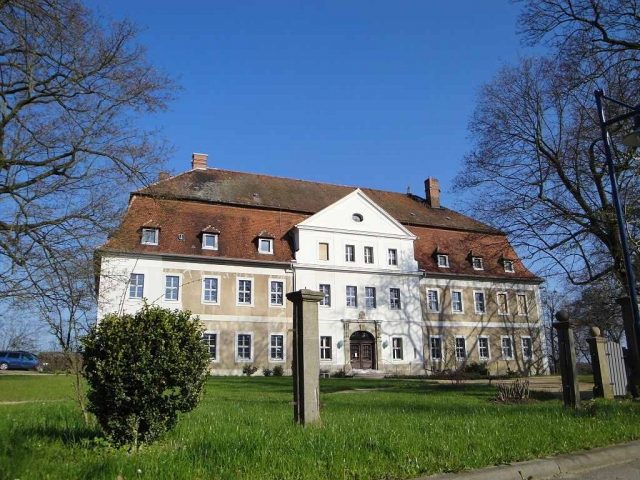
Right by the A4 motorway between Bautzen and Görlitz, a manor house rises before a steeply sloping terrain. The Gröditzer Skala, a valley through which the Löbauer Wasser flows, is rich in rare plants and animals. It is not without reason that the Gröditzer Skala is a nature reserve.
However, the entire knight's estate complex includes not only the castle, but also a more than 1,000-year-old Sorbian rampart, the former farm buildings, and a park. The place name "Gröditz" is derived from the Old Sorbian "grodisce", which means castle site. The former Slavic castle still exists in remnants today. Right next to the castle, one can see a former section of the rampart, which once belonged to the Slavic fortification. In the 13th century, a knight's seat emerged from this fortification.
With its first mention as Gradis in 1222, Gröditz is one of the oldest settlements in Upper Lusatia. The knight's estate seems to have belonged to a family von Porsitz in the 13th and 14th centuries. At the beginning of the 15th century, the estate passed to the von Maxen family. The partly baronial family von Maxen is an ancient Meissen noble family, which had its ancestral seat in Maxen near Pirna. Members of the family held high offices in Upper Lusatia and enjoyed high esteem. In the 15th and 16th centuries, the family provided several district governors in the larger cities of Lusatia and its surroundings. Around 1530, Haug (Hans) von Maxen auf Gröditz became a judge at the court in Bautzen, in 1547 imperial commissioner, in 1553 imperial councilor, and in 1557 district governor of Upper Lusatia in Bautzen. In 1562, he enlarged his property by purchasing the knight's estate Weicha.
In the 17th century, Gröditz came into the possession of the noble family von Gersdorff. With them began a new chapter in history. Hans Caspar II von Gersdorff, who was enfeoffed with Gröditz in 1721, is credited with the construction of the castle around 1738. The builder presumably incorporated older parts. The castle stands directly on the steeply sloping rock edge of the Löbauer Wasser. Two floors rise on a rectangular floor plan. The third floor is designed as a mansard roof. The show side of the castle faces the castle garden in front. In the middle, a strongly pronounced central risalit with a triangular gable emphasizes the stately claim. A spacious entrance hall welcomes the visitor. Via a generous staircase, the visitor reaches the upper rooms. On the half-landing there is a balcony, from which the lord of the castle could enjoy the wonderful view of the Görlitzer Skala. While the ground floor housed the reception rooms and the library, the upper floor contained the lords' bedrooms, children's rooms, salon, and dining room. The attic was primarily reserved for the service staff.
The Royal Saxon Chief Court Marshal Georg Rudolf von Gersdorff rebuilt the castle again in 1872. This marked the end of the era of the von Gersdorff family. After the death of Georg Rudolf von Gersdorff in 1894, the heirs sold the knight's estate to Clara and Oskar Krauß. A fire in 1922 severely damaged the noble residence. But the von Krauß family - Oskar Krauß had been ennobled in 1911 - had the damaged castle rebuilt. However, the far-reaching plans of the renowned castle researcher and architect Bodo Ebhardt could not be fully implemented due to lack of money.
In 1945, the owners were forcibly expropriated and expelled by the communists. Until 1967, the castle served as a tuberculosis sanatorium and an outpatient clinic of the Großschweidnitz specialist hospital. Most recently, its rooms housed a residential home for mentally ill people.
With the sale of the old manor house, the castle and park landscape is to be revitalized. Beat von Zenker zu Prommnitz - a great-nephew of the last owner Clara von Krauß - acquired the knight's estate in 2006 and is committed, together with the Förderverein pro Gröditz e.V., to a meaningful use. It remains to be hoped that this project will succeed.
Take Mobile History with you
You are reading this text for free. Premium adds what matters on the road: descriptions read aloud, sites found through your camera, whole regions taken offline.
- Every description, including the ~17,700 Premium sites
- Audio guide: have descriptions read to you on location
- AR finder: see sites through your camera, with distance and bearing
- Unlimited saved sites
14 days free, then from €2.99 a month. Cancel anytime.
Source: Wikipedia · Licence: CC BY-SA 4.0 · Image: http://de.wikipedia.org/wiki/Datei:Hrodziscanski_hrod_1.JPG
This description draws on the facts documented in the linked Wikipedia article; Wikipedia content is licensed under CC BY-SA 4.0. Wording and editing: Mobile History.
Location: 51.2063, 14.6250