Administration department
CastleGrimma
Grimma Castle
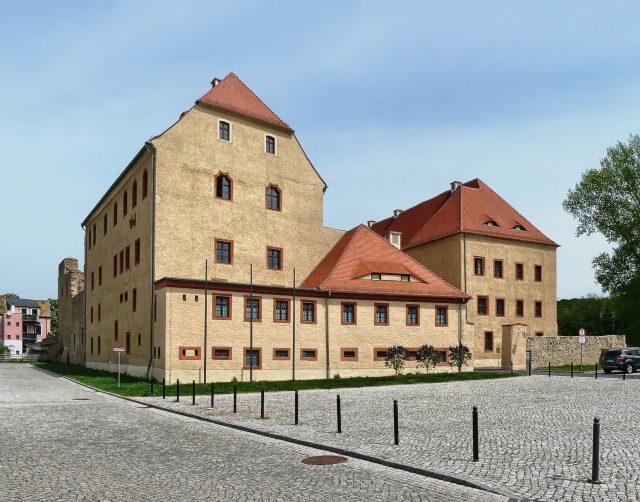
The origin of Grimma Castle was a sovereign castle, built shortly before 1200 by Dietrich the Oppressed to secure his rule and the Mulde crossing. With the construction of the castle, the Margrave of Meissen became independent of the Burgrave, who controlled another Mulde crossing only a few kilometers away in Wurzen.
The appearance of the original castle has not been clarified to this day due to numerous superstructures. Only an arcade window from the 13th century on the north side has been preserved as an architectural remnant. However, the castle was always closely connected to the Mulde bridge and the city, as evidenced by its connection to the northeast corner of the city fortifications.
Grimma was always Margravial-Meissen. The Wettin interest in the castle was also expressed in the foundation of the St. Oswald Chapel on the castle by Dietrich the Oppressed. However, the chapel, consecrated to Saint Oswald in 1218, has completely disappeared today. Subsequently, Grimma, as a site of administration and court, continuously held great importance for the Margraves, as numerous charter exhibitions prove.
Vigorous construction activity began at the end of the 14th century. During this time, the complex, consisting of an east and a west wing and a square tower, was probably finally completed. The massive tower, still preserved in its substructure today, marked the northwest corner of the medieval castle. A wall section between the two houses connected to it, delimiting the castle courtyard to the north. Finally, in 1509, the transformation into a residential castle began. Buildings were raised, curtain arch windows and the striking show gable on the north side adorned the castle. The sovereign character of the complex has been preserved even after the renovation.
Plunderings and destructions during the Thirty Years' War severely affected Grimma Castle. Subsequently, a rent and court office was established in the building. In 1810, the late Gothic castle tower was demolished, and the internal structure of the castle wings was greatly altered. The transformation from a princely castle to a functional building for an authority led to the simple architectural forms visible today. The two castle wings enclose a trapezoidal courtyard. The more prominent east wing is an elongated rectangular building with a steep gable roof. A early Gothic window group from 1230/40 and the north gable with rich blind tracery stand out in it. The northwest corner of the courtyard is filled by the ruin of the strong medieval tower.
After reconstruction measures, the building complex shines again in new splendor. A very beautiful view can be had from the remains of the Mulde bridge, which is adorned by a coat of arms stone. Its inscription reads: "For eternity - under the rule and at the expense of Frederick August King of Poland and Elector of Saxony, the benevolent prince and incomparable father of the country, this proud structure was erected from stone blocks since 1716 in place of a bridge destroyed in 1637, as a monument to royal and electoral grace." The Baroque Mulde bridge was built from 1716-19 according to plans by Matthäus Daniel Pöppelmann. The magnificent coat of arms stone, placed in 1724, shows the Saxon and Polish coats of arms and commemorates Saxony's splendor under Elector August the Strong.
Take Mobile History with you
You are reading this text for free. Premium adds what matters on the road: descriptions read aloud, sites found through your camera, whole regions taken offline.
- Every description, including the ~17,700 Premium sites
- Audio guide: have descriptions read to you on location
- AR finder: see sites through your camera, with distance and bearing
- Unlimited saved sites
14 days free, then from €2.99 a month. Cancel anytime.
Source: Wikipedia · Licence: CC BY-SA 4.0 · Image: Thomas Eichler
This description draws on the facts documented in the linked Wikipedia article; Wikipedia content is licensed under CC BY-SA 4.0. Wording and editing: Mobile History.
Location: 51.2379, 12.7319