Museum
Foundation
CastleTharandt - Grillenburg
Grillenburg Castle
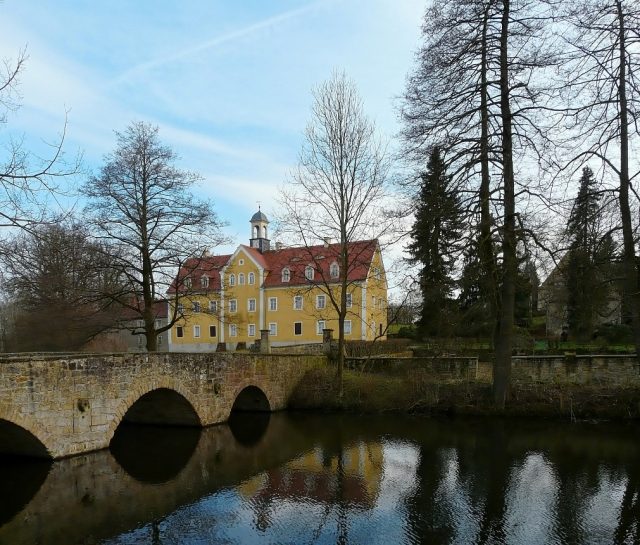
Grillenburg Hunting Lodge is located in the Tharandt Forest. It is situated in the eponymous district of Kurort Hartha near Tharandt in the Sächsische Schweiz-Osterzgebirge district in Saxony, on today's scenic route Silberstraße between Dresden and Freiberg. The State Office for Monument Preservation Saxony lists the ensemble, including the surrounding three ponds, as a cultural monument, including archaeological ground monument protection.
Origin
The origins of the hunting lodge complex, built on the so-called Grillenburg clearing, can be traced back to the 13th century. According to archaeological investigations from 1935–37 (Walter Bachmann, Hans Nadler) and 1980–83 (Reinhard Spehr), as well as the still existing cellar vaults, they are interpreted as an abbey/burial site, a Staufer or Margravial Meissen hunting palatinate, or a pilgrim hospice on the Holy Way or Way of St. James. Evidently, there was a close connection with the neighboring Tharandt Castle and the Meissen Margraves Dietrich and Heinrich. An early settlement is also evidenced by the fact that, among other things, the Golden Gate at Freiberg Cathedral St. Marien was made in 1225 from Grillenburg sandstone, which was quarried for millstones until the early 20th century, and the nearby deserted village of Warnsdorf, which dates back to 1162 (dendro).
Electoral Hunting Lodge and Official Residence
In the mid-16th century, by order of Elector August of Saxony, and under the direction of Hans von Dehn-Rothfelser and Hans Irmisch, an electoral hunting complex was built on the older foundations, replacing a net house. This complex served primarily for the Elector's relaxation (in the sense of driving away worries) in addition to hunting. The complex, consisting of the Prince's House, Hunter's House, Schösserei (forester's lodge), and the servants' house Bärenhaut with stables, was completed between 1554 and 1558, with the Hunter's House completed in 1599 and the Fronfeste (prison) in 1614. Building materials from Tharandt Castle were also used. Renovations and extensions took place in the 17th and 18th centuries, especially after a fire in 1654, by master builder Ezechiel Eckhardt, among others. Due to war damage, fires, and demolition work, only the Schösserei and the surrounding wall with the Colmnitz Gate remained of the complex. The Hunter's House was replaced by a field barn in 1720, and the Prince's House (except for the cellars) and the Fronfeste were demolished in 1828 (building material for the Grillenburg inn). The area was originally surrounded by four ponds, fed by the Schwarze Pfütze and via a canal from the original Triebisch (X-Bach / Kroatenbach or Kroatenwasser), and accessible via three gates and a wooden bridge. In 1730, the wooden bridge was replaced by a sandstone arch bridge according to plans by master builder Matthäus Daniel Pöppelmann. Only the pond with the stone bridge in front of today's hunting lodge has been preserved in its original state.
In 1568, Grillenburg became the administrative seat of the Grillenburg-Tharandt office and judiciary. The office, previously located in Tharandt, was moved here and renamed Amt Grillenburg. The Oberforst- und Wildmeisterei (Chief Forestry and Game Warden's Office) was located in Grillenburg from 1586–1852 and 1873–1909. From 1728 to 1813, it encompassed the offices of Dippoldiswalde, Freiberg, Grillenburg, and Nossen. From 1787, the Grillenburg office was co-administered from Freiberg, and in 1827, the administrative seat was moved back to Tharandt. The tasks of the Grillenburg judicial office were taken over by the Tharandt district court in 1856. The Rentamt (revenue office), which had existed as a separate department since about 1784 or as a separate authority alongside the judicial office since 1831, was merged with the Dippoldiswalde Rentamt with its seat in Tharandt in 1856. Its tasks were taken over by the Tharandt Forestry Revenue Office in 1865.
Hunting Lodge
The current Biedermeier facade of the complex largely dates back to a reconstruction based on plans by rural building conductor Rothe in 1855, when the Schösserei was converted into a royal hunting lodge. Around the same time, the three ponds south of the complex were filled in for agricultural use. In the vicinity of the hunting and administrative seat, in addition to the inn, the forge, and the Grillenburg mill, some cottagers settled after 1780 at the instigation of the then chief forester Friedrich Wilhelm von Hopfgarten. Their dwellings later formed the community of Grillenburg, which was incorporated into Kurort Hartha (since 1999 a district of the city of Tharandt) in 1973. In 1935/36, the hunting lodge, which had been leased since 1918 and used, among other things, as a hostel for the Ev.-luth. Jungmännerbund Sachsen (Hieckeheim, named after federal warden Friedrich Hiecke) and a café with public gondola service, or in 1925 as the Saxon Farmers' College, was converted into the Saxon Jägerhof (1936–45), during which the Biedermeier interior disappeared. The hunting hall was decorated with a wall frieze depicting a replica of the procession of the Electoral Saxon hunt (original in the Waldschänke Moritzburg near Dresden).
Museum and Seat of the State Foundation for Nature and Environment
After 1945, the castle served, among other things, briefly as an FDGB training center. From 1953, it was used by the Technical University (TH) Dresden (since 1961 Technical University of Dresden) – Department of Forest Sciences Tharandt, which opened a Forestry and Hunting Exhibition there in 1966, which still exists today as the Forest Museum. Since 2004, the Forest Museum has been operated by the Academy of the Saxon State Foundation for Nature and Environment, based in the castle. On June 16, 2009, the Academy moved completely to the Nobbe building of the TU Dresden in Tharandt for two years due to necessary construction work on the castle, and the Forest Museum was closed and relocated. On January 25, 2011, the Saxon cabinet decided to move the entire Saxon State Foundation for Nature and Environment to Grillenburg by January 1, 2014, which, however, will now only take place on January 1, 2017. After the gutting of the attic in 2010, renovation work on the castle roof took place in 2011. It was newly constructed as a cold roof, lost its massive dormers from 1855 in the castle courtyard, and received a replica of the weather vane from 1730 on the renewed tower. Further work on the castle, which is currently vacant and force-ventilated, is only planned for 2015/16. In addition, the inclusion of the New Hunter's House or the Forestry Training Center in Grillenburg is being examined.
New Hunter's House
On a hill behind the hunting lodge, above the Romanesque vault, the state guesthouse Neues Jägerhaus (New Hunter's House) was built for the Saxon Jägerhof between 1937 and 1939 (including an air-raid bunker, hunting lodge, bathing and gondola pond with boathouse, bowling alley, garages, and dog kennels). It is mistakenly referred to by the public as Mutschmannvilla, as it was partly used privately by the Saxon Reich Governor, Prime Minister, and State Master of the Hunt, Martin Mutschmann. The architects of the Neo-Renaissance building were the Rector of the Technical University of Dresden, Prof. Wilhelm Jost (1887–1948), and for the interior, Prof. Oswin Hempel (1876–1965). The plans were executed by the Tharandt master builder Burkhardt and the Deutsche Werkstätten Hellerau. It contained, among other things, probably the largest intarsia wall in Europe, based on designs by the artist Max Wendl (1904–1984), parts of which were stolen in May 2009 and the remaining pieces relocated. A weapons chest from the original furnishings by Theodor Artur Winde (1886–1965), whose works were interestingly removed by the National Socialists elsewhere as so-called degenerate art, just like those of Max Wendl, is now in the Dresden Museum of Decorative Arts at Pillnitz Castle. To improve fish farming and for flood protection, a canal was also built west of the three ponds in 1937, from the Schwarze Pfütze to the Triebisch, with the Faule Pfütze retention basin, Kalkmühle (lime mill), and Kalkstaustufen (lime weirs). During the GDR years, the Neues Jägerhaus was used until 1990 as the VdN-Kurheim Elsa Fenske, served to accommodate the Soviet delegation with Leonid Brezhnev, Alexei Kosygin, Nikolai Baibakov, and Pyotr Abrassimov during the secret Dresden meeting of the Warsaw Pact states at the end of March 1968 concerning the Prague Spring, and in June 1972 as quarters for Fidel Castro during a visit to the GDR. Until 1993, it was still used as the Jägerhof guesthouse by the municipality of Kurort Hartha. After the Free State of Saxony was awarded the property in 1994 and privatized it in 1999, it has been owned by the city of Tharandt since 2006, which had leased it to the Stiftung Musik Kunst Natur from Bannewitz from 2006–2011. In 2012, the Tharandt city council decided to transfer the currently unused property to the Free State of Saxony. The residents of Grillenburg also submitted a petition to the responsible Saxon state ministries and the Saxon State Parliament in 2013, the status of which has been displayed on the public notice board of the town since 2014.
Castle Park
The current garden design dates back to landscape architect Hermann Schüttauf, director of the State Gardens of Saxony, who designed the complex, dating back to the 16th century, in harmony with the new buildings in 1937-38. Three bronze sculptures in the castle park were cast in 1938 at the Lauchhammer Art and Bell Foundry, based on designs by artists Otto Rost (1887–1970; master student of Georg Wrba) – sculptures Wild Boar (stolen in 2000) and Bear (stored) – and Johannes Darsow (1877–1946; sculptor from Berlin) – sculpture Hubertus Stag (moved to Kurplatz in Kurort Hartha in 2013). Three sandstone hunter figures, created around 1645 by Conrad Buchau († 1657) or as early as 1602 by Christoph Walther IV (around 1572–1626) or, according to other sources, around 1620 for the Jägerhof (1569–1830) in Dresden-Neustadt, were placed at Grillenburg Castle from about 1900 to 1952. Today they are located in the foyer of the Museum for Saxon Folk Art or at the entrance to the Museum for Hunting Animals and Ornithology in Augustusburg Hunting Lodge. In an unprecedented charitable action, the residents of Grillenburg began working in the communal part of the castle park in spring 2014 to restore the complex, which had not been maintained for over 20 years, for public use. In autumn 2014, new trees of the varieties Alte Deutsche Hauspflaume and Borsdorfer Apfel were planted in the plum garden, next to an old apple tree of an unknown variety, according to a garden monument preservation plan.
Take Mobile History with you
You are reading this text for free. Premium adds what matters on the road: descriptions read aloud, sites found through your camera, whole regions taken offline.
- Every description, including the ~17,700 Premium sites
- Audio guide: have descriptions read to you on location
- AR finder: see sites through your camera, with distance and bearing
- Unlimited saved sites
14 days free, then from €2.99 a month. Cancel anytime.
Source: Wikipedia · Licence: CC BY-SA 4.0 · Image: Thomas Eichler
This description draws on the facts documented in the linked Wikipedia article; Wikipedia content is licensed under CC BY-SA 4.0. Wording and editing: Mobile History.
Location: 50.9513, 13.5056