Tax office
CastleGriesbach
Griesbach Castle
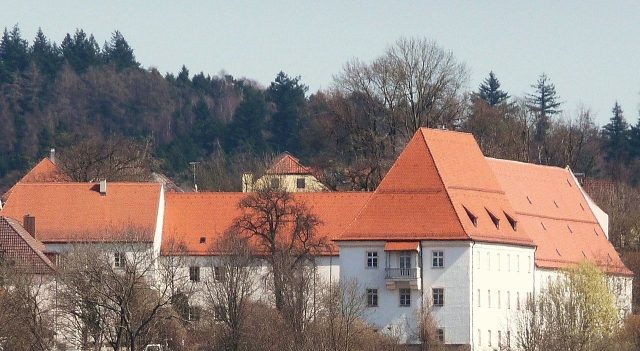
Griesbach Castle is a castle in Bad Griesbach im Rottal in the district of Passau. Today, it houses a branch office of the Passau tax office.
The castle, first mentioned in a document in 1076, was probably founded by the Counts of Vornbach. In 1078, the castle was destroyed in the Investiture Controversy by the army of King Henry IV, as the Vornbachers were vassals of the Pope. When the castle was rebuilt is not known, probably after the return of the Vornbach counts from their Hungarian exile in 1099. At the beginning of the 12th century, they granted the Griesbach castle to their vassals, the Lords of Griesbach-Waxenberg. These managed to allodialize the property over time. Around the year 1220, however, the Griesbach-Waxenberg family died out. The rightful heirs, the Counts of Vornbach, had already died out in 1158, and their heirs, the Counts of Andechs, had been powerless in the Rottal and on the Inn since their involvement in the regicide and the resulting outlawing in 1208. Thus, the inheritance, as explicitly attested in a document from 1241, fell to the Bavarian Count Palatine Rapoto II from the House of the Counts of Ortenburg. How he established and enforced this inheritance is not recorded; however, it is to be assumed that he usurped the possessions. Rapoto expanded the fortress into his administrative center for the Rottal and the Inn.
In 1256, Griesbach fell to Hartmann I of Werdenberg through marriage, who sold the castle to Duke Heinrich XIII in 1260. He took over the Ortenburg administration and established a ducal district court (Pfleggericht). The first administrator (Pfleger) Wigund is already traceable in 1262. Separate from the district court, there was also a treasury office (Kastenamt), headed by a ducal treasurer (Kastner). Wernher der Auer (1382–1385) was the first treasurer.
As an important seat of a territorial authority, the castle was expanded accordingly, namely between 1460 and 1478, when the master mason Stephan Westenholzer from Schärding erected new defensive walls and towers, gatehouses, and economic wings. In the Landshut War of Succession in 1504, unlike the town of Griesbach, it was spared from destruction. Hans Donauer the Elder depicted the complex around 1590 in the fresco in the Antiquarium of the Munich Residenz.
In the War of the Austrian Succession, Griesbach Castle was severely damaged in 1743 but soon repaired. In 1799, the district court and treasury office were dissolved, and a provisional district court (Landgericht) was established; in 1802, a rent office (Rentamt) was created.
On May 8, 1805, the castle almost completely burned down. The rent office was initially relocated to St. Salvator Monastery and in 1808 to Ortenburg Castle. In 1810, the court architect Franz Anton Glonner from Burghausen built two large "Dikasterialtrakte" (administrative wings) on the foundations of the old complex, omitting the keep and the fortifications. In 1817, one granary was converted into the rent office, and in 1858, the other granary was expanded into the district court with a prison. A further addition was made in 1912 when the district court was moved from the castle to a new building. The rent office was raised by one floor, and the new building for the district office (Bezirksamt), which later became the district administration (Landratsamt) of the Griesbach im Rottal district, was added.
Northeast of the castle stands the late Gothic castle church St. Michael from around 1500. It has an onion dome and today serves as a cemetery church. The drawbridge between the church and the castle collapsed in 1822 and was replaced by an embankment. The castle itself now houses a branch office of the Passau tax office.
Take Mobile History with you
You are reading this text for free. Premium adds what matters on the road: descriptions read aloud, sites found through your camera, whole regions taken offline.
- Every description, including the ~17,700 Premium sites
- Audio guide: have descriptions read to you on location
- AR finder: see sites through your camera, with distance and bearing
- Unlimited saved sites
14 days free, then from €2.99 a month. Cancel anytime.
Source: Wikipedia · Licence: CC BY-SA 4.0
This description draws on the facts documented in the linked Wikipedia article; Wikipedia content is licensed under CC BY-SA 4.0. Wording and editing: Mobile History.
Location: 48.4508, 13.1903