Cultural Events
CastleSüderholz-Griebenow
Griebenow Castle
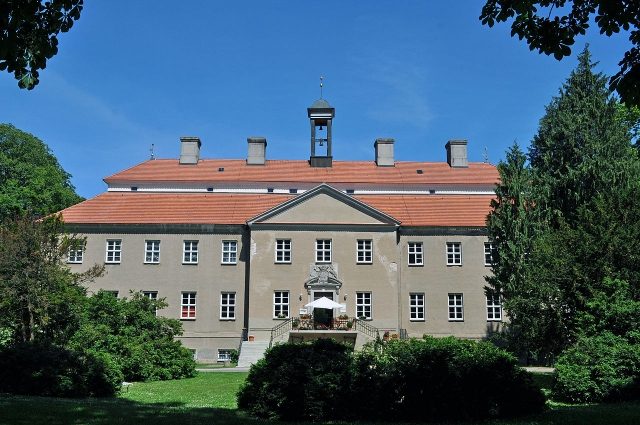
Griebenow Castle is located in the municipality of Süderholz in the district of Vorpommern-Rügen. It was built in 1709 and, together with the manor park, the preserved outbuildings, and a remarkable church, forms a listed ensemble in the village of Griebenow, nine kilometers west of Greifswald.
The Griebenow estate was founded after 1219 by the Cistercian monastery of Eldena and first mentioned in a document in 1248. In the Rügen War of Succession, the people of Greifswald defeated the Mecklenburgers in a battle near Griebenow in 1327. In the first half of the 14th century, the Eldena monastery probably gave up this possession. A tax register from 1343 named several feudal tenants for the 32 hides, almost half of which belonged to a family named von Rausche. In the 15th century, this family then owned the entire village of Griebenow.
During the Thirty Years' War, the von Rausches died out and the Griebenow estate fell to the Swedish crown. Gerdt Anthon von Keffenbrinck was enfeoffed with the estate by Queen Christina of Sweden in 1648. As Chamber President of the financial administration for Swedish Pomerania, he had rendered extraordinary services to the royal house and had been ennobled under the name Rehnskiöld. From 1653, he was curator of Greifswald University and, after his death in 1658, was buried in the family crypt in the castle chapel, which he had built between 1648 and 1654. The chapel is a remarkable and rare 15-sided half-timbered central building. It was restored in 1948.
It was not until 1702 that his son, Field Marshal Carl Gustaf von Rehnskiöld, inherited the estate. It was in such poor condition that the castle was demolished and rebuilt between 1707 and 1709. It was one of the largest non-royal castles of the late Caroline period and is one of the architectural testimonies to Swedish rule in Northern Germany. Comparisons with other castle complexes in Sweden suggest the renowned Swedish Baroque architect Nicodemus Tessin the Younger and his circle for the designs of Griebenow.
In 1706, the newly laid out "pleasure garden" was mentioned for the first time. Essential elements of the design were the main axis, designed as a lime tree avenue, and a castle pond with a rectangular island. Two different versions of the park layout are documented in map sheets from 1761 and 1836.
In the first half of the 19th century, changes were made inside and to the castle. The facade was decorated with classical elements, and some rooms and the staircase were redesigned. Later, a "courtyard of honor" was laid out in front of the castle, a four-row chestnut avenue was planted, outbuildings and a stable were erected, and the park was landscaped. By 1910, the castle, outbuildings, and park were thus transformed into a cohesive complex.
Until 1935, the estate was privately used by the Barons von Langen-Keffenbrinck. However, the owners allowed the park to become overgrown. Until 1947, the castle was a mother's convalescent home, then until 1958, an outpatient clinic of the university hospitals for tuberculosis patients. In 1958, the Grimmen district took over the estate and set up a nursing home in the castle.
Maintenance work during the GDR era in 1974 could only provisionally ensure the operation of the castle. No work commensurate with the value of the castle complex was possible, and therefore the structural defects were so great in 1988 that the castle had to be vacated. A restoration planned from 1989 was no longer carried out, and the building stood empty until 1998.
In 1992/93, the Grimmen district invested over one million DM in roof and window renovation, as well as the reconstruction of the bell tower.
Current Use+
Since May 1, 2003, the "Barockschloss zu Griebenow e.V." (Baroque Castle of Griebenow e.V.) has been the owner of the castle. The association operates it as a cultural meeting center and hosts exhibitions, concerts, Easter and Advent markets, fashion shows, and painting circles. Weddings, anniversaries, and family celebrations can be held there. Over 10,000 visitors come each year.
An old people's nursing home run by the Diakonie is located in an annex of the castle.
Take Mobile History with you
You are reading this text for free. Premium adds what matters on the road: descriptions read aloud, sites found through your camera, whole regions taken offline.
- Every description, including the ~17,700 Premium sites
- Audio guide: have descriptions read to you on location
- AR finder: see sites through your camera, with distance and bearing
- Unlimited saved sites
14 days free, then from €2.99 a month. Cancel anytime.
Source: Wikipedia · Licence: CC BY-SA 4.0 · Image: https://commons.wikimedia.org/wiki/File:Griebenow,_Schloss_%282011-06-11%29_2_by_Klugschnacker_in_Wikipedia.jpg
This description draws on the facts documented in the linked Wikipedia article; Wikipedia content is licensed under CC BY-SA 4.0. Wording and editing: Mobile History.
Location: 54.0800, 13.2469