Hochschule für Musik Karlsruhe
CastleKarlsruhe-Oststadt
Gottesaue Castle
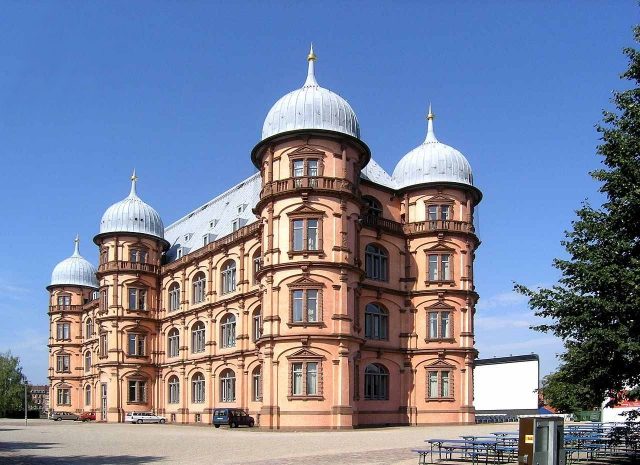
Gottesaue Palace, located on the grounds of a former Benedictine abbey, is a Renaissance palace in Karlsruhe's Oststadt that has been destroyed and rebuilt multiple times. Today, it houses the Karlsruhe University of Music.
Overview
In 1094, the Benedictine abbey of Gottesaue was founded by Count Berthold of Hohenberg. The monastery was plundered and damaged by fire in 1525. Margrave Ernst Friedrich of Baden-Durlach had a palace built on the site between 1588 and 1597 according to plans by Johannes Schoch. In 1689, the palace was destroyed by fire during the War of the Palatine Succession and hastily repaired. After another fire in 1735, it was rebuilt lower in 1743 and used as a granary by the Kammergut (chamber estate). In 1818, the building became a barracks and in 1919, a tenement barracks. After briefly serving as a police school in 1935, it became a barracks again in 1936. During an air raid in 1944, the building was destroyed, and part of the ruins was subsequently blown up due to the risk of collapse. Reconstruction began in 1982, largely in the external style of the 16th century, with visible integration of preserved wall remnants. In 1989, the Karlsruhe University of Music moved in. Subsequently, the Fuchsbau cavalier house, the stables, and other outbuildings were also prepared for use by the university.
Monastery
Count Berchtholdus de Hohenburg founded the monastery in Gotzaugen in 1094, which was consecrated by Bishop Gebhard III of Constance in 1103. This is reported in a 17th-century excerpt from the non-preserved monastic annals. Gotzaugen was a cleared area on the edge of the county in the Ufgau. Berthold, who named himself after the castle he or his predecessor built on the Hohenberg – today's Turmberg near Durlach – was the holder of the county in the Pfinzgau. He donated the necessary property for the convent's sustenance. Influenced by the Hirsau Reform, in the spirit of the Cluny reform movement, Count Berthold renounced the right of the proprietary church lord to elect and appoint the abbot. This is documented by a charter of King Henry V from 1110, which confirms the founder and his family's right to the conditionally hereditary monastery Vogtship. Berthold's house monastery, the Benedictine abbey of Gottesaue, was intended to be the spiritual and intellectual center of his rule and the burial place of his lineage. The first abbot of the monastery came from Hirsau, and certainly some monks as well. Count Berthold died as early as 1110; he was buried in the crossing of the monastery church. The Counts of Hohenberg soon died out, and their inheritance fell to the Margraves of Baden, including the right to the founder's Vogtship.
The monastery had only a short period of flourishing. After donations and the purchase of possessions and rights, after the abbey's clearing and settlement activities, the extensive manorial lordship provided a solid economic foundation in the late 13th century. In the 14th century, decline set in, and sources report great poverty. In the 15th century, things improved again. In 1485, a newly built chapel was consecrated, as were the altars in the renovated church.
Nothing remains of this monastery church, and its exact location within the former monastery district is still not definitively known. The approximately 100 x 250 m area of the medieval monastery complex has been repeatedly rebuilt since the 16th century. However, with insights gained from written traditions and comparison with the Benedictine abbey in Alpirsbach, built at the same time, one can form an idea of the monastery complex in Gottesaue: The monastery church in Gottesaue was a three-aisled basilica with a transept and a two-story westwork. The chapter house and cloister, along with the convent buildings, were on the south side of the church; on the north side were the new cemetery consecrated in 1485 and the aforementioned chapel. West of this complex was the presumably modest farmstead.
Naturally, there was a library in the monastery. Three books accidentally found recently attest to the study of philosophical, theological, and legal topics. However, nothing is known about a lively intellectual life in the monastery. In the mid-15th century, the abbey sought to join the reform movement of the Bursfelde Congregation.
In 1525, during the German Peasants' War, the monastery was plundered and set on fire. After the suppression of the uprising, the returning monks hastily re-established themselves in the surviving buildings, but monastic life gradually came to a standstill. When the abbot died in 1529, no successor was elected for him. In 1556, the last monk died. In the same year, the Reformation was introduced in the Margraviate of Baden-Durlach. The monastic property was secularized and became a domain of the Margraves of Baden.
Palace
Under Margrave Ernst Friedrich, extensive construction activity began after 1584. A cattle shed and stables were erected, and a granary was built in part of the old monastery church. According to the plans of the Strasbourg master builder Johannes Schoch, construction of Gottesaue Palace began in 1588. Apart from the interior work, construction was completed in 1597. The second floor housed the palace chapel and a small hall, and the third floor contained the large ballroom. The new building, constructed in two phases with its five towers, does not stand on the foundations of the repurposed and partially demolished old church.
During the Thirty Years' War, Gottesaue experienced an attempt to re-establish a monastery. The Edict of Restitution of 1629 stipulated that ecclesiastical property secularized after 1552 was to be returned to the church. Since the monastery and its possessions had only become a margravial domain in 1556, this also applied to Gottesaue. When two Benedictines arrived in 1631 to organize the administration of the monastery, nothing remained of the former monastery church and convent buildings. But in addition to three or four habitable houses and some stables and barns, they saw "a beautiful, outwardly quite stately palace with many empty rooms." After a year, the two monks had to flee due to the war, but they soon returned and in 1635 set up the palace chapel in the neglected palace. In 1648, in the Peace of Westphalia, Gottesaue was then again awarded to Margrave Friedrich of Baden-Durlach, and the Benedictines had to permanently leave their old possessions.
The palace had more or less survived the Thirty Years' War unscathed, but in 1689 it was destroyed by fire during the War of the Palatine Succession. The third floor was then removed, the burned-out rooms were hastily repaired, and the building again served the Kammergut as utility space. Due to a fire in the neighborhood that was not noticed in time, the remaining parts of the palace were destroyed a second time in 1735. Now "the entire palace was laid to ashes." According to plans by the engineer Johann Christoph Lauterbach, the building was rebuilt in a modified, two-story form from 1743 onwards and used as a granary.
The partial margraviates of Baden-Durlach and Baden-Baden, which emerged in 1535, reunited in 1771 to form the Margraviate of Baden, which experienced a huge territorial expansion in the wake of the French Revolution. Margrave Karl Friedrich adopted the title of Grand Duke in 1806. The Grand Duchy had to be reorganized, including its military. Thus, in 1818, the military moved into a part of the Gottesaue Kammergut, which had since been used for agriculture. The converted former Renaissance palace was now used as barracks.
In November 1918, the last Grand Duke abdicated, and in 1919, the Free State of Baden was established. After 1922, the city of Karlsruhe (a residential city since 1715) set up emergency housing in the former barracks, alongside commercial enterprises and social facilities. In 1935, the police school was then moved to Gottesaue. Construction measures for the intended use of the palace as a police barracks were halted in 1940 due to the war. On May 27, 1944, during an air raid on Karlsruhe, large parts of the palace and many other buildings in Gottesaue were destroyed. After the necessary demolition of further parts to secure the ruins, only about half of the outer walls of two floors remained standing. From 1982 to 1989, the palace was reconstructed with visible integration of existing remnants. In its external appearance, the building today largely corresponds to the 16th-century Renaissance palace. In 1989, the Karlsruhe University of Music moved in as the new user.
Name of the Palace+
While the city of Karlsruhe's website usually refers to it as "Schloss Gottesaue" and an adjacent street also bears this name, the Karlsruhe City Archives advocate for the name "Schloss Gottesau," as it is referred to as such in a work by Emil Lecroix ("Die Kunstdenkmäler des Amtsbezirks Karlsruhe-Land. Karlsruhe 1937").
Take Mobile History with you
You are reading this text for free. Premium adds what matters on the road: descriptions read aloud, sites found through your camera, whole regions taken offline.
- Every description, including the ~17,700 Premium sites
- Audio guide: have descriptions read to you on location
- AR finder: see sites through your camera, with distance and bearing
- Unlimited saved sites
14 days free, then from €2.99 a month. Cancel anytime.
Source: Wikipedia · Licence: CC BY-SA 4.0 · Image: http://de.wikipedia.org/wiki/Datei:Karlsruhe_Gottesaue3.jpg
This description draws on the facts documented in the linked Wikipedia article; Wikipedia content is licensed under CC BY-SA 4.0. Wording and editing: Mobile History.
Location: 49.0045, 8.4272