To be privately owned
CastleNeidling-Goldegg
Goldegg Castle
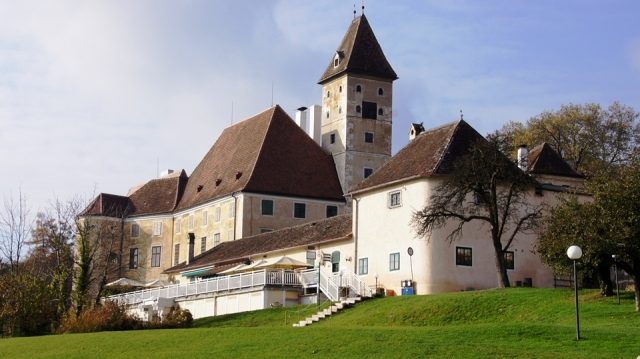
Goldegg Castle is situated on an elevated southern spur of the Dunkelsteiner Forest in the village of Goldegg at No. 1 in the municipality of Neidling in Lower Austria.
A document from 1293 mentions a Wézil von Goldegg. In 1326, the princely property was granted as a fief to the Goldegg family, which gave the castle and the village their name. This was followed by further changes of fief and ownership. In 1495, the chapel is mentioned under the owner Stephan Urtendorfer. From 1589 to 1639, the existing castle with its keep, palas, and chapel was transformed into a spacious, irregular three-winged Late Renaissance castle by a generous redesign by the Enenkel family. In 1641, the castle came into the possession of Johann Mathias Prücklmayer, Baron von und zu Goldegg, who bequeathed it to his daughter. She sold it in 1669 to the Trautson family, who began further expansion of the complex. Since 1782, the castle has been owned by the Auersperg family. War damage from 1945 was later repaired.
In the southwest of the castle complex, the approximately square keep and palas of the castle are recognizable. To the east, the later chapel adjoins, which projects or was built far to the south with its choir. Further to the east, the manor house with an adjoining gate tower was then erected. To the north, on the axis of the chapel, a kitchen wing was added. The extension of the manor house and kitchen wing was then provided with a castle courtyard, which was equipped with a corner tower in the northeast corner.
Castle Chapel+
The three-bay chapel of the Crucified Savior has a cross-rib vault and is adorned with rich stucco from the end of the 17th century. The altarpiece "Christ on the Cross" is by Josef Baldauf from 1839. The canvas paintings "St. Andrew embracing the Cross" from 1745 and "Christ in Limbo" from 1747 are by Martin Johann Schmidt. In the light well next to the chapel entrance is a tombstone for Charlotte Auersperg, née von Lasberg, from 1743.
Castle Garden+
North of the castle lies a castle garden as a prime example of Lower Austrian garden art. The Goldegger Bach and other watercourses necessitated several bridges. There is a small pond with an island. Notable buildings include a wooden pleasure house with an elliptical floor plan and shingle roof from around 1800 and a two-story glasshouse with an iron supporting structure from around 1900.
Minor Monuments+
At the approach to the castle stands a statue of St. John of Nepomuk on a volute pedestal from the mid-18th century. In the castle garden stands a Marian column from 1910.
Take Mobile History with you
You are reading this text for free. Premium adds what matters on the road: descriptions read aloud, sites found through your camera, whole regions taken offline.
- Every description, including the ~17,700 Premium sites
- Audio guide: have descriptions read to you on location
- AR finder: see sites through your camera, with distance and bearing
- Unlimited saved sites
14 days free, then from €2.99 a month. Cancel anytime.
Source: Wikipedia · Licence: CC BY-SA 4.0 · Image: http://www.wehrbauten.at/noe/niederoesterreich.html
This description draws on the facts documented in the linked Wikipedia article; Wikipedia content is licensed under CC BY-SA 4.0. Wording and editing: Mobile History.
Location: 48.2371, 15.5310