Nursing home
CastleKleinzell im Mühlkreis
Gneisenau Castle
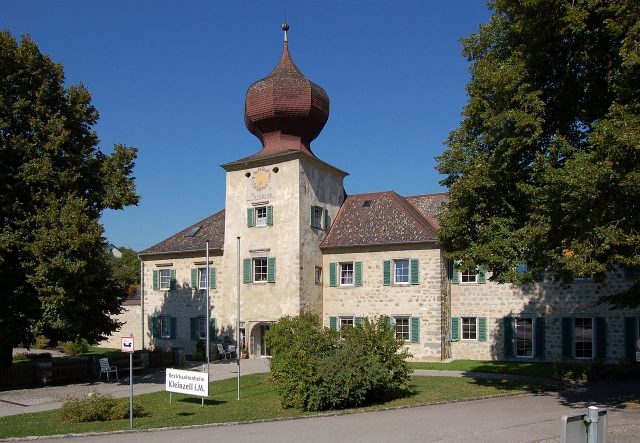
Gneisenau Castle is located in the Rohrbach district, in Kleinzell im Mühlkreis, 30 kilometers northwest of Linz (Upper Austria). Of the former moated castle from the 16th and 17th centuries, only the massive gate tower and the arcades in the courtyard have been preserved in their original state.
The first documented mention of a noble seat at this location was in 1161. Until 1338, it belonged to the Passau ministerial family of the Gneussen (the first was Sigeboto von Gneuß), then to the Teuerwanger family from Steyr (1338 to 1370), the Harrach family, and the Diendorfer family (1434 to 1524). The next owner was Georg Perkhammer (1524 to 1540), then Erasmus and Anna Kaplan von Tandleinsbach owned it. They sold it in 1547 to their brother-in-law Seibold Raiger.
They were followed by the Neithart family (1556 to 1589), a patrician family originally from Ulm. The first of this family, Zacharias Neithart, was a caretaker at Waxenberg. The Neitharts adopted the predicate "von Gneissenau" in the 18th century. This family included Cardinal Johann Eberhard Neidhardt and the Prussian Field Marshal August Neidhardt von Gneisenau. The Neitharts were followed by the Hohenegg family. In 1597, the castle went to Hanns dem Pranter, caretaker at Weidenholz. Erasmus Märk von Haimerhofen was the owner of the castle from 1602 to 1630. Due to the clever conduct of Hans Christoph Mäerk, Gneisenau was spared from looting during the Peasants' Wars in 1626. In 1630, the lordship was sold to Christoph Heinrich Murhamber von Murau. From 1634 to 1767, the Counts Fieger owned Gneisenau. Johann Philibert Freiherr von Fieger had the chapels Maria Hilf, Maria Trost, and Johann Nepomuk built on the castle grounds. In 1767, the lordship was sold to Count Franz Gundaker von Starhemberg. The administration was then moved to Eschelberg.
From 1875 to 1906, Josef Penn from Zwettl acquired the castle, but had to sell it to the O.Ö. Volkskredit due to his debts. From 1907 to 1910, Captain Friedrich Engl followed him. He had the castle rebuilt. In 1910, it came to Rudolf Wilhelmseder, then to Hugo Ferner (1911) and Heinrich Reinhardt (1917). Until 1938, the castle was owned by an Englishwoman.
Gneisenau Castle in the Past and Present+
The castle, probably built at the beginning of the 16th century, underwent several structural changes in the following centuries and experienced numerous changes of ownership. The old walls of the original castle are likely still incorporated into the new castle. As can be seen in the engraving by Georg Matthäus Vischer, Gneisenau was a compact building in the middle of a round pond. A stone bridge led to the gate tower, which is still preserved today, and the inner courtyard of the castle. The four wings were created by additions to the original ring wall. In recent times, further wings have been added to the now renovated castle.
The castle was plundered by Soviet soldiers in 1945 and was occupied by Russian soldiers until 1953. Due to severe damage, the building had to be completely renovated. It was rebuilt according to plans by architect Krohn and master builder Sparschuh. Since 1959, it has housed a district retirement home.
Take Mobile History with you
You are reading this text for free. Premium adds what matters on the road: descriptions read aloud, sites found through your camera, whole regions taken offline.
- Every description, including the ~17,700 Premium sites
- Audio guide: have descriptions read to you on location
- AR finder: see sites through your camera, with distance and bearing
- Unlimited saved sites
14 days free, then from €2.99 a month. Cancel anytime.
Source: Wikipedia · Licence: CC BY-SA 4.0 · Image: http://commons.wikimedia.org/wiki/File:Schloss_Gneisenau_2013_06.jpg
This description draws on the facts documented in the linked Wikipedia article; Wikipedia content is licensed under CC BY-SA 4.0. Wording and editing: Mobile History.
Location: 48.4548, 13.9866