Museum
Public library
CastleGlauchau
Glauchau Castle
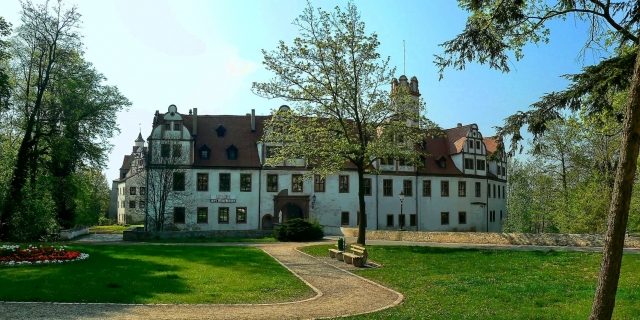
Just a few kilometers from Zwickau, between 1170 and 1180, the Imperial Ministeriales of Schönburg built Glauchau Castle on a promontory leading to the steeply sloping Mulde Valley. Remains of the palas, keep, and curtain walls can still be seen today in the east and south wings of the castle. With the castle, the Lordship of Glauchau and the town of the same name were established. Glauchau Castle remained untouched by changes of ownership for centuries and was thus always in the hands of the Schönburg family.
The history of Glauchau Castle is marked by many construction periods, as the Schönburgs had developed various sources of income to expand their ancestral seat representatively and thus demonstrate their political power - especially against the Wettins. Today, on a rocky outcrop by the Mulde, stands Hinterglauchau Castle, separated only by a ruined moat from Forderglauchau Castle. The two Renaissance-style buildings form a historical and architectural peculiarity, which is due, among other things, to the division of the Schönburg lordship.
Hinterglauchau Castle, like many Saxon castles, dates back in its beginnings to the irregular castle complex of the 12th century. Only speculation can be made about its appearance. It is probable that in the Middle Ages, the spur castle had multiple parts, with buildings in the north and south wings, and an east wing with a palas. However, in view of the increased living and representation needs, the lord of the castle had his castle converted into a late Gothic residential castle between 1470 and 1485. The ogee arch windows in the east wing still recall the architectural forms that Arnold von Westfalen already gave to Albrechtsburg in Meissen. The moat separating Hinterglauchau and Forderglauchau castles was laid out at the turn of the 15th to the 16th century.
Ernst II von Schönburg had Hinterglauchau Castle altered in the style of the Early Renaissance between 1527 and 1534. After the north wing was renovated in the 18th century, the poor structural condition forced the lord of the castle, Albert Christian Ernst, to also rebuild the buildings in the Baroque style from 1752 to 1765.
Sagas about castles often tell of mysterious underground passages that were supposed to allow the besieged lord of the castle a safe escape. In Glauchau, these sagas find further fertile ground, because 13 meters below the castle there is a system of passages from the Middle Ages. However, investigations of the carefully carved and bricked-up passages with niches suggest their use as storage cellars.
With the emergence of Forderglauchau Castle, a double complex developed. The horseshoe-shaped three-wing complex of Forderglauchau Castle was begun between 1527 and 1534 under its then owner Ernst II von Schönburg. The master builder Andreas Günther erected the castle building with a stair tower and a small corner building on the north side in place of a castle outwork. In 1603, a long extension was added at a right angle on the south side, and in 1799, two buildings were added as an extension of the corner building on the north side. The main front of Forderglauchau Castle is structured by four dormer houses. Further alterations were carried out between 1720 and 1730 by Otto Ernst and from 1752 by Albert Christian Ernst. Forderglauchau Castle forms the access to Hinterglauchau Castle.
Already in 1932-33, Joachim Count von Schönburg-Glauchau made rooms available in the castle for art exhibitions. The castle museum opened in them in 1940. Since October 1991, Hinterglauchau Castle has housed furniture from the 16th to 19th centuries, art by German, French, Italian, and Dutch masters, as well as two cabinet exhibitions on the history of the town and castle.
Forderglauchau Castle houses the "Georgius Agricola" City and District Library, the "art gluchowe" Gallery, a concert hall, and the music school of the Chemnitzer Land district.
Take Mobile History with you
You are reading this text for free. Premium adds what matters on the road: descriptions read aloud, sites found through your camera, whole regions taken offline.
- Every description, including the ~17,700 Premium sites
- Audio guide: have descriptions read to you on location
- AR finder: see sites through your camera, with distance and bearing
- Unlimited saved sites
14 days free, then from €2.99 a month. Cancel anytime.
Source: Wikipedia · Licence: CC BY-SA 4.0 · Image: Thomas Eichler
This description draws on the facts documented in the linked Wikipedia article; Wikipedia content is licensed under CC BY-SA 4.0. Wording and editing: Mobile History.
Location: 50.8166, 12.5383