Home for people with handicap
CastleGettenbach
Gettenbach Castle
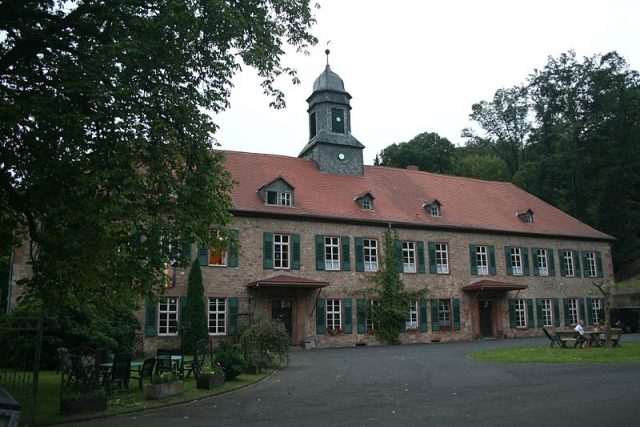
Gettenbach Castle is a 19th-century castle building in Gettenbach, municipality of Gründau in the Main-Kinzig district in Hesse.
Gettenbach is first mentioned in 1252 in an exchange transaction between Heinrich von Ysenburg and Ilbenstadt Monastery. The Hube (hide of land) as the object of the exchange could already be identical with the estate that served as the endowment for a forester. The place is located in the Büdinger Wald and was, since the Middle Ages, the seat of one of the twelve mounted foresters of the forest. The forest law (Waldweistum) of the Büdinger Wald from 1380 counts Gettenbach among the villages "dye geforstes sin in dem Büdinger walt" (that are forested in the Büdinger forest).
In the late 17th century, two glassworks were successively operated and an iron smelter was established, which worked as a supplier for the Büdinger Hammer. The older farmstead was expanded into a small castle during major renovations in the 1840s and 1850s. It served as a hunting lodge, summer residence, and widow's seat for the Isenburg-Meerholz line, a collateral line of the County of Isenburg, which had its main seat in the nearby Meerholz Castle.
With the extinction of the Meerholz line in 1929, the property fell to Isenburg-Büdingen, who, however, did not use the castle themselves and rented or leased it out. In 1938, the female labor service was housed here, and from 1945–1957, a hospital. Since 1958, there has been a hereditary building right contract with usufruct (until 2025) with the Internationaler Bund, which operates a care facility for people with disabilities here.
Layout+
The castle complex in the valley of the stream of the same name still clearly shows the original three-winged courtyard. On its west side, around the middle of the 19th century, the elongated castle building with an octagonal roof turret and clock tower was erected. It is a very modest building made of unplastered quarry stone. Even during the time of the Isenburg-Meerholz line, it seems to have had no significant architectural decoration or important furnishings inside.
Take Mobile History with you
You are reading this text for free. Premium adds what matters on the road: descriptions read aloud, sites found through your camera, whole regions taken offline.
- Every description, including the ~17,700 Premium sites
- Audio guide: have descriptions read to you on location
- AR finder: see sites through your camera, with distance and bearing
- Unlimited saved sites
14 days free, then from €2.99 a month. Cancel anytime.
Source: Wikipedia · Licence: CC BY-SA 4.0
This description draws on the facts documented in the linked Wikipedia article; Wikipedia content is licensed under CC BY-SA 4.0. Wording and editing: Mobile History.
Location: 50.2417, 9.1670