Art gallery
CastleDessau-Roßlau-Ziebigk
Georgium Castle
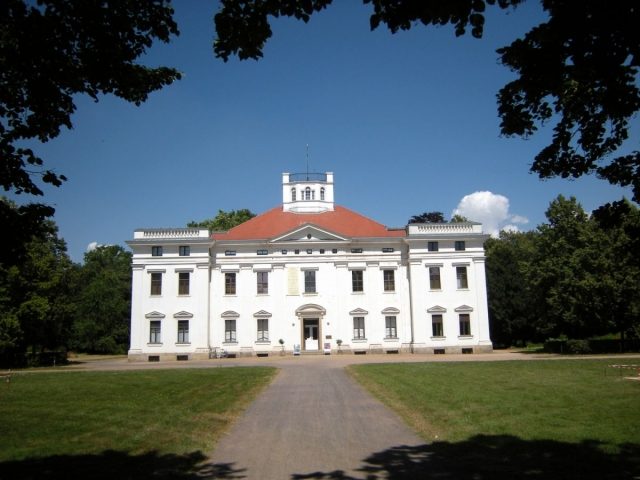
The Georgium, alongside Wörlitz Park, is the most art-historically significant landscape park in the Dessau-Wörlitz Garden Realm in the English style. It was created by Prince Johann Georg, the younger brother of Prince Leopold III. Friedrich Franz of Anhalt-Dessau, and named after him. Today it is located in the Ziebigk district of Dessau-Roßlau.
From 1780, Prince Johann Georg had a small classical country house built by Friedrich Wilhelm von Erdmannsdorff in a floodplain forest north of the then city of Dessau. The area around the building was transformed into an English-style garden, similar to Wörlitz Park. It also received numerous classical and romanticizing park buildings, sculptures, small architecture, and monuments, which were harmoniously embedded in the landscape and nature.
Among the most important are the so-called Fremdenhaus (Guest House), the Roman Ruin, an Ionic round temple, as well as two replicas of ancient archways and the monument to Prince Franz in ancient attire. The Beckerbruch (97 ha), which adjoins the actual Georgengarten (21.3 ha), was left as a natural floodplain and marsh landscape but was also embellished with small architectural features and monuments. The artfully designed landscape park here harmoniously transitions into the natural landscape. The Elbpavillon (Elbe Pavilion) and Wallwitzburg (artificial ruin) offer a wide view over the garden landscape along the Elbe. The Mausoleum Park, created between 1894 and 1896, borders the complex.
Anhaltische Gemäldegalerie (Anhalt Picture Gallery)+
Georgium Palace houses the Anhalt Picture Gallery, which displays Old German and Dutch paintings. Furthermore, early original graphics by Albrecht Dürer and Lucas Cranach the Elder can be admired, including Dürer's most famous work, Melancolia.
The works of the picture gallery had been evacuated to the Solvayhall potash mine near Bernburg during World War II. Some artworks were stolen by US soldiers and later appeared on the American art market. In July 1945, the Trophy Commission of the Red Army confiscated the entire existing collection and transported it to the Soviet Union in April 1946: 800 paintings and 17,000 graphic sheets. In 1958/59, 600 paintings, 1,000 drawings, and 10,000 prints returned.
Take Mobile History with you
You are reading this text for free. Premium adds what matters on the road: descriptions read aloud, sites found through your camera, whole regions taken offline.
- Every description, including the ~17,700 Premium sites
- Audio guide: have descriptions read to you on location
- AR finder: see sites through your camera, with distance and bearing
- Unlimited saved sites
14 days free, then from €2.99 a month. Cancel anytime.
Source: Wikipedia · Licence: CC BY-SA 4.0 · Image: http://schloesserrundschau.de/anhalt/schloesser/dessau001.html
This description draws on the facts documented in the linked Wikipedia article; Wikipedia content is licensed under CC BY-SA 4.0. Wording and editing: Mobile History.
Location: 51.8442, 12.2303